dailynewsnblog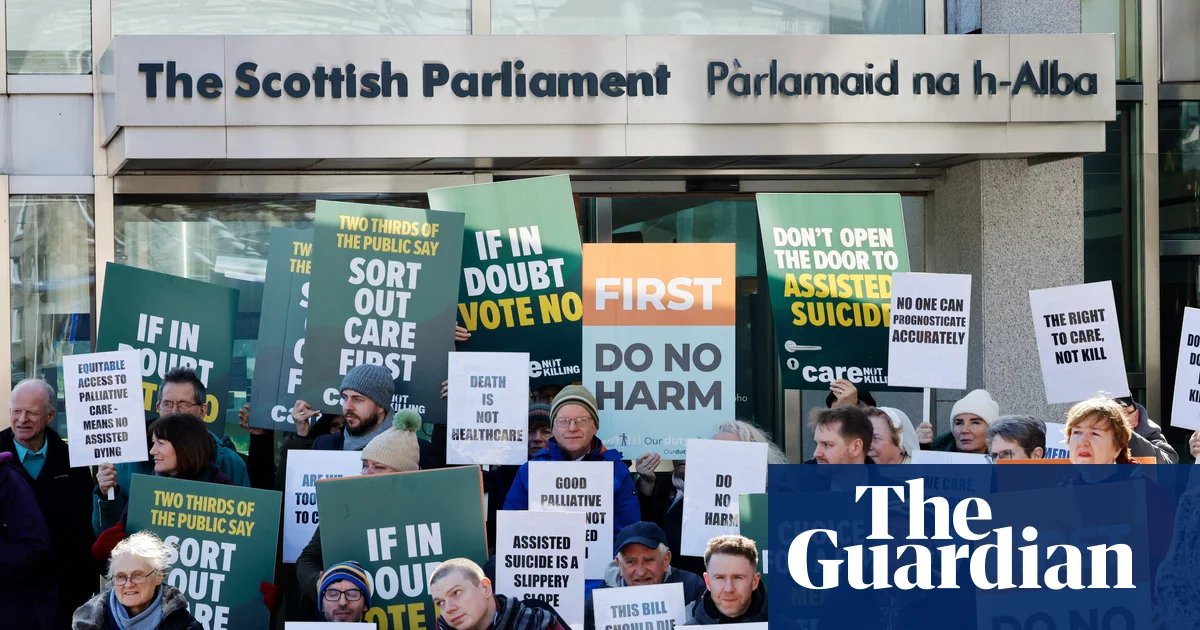
The Scottish parliament has voted against legalising assisted dying after critics and religious groups led a concerted campaign to block the measures.
MSPs voted 69 to 57 to reject the proposals in a late night vote on Tuesday – a larger margin than expected, despite a series of last-minute amendments designed to placate critics of the private member’s bill.
The bill’s defeat followed four days of intense debate at Holyrood last week about whether disabled and infirm people were properly protected from coercion. In May last year, Holyrood had voted to allow the bill to go forward for scrutiny by 70 votes to 56.
In the biggest concession, Liam McArthur, a Scottish Liberal Democrat MSP, agreed last week to limit access to people judged to have six months left to live, despite previously arguing that a time bar was too arbitrary, in an effort to placate wavering MSPs.
Speaking in the final debate on Thursday evening, McArthur said rejecting his bill would increase the numbers of those suffering intolerable pain and those travelling overseas to access assisted dying clinics, and urged MSPs to support it.
Describing a “no” vote as “unforgivable”, McArthur said the no campaign was being driven by unfounded fears raised by opponents of the bill, as the conscientious objections, no detriment clauses, and training provisions were robust. “This bill is tightly drawn, heavily safeguarded and legally defensible,” he said.
Defeat for this bill would “leave ever increasing numbers of dying Scots more at risk, isolated and vulnerable. This issue isn’t going away, but by refusing to take this opportunity to act, parliament will simply force people to travel overseas, take decisions behind closed doors with no safeguards, no protections, no support or condemn them to suffer.”
The parallel bill for England and Wales, which was passed by a majority of MPs in the Commons last year, is now expected to fall because of concerted opposition in the Lords, where more than a thousand amendments have been tabled, leading to accusation of filibustering by peers.
It will mean no part of the UK will have rights to assisted dying in the near future, despite its widespread popularity among voters, and its growth in other wealthy nations, including the US and Australia, as well as recent legalisation votes in Jersey and the Isle of Man.
Sandesh Gulhane, a Scottish Conservative MSP and the only practising GP in Holyrood, who also chaired the bill’s medical advisory group, said he backed the legislation because it was a “a good bill, a sound bill”, as did 81% of Scottish voters.
“Choice matters,” he said. “This bill represents years of work, consultation and scrutiny. It offers compassion, safeguards and dignity for those facing the end of life. If it falls today, [it] will be a lost opportunity to help those suffering and dying who have no voice.”
Numerous MSPs spoke against the bill during a lengthy and passionate debate, including the SNP MSP Jamie Hepburn, who said he had changed his mind because it altered the patient-doctor relationship. Brian Whittle, of the Scottish Tories, said he believed cuts to social care made it too unsafe to support the bill.
Edward Mountain, a Scottish Tory MSP, said this measure meant doctors would be empowered to offer death to people. “Pathways to care are rightly the top priorities but this bill will now give doctors the right to say in terminal cases death is available. I believe the last thing we should be doing is suggesting that ending life is a form of treatment,” he said.
Jeremy Balfour, an independent MSP and one of two disabled MSPs campaigning against the bill, said disabled Scots would be “terrified” listening to the debate. “The protections in this bill are not good enough. They can never be good enough.”
But George Adam, an SNP backbencher, said his wife Stacey, who was watching from a wheelchair in the public gallery, had multiple sclerosis and wanted the right to die. “If the worst should ever come to her, if she was ever facing that unbearable suffering at the end of life, she would want a choice,” he said.
While the Scottish government is officially neutral, the first minister and SNP leader, John Swinney, made clear last year he opposed the legislation and would vote against it, as had Nicola Sturgeon, the former first minister, and Anas Sarwar, the Scottish Labour leader.
The 175 amendments agreed to by MSPs last week included contentious decisions to remove clauses which gave Scottish ministers the power to regulate the training and qualifications of medical staff involved in assisted dying, because those powers belong to the UK government and Westminster.
Royal medical colleges said these safeguards had to be included in the bill at this stage, and rejected written assurances from UK ministers that Westminster would pass those powers to Holyrood without any attempt to water them down.
Tom Arthur, a Scottish health minister, told MSPs the Scottish and UK governments had engaged in “timely, constructive and good faith” discussions to ensure the necessary powers would be made available to Holyrood.
Patrick Harvie, a Scottish Green MSP and former party co-leader, said the bill had built-in safeguards because it could not become law until the Scottish parliament agreed that the training and qualifications powers being provided by Westminster were the right ones.
The UK and Scottish governments, which were officially neutral on the proposals, agreed earlier this year to a section 30 order which has given Scotland the powers normally controlled by Westminster to use legally restricted drugs and equipment. Those powers came into force on 11 March.
Rona Mackay, the SNP’s chief whip, urged MSPs to back the bill. “We in this chamber have a choice. Terminally ill people who are terrified of what they may face at the end of their lives do not. Who are we to deny them that choice,” she said.
“We know that many terminally ill Scots face a bad death and are forced to contemplate a series of desperate, traumatic decisions. Decisions which do not belong in a compassionate 21st-century Scotland.”