dailynewsnblog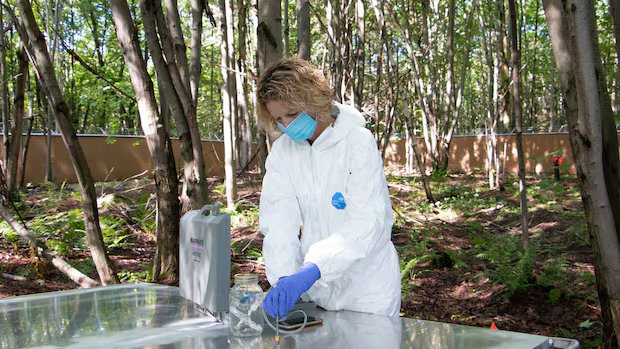
A Windsor-based forensic scientist is working to bring an outdoor lab to Kingsville, Ont., that would study how human bodies decompose over time. It would be just the second of its kind in Canada.
The work could help develop better ways of finding human remains, recovering them, identifying them or determining the time or manner of death, said Shari Forbes, who is the chair of the University of Windsor’s forensic science program.
Building the facility would require minimal changes to the natural landscape, Forbes said, because the researchers are trying to recreate the conditions under which they might discover human remains in the wild.
“It could be anything such as … a missing hiker, so just somebody who’s naturally decayed on the surface,” she said.
“But in the case of a victim of homicide, it may be a shallow burial. And where we try and test how things change when they’re underneath the ground versus on top of the ground.”
The new lab would be called the Southwestern Institute for Forensics Taphonomy (SWIFT).
Southwestern Ontario facility needed, researcher says
The proposed location is in a private woodland on the town limits of Kingsville, one kilometre from the nearest access road, according to the town’s website.
It will be secured by opaque fencing, security cameras and regular security patrols, and it will not be visible to passing traffic or surrounding homes.
Forbes has already opened a similar facility in Quebec — currently the only such lab in Canada — but she said it’s important to have a similar facility in Essex County because the environment in southwestern Ontario is unique.
Kingsville is the proposed location because the town has expressed an interest in collaborating with the university on a number of projects, including this one, Forbes said.

A human decomposition facility is being proposed for Essex County. The public had their say Thursday evening — the CBC’s Jason Viau explains.
Forbes answered questions about the proposal at a public meeting in Kingsville on Thursday night.
One resident who attended the meeting said she’s not opposed to the facility and likes the idea of contributing to science — but she’s concerned that there are no plans to ever reveal the precise location.
Anne Marie Lemire said that’s worrying to homeowners whose property values and enjoyment of their properties might be impacted.
“I had a property near the graveyard here in Kingsville as a rental property, and I did sell it,” Lemire said.
“But it was difficult because there’s a lot of people that don’t want to live next to a graveyard where the bodies are in the ground … unlike this one where … they’re sitting against a tree.”
SWIFT’s location will not be publicized, it said, in response to frequently asked questions on the town’s website.
“While the community may have knowledge of the general location of SWIFT, the specific location is not publicized to respect the privacy of our donors,” the website reads.
Concerns about smell
But Lemire said that amounts to respecting the dead more than the living.
She also raised concerns about the potential of the site to attract pests and flies and about potential foul odours.
“Even the mushroom farm, which is about four kilometres away from our home … we do experience quite a bit of odour from that at times,” Lemire said.
“And so I imagine that with dead bodies … this could be a real issue.”

Forbes told CBC that the scent would be overwhelmingly blocked by the opaque fence and the forest.
“Probably really it is only the dogs who could detect that at that distance,” she said.
Studies conducted at other forensic taphonomy facilities with similar climates to Kingsville’s have shown no observable difference in insect or animal activity near the facility, the town wrote on its website.
Kingsville Coun. Sheri Lowrie said she understands the concerns of those who want to be informed about the lab’s location and said she is deferring to experts on the best approach.
She currently plans to support the facility, but says she is watching public feedback.
Kingsville council is expected to vote on the issue at a future meeting.
Possible economic benefits, councillor says
The project will help the university and contribute economically to Kingsville, she said.
“Law enforcement will come down to Kingsville to be able to do training in this facility,” she said.
“Well, all of those people, they need to eat somewhere; they need to sleep somewhere.”
Lowrie, who works at the university but is in the faculty of arts, has consulted with the integrity commissioner to ensure she can vote on the project, she said.
Lemire said lots of people at the public meeting were curious about the project and asked questions about how they could donate their bodies and even how much say they could have in how they were positioned in it.
But she said the town needs to be more transparent with residents.
“Because it’s an extraordinary facility, [where] they’re doing extraordinary things … I believe that they should take extraordinary measures to protect the residents who live on that street or live in that community,” she said.