dailynewsnblog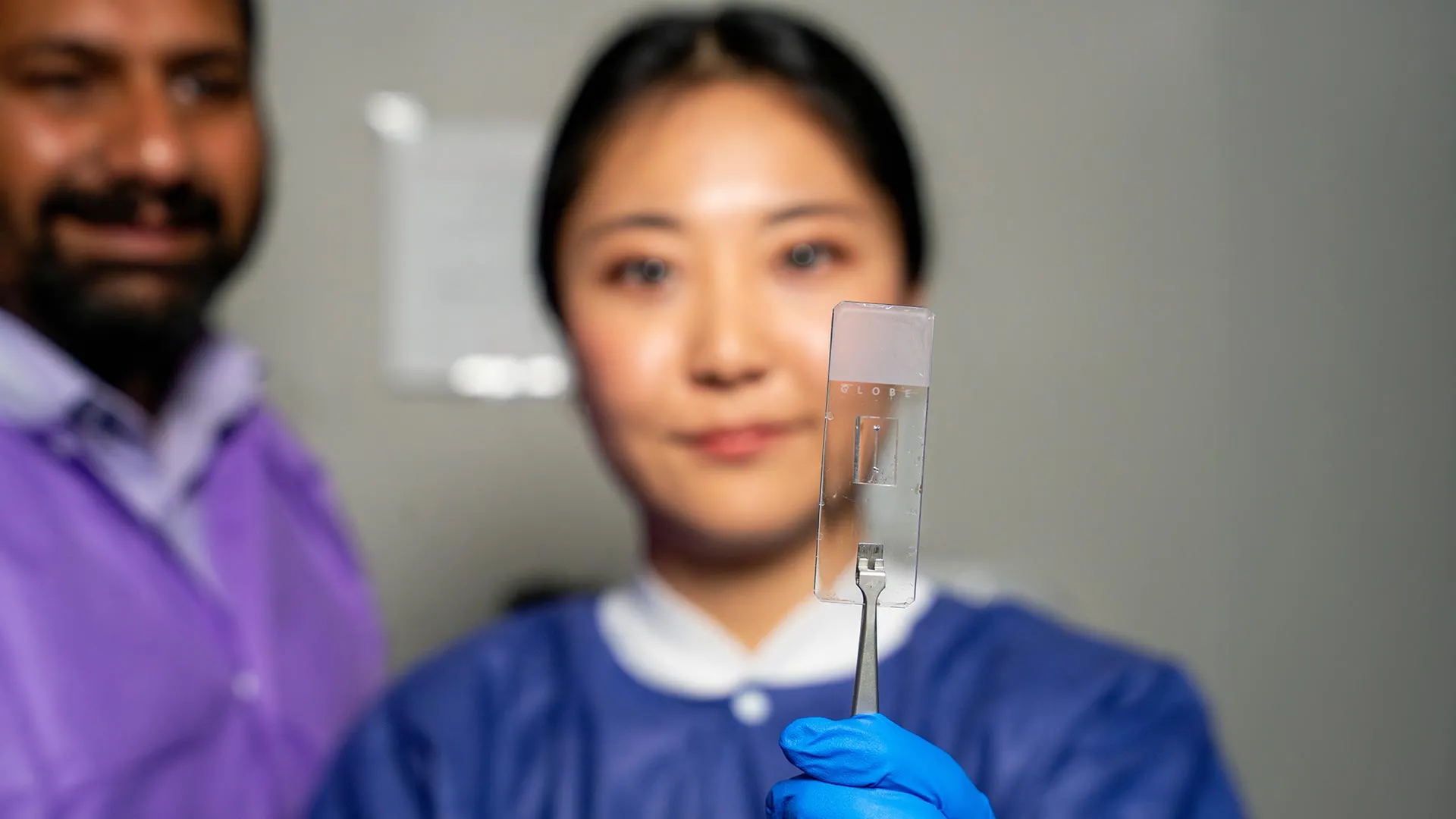
Human blood vessels are anything but simple. They bend, branch, narrow, and widen, creating complex pathways that affect how blood moves through the body. For a long time, however, laboratory models treated blood vessels as straight, uniform tubes. While useful, those simplified designs failed to reflect the conditions where many vascular diseases actually develop.
To better represent the true structure of human blood vessels, researchers in the Department of Biomedical Engineering at Texas A&M University have created a customizable vessel-chip system. The new approach allows scientists to study vascular disease more realistically and provides a powerful platform for testing new drugs.
Vessel-chips are microfluidic devices designed to replicate human blood vessels at a very small scale. They can be tailored to individual patients and offer a non-animal way to study blood flow and evaluate potential treatments. Jennifer Lee, a master’s student in biomedical engineering, worked in Dr. Abhishek Jain’s lab to design an advanced vessel-chip capable of reproducing the wide range of shapes seen in real blood vessels.
“There are branched vessels, or aneurysms that have sudden expansion, and then stenosis that restricts the vessel. All these different types of vessels cause the blood flow pattern to be significantly changed, and the inside of the blood vessel is affected by the level of shear stress caused by these flow patterns,” Lee said. “That’s what we wanted to model.”
Advancing Beyond Straight Vessel Designs
Lee’s work builds on earlier research in the same lab. Just a few years earlier, her mentor and former graduate student Dr. Tanmay Mathur developed a straight vessel-chip design. Both projects were carried out in the Bioinspired Translational Microsystems Laboratory under Jain, who is an associate professor and the Barbara and Ralph Cox ’53 faculty fellow in biomedical engineering. Lee’s research was published in Lab on a Chip and will appear on the cover of the journal’s May 2025 issue.
“We can now start learning about vascular disease in ways we’ve never been able to before,” Jain said. “Not only can you make these structures complex, you can put actual cellular and tissue material inside them and make them living. These are the sites where vascular diseases tend to develop, so understanding them is critical.”
From Undergraduate Research to Published Science
Lee joined Jain’s lab while she was still an undergraduate honors student looking for hands-on research experience. At the time, she had little familiarity with organs-on-a-chip technology. As she learned more about the field, she became interested in its potential impact on future medical research. That interest led her to continue her work through the Master of Science fast-track program.
“Jennifer demonstrated perseverance, curiosity, and creativity and started taking up research projects very quickly. Our fast-track program enables students like Jennifer to take on sort of high-impact, high-risk research and not just do a science project, but take it all the way to its outcome and get it published,” Jain said.
Expanding the Complexity of Living Vessel Chips
Although the current vessel-chip design offers a more realistic view of blood vessels, the research team plans to take the work further. So far, Lee’s model includes only endothelial cells — or cells that make up the lining of the blood vessel — but future versions may incorporate additional cell types. Including these cells would allow researchers to better understand how different tissues interact with each other and with flowing blood.
“We are progressing and creating what we call the fourth dimensionality of organs-on-a-chip, where we not only focus on the cells and the flow, but this interaction of cells and flow in more complex architectural states, which is a new direction in the field,” Jain said.
Building Skills Beyond the Laboratory
Along with technical research experience, Lee says the lab environment helped her develop practical skills that extend beyond science coursework. Working alongside peers, graduate students, and postdoctoral researchers gave her experience in collaboration, communication, and problem-solving.
“It’s such a good environment to interact with not only peers but also graduate students and postdoctoral researchers,” she said. “You’re able to learn teamwork and communication, work ethic, and just trying different things out. I think it’s such a valuable experience that students have available. We have such good faculty research labs.”
The project received support from several major organizations, including the U.S. Army Medical Research Program, NASA, the Biomedical Advanced Research and Development Authority, the National Institutes of Health, the U.S. Food and Drug Administration, the National Science Foundation, and the Texas A&M University Office of Innovation Translational Investment Funds.