dailynewsnblog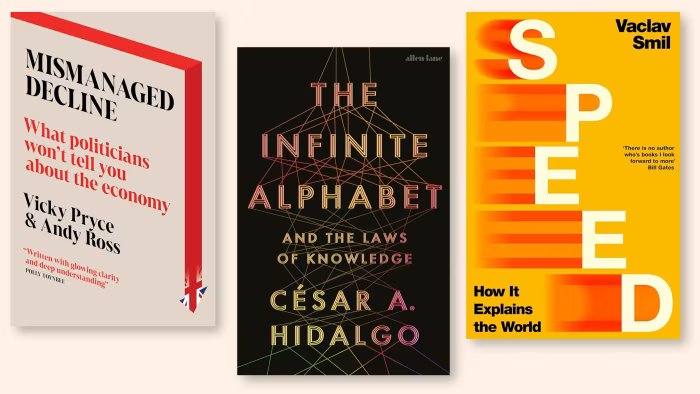
Unlock the Editor’s Digest for free
Roula Khalaf, Editor of the FT, selects her favourite stories in this weekly newsletter.
Economic confidence bounced after Britain’s Labour party won the election in 2024. Following years of political instability, there was optimism for a government with a large parliamentary majority.
But that hope is now fading. After a sapping start to Labour’s five-year term, talk of the UK’s continued long economic decline has, once again, returned. Enter Mismanaged Decline: What Politicians Won’t Tell You About the Economy (Biteback Publishing, £22) by esteemed economists Vicky Pryce and Andy Ross. The book’s opening chapters are its most invaluable. Here, the authors chart the country’s economic trajectory from industrial superpower to an IMF bailout in 1976 and more recent shocks, including the global financial crisis, Brexit and the Covid-19 pandemic.
The historic tour is one of the more detailed yet concise expositions of Britain’s economic history in what is a crowded genre. This serves as a timely wake-up call to politicians and policymakers of all stripes, holding a mirror to the flawed choices and policies made in the past.
Drawing on both authors’ frontline experience of economic policy, the book also examines the pressing current issues the country faces, such as regional inequality, stagnating productivity and low investment — the debates around which most UK-based readers will be familiar with. Ultimately, Pryce and Ross argue that pragmatism rather than political dogma is the best way to get the country on to a stronger, fairer and more resilient economic course. “Whether left, right or middle, ideology is simply not a good guide for policy,” they write. An important reminder that Westminster ought to grasp.

In an era when globalisation seems to be constantly recalibrating, The Fractured Age: How the Return of Geopolitics Will Splinter the Global Economy (John Murray Business, £25) is one of the clearest guides yet to the risks, dynamics and networks that will shape the world economy in the coming decade. Author Neil Shearing, chief economist at Capital Economics, provides a rare, data-driven analysis blending economics with geopolitics to map how relations between major powers and alliances will pan out. He outlines how the “era of hyper-globalization has ended” and that, over time, the world is likely to coalesce into two broad blocs splintered between the US and China, with a number of unaligned countries between.
Shearing explains in detailed chapters how this fracturing doesn’t necessarily mean that globalisation will go into reverse, and will occur along critical geopolitical faultlines, including high-tech manufacturing, dual-use goods and critical minerals. “It may not be possible to reconcile differences between the US and China, but it is possible to contain them,” he argues.
Indeed, his nuanced analysis underscores the practical implications of the global realignment. He lays out how supply chains will be rewired and what policymakers and business might do to navigate a more volatile operating environment, and offers a thesis on what the future global macroeconomy might look like. The Fractured Age is a crisp, compelling roadmap to an international economy pulling in new directions.

In The Infinite Alphabet: And the Laws of Knowledge (Allen Lane, £25) César Hidalgo, a world-renowned expert in the study of economic complexity, explores how human knowledge grows and diffuses. With dozens of entertaining case studies, from the rise of China’s engine of innovation to Saudi Arabia’s Neom and Ecuador’s Yachay “city of knowledge”, Hidalgo shows how knowledge is both a social construct and a measurable force that shapes prosperity. He outlines what causes different information economies to flourish, thrive and fail by weaving together insights from physics, network theory, economics and behavioural science.
Hidalgo establishes three “laws of knowledge” — covering time, space and value — which cast in a new light the ways in which ideas, experience and wisdom shape business and nations today. The Infinite Alphabet is an intriguing blueprint for how knowledge continually shapes our world.

The best books of the year 2025
From economics, politics and history to science, art, food and, of course, fiction — our annual round-up brings you top titles picked by FT writers and critics
Read more
Another title that uses interdisciplinary analysis to deepen our grasp of an abstract concept in an engaging way is Speed: How It Explains the World (Viking, £18.99). The author Vaclav Smil, distinguished professor emeritus at the University of Manitoba, assesses in a wide-ranging book how speed impacts every element of life on Earth. Along the way, he traces how biological limits, engineering breakthroughs and cultural expectations intertwine to create a world in which acceleration has become an organising principle.
Smil shows how humanity’s never-ending pursuit of speed, in areas including technology and production, shapes our lived experiences in ways we may not even notice and brings with it major social and environmental consequences. The important question the book raises is whether our need for speed is always a good thing. “The main quality associated with speed should be the one expressed by the Latin proverb non multa, sed multum (not many, but much), its essence being that it is the quality rather than sheer quantity that matters,” the author argues. Smil’s latest is a valuable reminder that speed defines us, for better and worse.
Join our online book group on Facebook at FT Books Café and follow FT Weekend on Instagram, Bluesky and X