dailynewsnblog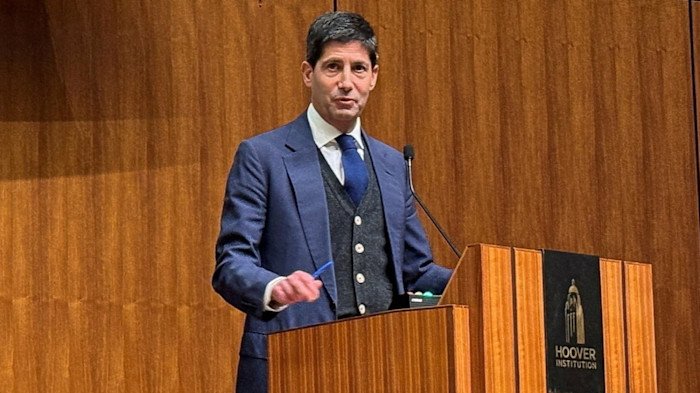
Unlock the Editor’s Digest for free
Roula Khalaf, Editor of the FT, selects her favourite stories in this weekly newsletter.
This article is an on-site version of the Free Lunch newsletter. Premium subscribers can sign up here to get the newsletter delivered every Thursday and Sunday. Standard subscribers can upgrade to Premium here, or explore all FT newsletters
There is no shortage of commentary on Kevin Warsh’s nomination as Federal Reserve chair, including by my many brilliant colleagues. Katie Martin and Robert Armstrong have produced a podcast on him, Chris Giles has set out a range of plausible scenarios for how Warsh may steer the Fed, and Martin Wolf has pondered how he will navigate the Trumpian political economy of US policymaking. Chris and Robert have both discussed how Warsh is likely to be less data-dependent and more willing to go with a gut feeling, I mean conviction, about what is going on in the economy. Specifically, Warsh has suggested the current AI boom may boost productivity in under-measured ways like the internet revolution did in the 1990s, and “do a Greenspan” by keeping rates lower than the data would normally indicate. (Paul Krugman thinks that’s nuts.)
I don’t know. But I have been considering some other aspects of what I can glean about Warsh’s economic thinking that I don’t see receiving a lot of attention yet.
From all the commentary on Warsh, a consensus emerges on two related points. One is that he is likely to tilt the Fed towards looser policy in terms of policy (short-term) interest rates compared with Jay Powell’s Fed. The other is that he is likely to move the central bank towards a smaller balance sheet than previously foreseen, which, all else being equal, should push up long-term rates. Put this together, and we should expect lower short rates and higher long rates than otherwise, or a steeper yield curve in the jargon.
If a yield curve steepening is the safest thing to expect from a Warsh Fed, at least in the immediately foreseeable future, then what does that imply?
The responsible answer is “it’s complicated”. It is not at all clear whether a steeper yield curve will by itself amount to a looser or tighter overall monetary policy stance. That depends on the relative moves at the different maturities, and how strongly they affect the economy — through exchange rate movements, market valuations and government borrowing costs at the short end, and through “real economy” financing costs such as mortgage rates at the long end. Warsh himself has intimated that the long benchmark Treasury rates are more consequential than short-term policy rates. I share this view. But it is clear that short-term rates matter a lot too. So the macroeconomic effects of a yield curve steepening go in both directions and it’s hard to be confident of the overall impact.
Also, things are not static — a steeper yield curve will encourage borrowers to shift more towards short-term borrowing, which would damp the cooling effect of higher low rates. For the biggest borrower, the US government, lowering the length to maturity of the debt is already under way as a matter of desired policy, and the tendency seems to be to spend any money freed up as a result. So it’s a tricky empirical issue what happens to monetary stimulus overall.
What is much clearer is that a steeper yield curve increases the return to maturity transformation, that is to say, from borrowing short term and lending or investing long term. That is the core business of banks, of course. Which means that an under-discussed consequence of Warsh’s apparent policy preferences is that good days for banks are on the way. (And for shadow banks, institutions that also borrow short to lend long.)
A lot then depends on how financial institutions react to those conditions. They could simply accumulate the additional profits or return them to their shareholders. Or they could respond by expanding their business — more lending, in other words. That is one of the ways in which a steeper yield curve could be, on net, stimulative. But this would be expansion on the back of increased risk, because the financial system as a whole would feature bigger and more maturity-mismatched balance sheets.
Add to this both Warsh’s and Treasury secretary Scott Bessent’s fondness for deregulation, and it is clear that we could be moving into an economy with structurally higher levels of financial risk. There will be more things that could go wrong and greater damage to be expected if they do. So long as they do not, on the other hand, growth may accelerate.
Those observations are all about the US economy. But how the Fed behaves shapes financial conditions in the rest of the world too. So the other aspect of a Warsh regime change that we need to think harder about is its implications for the global economy. I have three preliminary thoughts to offer on that.
First, if a Warsh chairmanship really does herald a structurally looser Fed, as many seem to think, the consequences would be far-reaching. They could include inflationary pressures globally if easier financial conditions and credit growth spill over to other economies, but also a weaker dollar. Depending on which effect predominates and the resulting pressures on prices — and this could be different in different countries — it would shift monetary policy there, as other central banks stick to their mandates. (The Bank of England’s Megan Greene offered an analysis of how such monetary policy divergence could work in a recent speech.)
One possible outcome — if the US has both a relatively larger stimulus and a weaker exchange rate — could be an even greater investment gap between the US and other economies, and the international political frictions that could come with that. But as I spell out above, it’s not obvious that a US structural loosening actually is on the cards.
Second, other currencies’ yield curves would probably steepen along with the US ones. The effect on each economy would depend on the local characteristics of the transmission from the cost of credit to real economic activity at different maturities, which could be highly idiosyncratic.
Third, one aspect of Warsh’s economic philosophy bodes ill for the Fed’s role as a global stabilising force. In my contribution to the FT commentators’ quick takes on the Warsh nomination, the man seems to have a bit of a “Schumpeterian” disposition — a dislike of central banks trying to micromanage the financial economy and a willingness to let markets shake out their own anomalies. That means investors shouldn’t count on Fed support when stock prices collapse. But it also means — especially in the context of the Trump administration’s broader America First approach to international finance — that the Fed may be less willing to remedy sudden dollar liquidity squeezes abroad through swap lines. Both investors and foreigners should realise they will be more on their own.
That will leave a gap to fill in global financial governance. As I wrote last week, the Eurozone should not waste the opportunity to step up. If not, China will surely fill the governance gap eventually.
Other readables
● For the FT magazine, I wrote about what philosophical ideas from the 1980s and 1990s may have led us astray, in conversation with my one-time professor Michael Sandel, recent winner of the Berggruen Prize.
● Europe faces the choice of becoming a global power or being divided and ruled, warns Mario Draghi.
● Could Sweden get the bomb?
● Will “Buy European” policies work?
● The European Central Bank’s Isabel Schnabel weighs in in favour of a common EU corporate code or “28th regime”.
Recommended newsletters for you
Chris Giles on Central Banks — Your essential guide to money, interest rates, inflation and what central banks are thinking. Sign up here
The AI Shift — John Burn-Murdoch and Sarah O’Connor dive into how AI is transforming the world of work. Sign up here