dailynewsnblog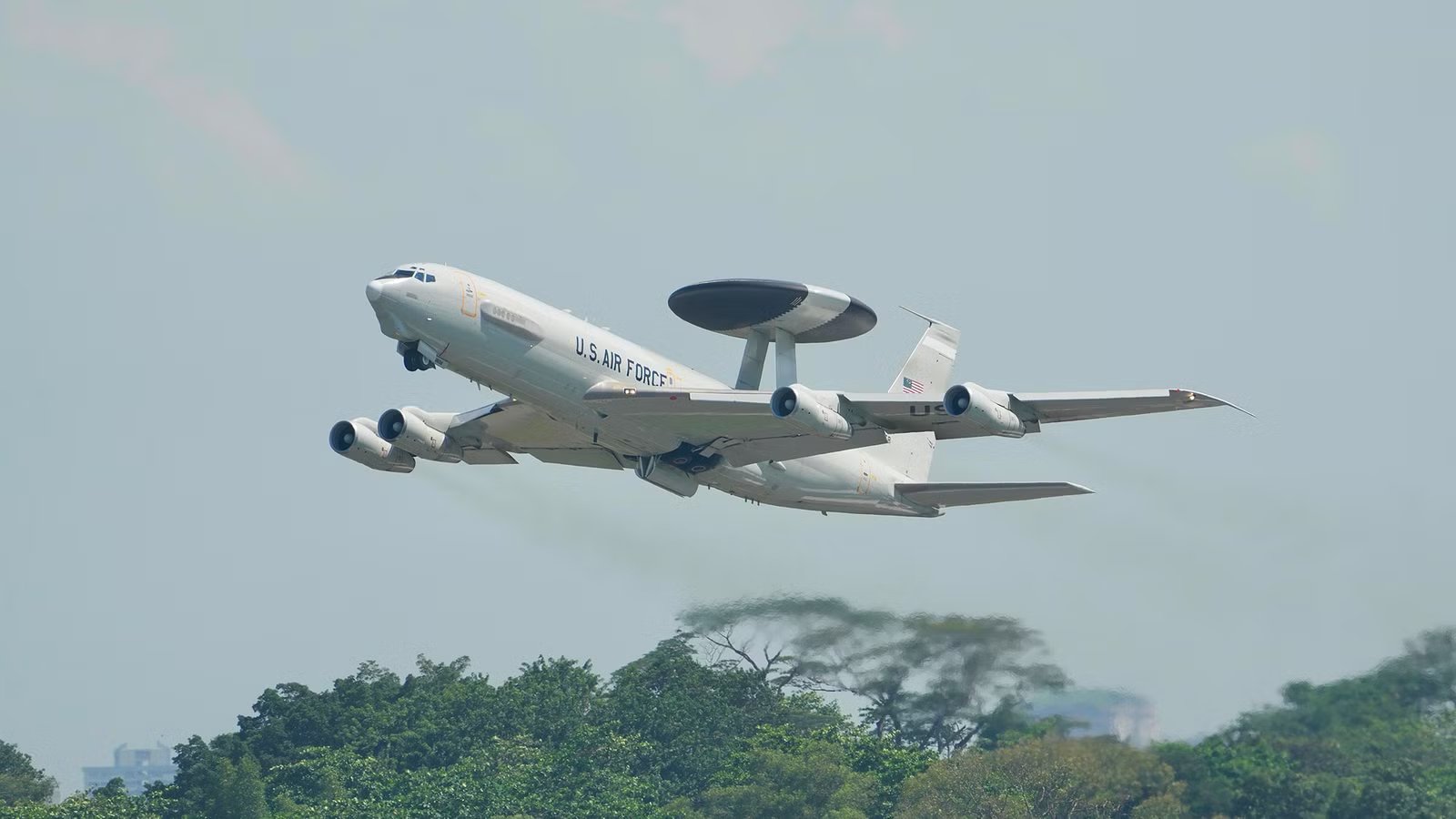
The United States Air Force (USAF) has reportedly lost one of its Boeing E-3 Sentry aircraft following an Iranian missile and drone strike on Prince Sultan Air Base in Saudi Arabia. The command plane — often dubbed the Air Force’s “eye in the sky” for its advanced surveillance capabilities — was one of several aircraft damaged during the attack, along with multiple KC-135 refueling tankers.
Images from the aftermath show that the aircraft’s rear section, which contains its sophisticated AN/APY-2 radar dome, has been completely destroyed, severing the tail from the main fuselage. With the loss of one of its advanced E-3G variants, the USAF’s E-3 Sentry fleet has now been whittled down to just 15 aircraft.
US Reportedly Loses Critical E-3 Sentry AWACS Aircraft

Images first posted to Facebook group Air Force amn/nco/snco reveal the extent of the damage suffered during an Iranian attack on March 27. The E-3G appears to have been struck directly on its radar dome, shredding the tail off the main fuselage. Sources familiar with the matter confirmed to Air & Space Forces Magazine that the Airborne Warning and Control System (AWACS) plane was among several aircraft hit in the attack, with a second E-3 rumored to have been partially damaged.
At least 15 service members were injured during the raid, of which five are said to be in serious condition. The US has kept up to six of its important E-3 command planes parked at Prince Sultan Air Base over the past few weeks, alongside several KC-135 and KC-46 refueling tankers. Multiple tankers were also reportedly damaged during the strike, but no further information on their condition is available at this stage.
What Is The E-3 Sentry?

The E-3 Sentry entered service in 1977 and performs surveillance and command-and-control roles from the sky. The Boeing 707 derivative is approaching 50 years of service, but remains a crucial part of the US military’s current surveillance, command and communications capabilities. Although it is slowly being phased out as the Air Force transitions to the Boeing E-7 Wedgetail, the US is heavily reliant on its few remaining E-3 planes, which cannot be quickly replaced.
The AWACS plane houses a sophisticated rotating radar system that is critical to US surveillance capabilities. This enables it to monitor an area of more than 120,000 square miles, and it was this area of the plane that appears to have been surgically targeted by Iranian missiles and drones. The E-3 also serves as a central communications hub for US assets, coordinating its various air, ground and sea forces.
The USAF’s aging E-3 fleet has been notoriously difficult to keep airworthy, with a fleet-wide mission-capable rate of just 56% in fiscal year 2024. This means that almost half the fleet is grounded and cannot be called upon at any given time, making the loss of just a single aircraft even more critical.

Why The US Air Force Still Relies On The Boeing 707 In 2025
The 707s still serving seven decades later.
Calculating The Cost Of This Loss

The loss of an E-3 is valued at over half a billion dollars, and any damaged aircraft cannot be so easily repaired as a dated platform. With no like-for-like replacement ready at hand, the greatest loss for the US will be felt operationally. This is not the first time Prince Sultan Air Base has been hit, with a previous attack this month damaging several US tankers.
Iran has been heavily focusing on striking critical US and allied infrastructure in an attempt to wear down its resources and economic patience. It has already struck multiple expensive radar arrays, like AN/FPS-132 early warning and AN/TPY-2 radar arrays across the Middle East, in attacks valued in the billions of dollars.
Despite CENTCOM’s reporting a 90% reduction in Iranian strike capability, the country is choosing its shots wisely for maximum impact. It also continues to harass civilian airports, particularly those in the UAE, with  Dubai International Airport (DXB) coming under regular drone attacks over the past month.