dailynewsnblog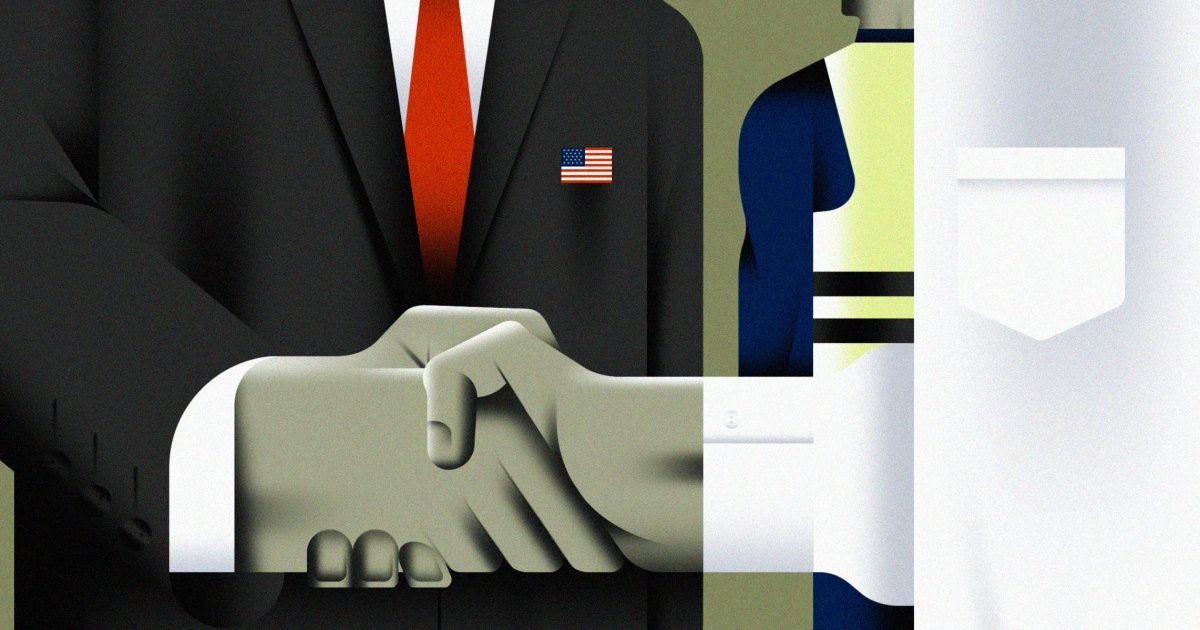
Blue-collar workers have been at the center of political messaging for years. Politicians meet with waitresses at a diner to pitch raising the minimum wage, tour a factory to spotlight job growth or tell stories of their family’s hardscrabble bona fides while visiting cities like Detroit or Pittsburgh.
Lately, though, a different group has been getting more attention: white-collar professionals. And Florida Gov. Ron DeSantis is at the forefront of this development.
The Republican governor expressed concern in August that “some of these white-collar jobs … could end up being obsolete” due to advancements in AI. In September, he said the H-1B visa program was “especially galling” at a time when AI “is forecast to reduce a significant number of white-collar jobs.” And in November, he worried about predictions that AI is “going to really undercut a lot of jobs — a lot of white-collar jobs.”
“I don’t think that’s a good thing,” he said, adding, “Why would we subsidize something that could potentially cause problems for folks?”
DeSantis’ political rise has been based in large part on his ability to see where the puck is going. He positioned himself as an early opponent of Covid regulations. And he was at the forefront of right-wing attacks on trans issues years before President Donald Trump made them part of his closing message in the 2024 campaign. Now, he’s a leading political voice on AI skepticism ahead of a looming shift in U.S. politics in which the fears of white-collar workers — a college-educated and increasingly Democratic demographic — will be more pronounced.
Other officials are sounding the alarm, too, including Sens. Josh Hawley, R-Mo., and Bernie Sanders, I-Vt., as well as California Gov. Gavin Newsom, a Democrat.
This is a notable development in U.S. politics, which has long centered on the anxieties and grievances of blue-collar workers who for decades saw manufacturing jobs dwindle because of trade deals and automation. More recently, these workers helped power Trump’s rise and led both parties to reorient their industrial policy, with calls to reshore manufacturing jobs and rebuild the nation’s industrial base becoming central to Republican and Democratic campaigns.
Former Rep. Brad Carson, D-Okla., said in an email he fears most political leaders will already be too late by the time they turn attention to the potential displacement of white-collar workers.
“We spent decades watching manufacturing communities hollow out before politicians started paying serious attention, and by then the damage was permanent,” said Carson, a former Defense Department official who is now one of the leaders of the super PAC Public First Action, which has called for more significant regulation of AI. “The difference this time is speed and breadth. White-collar displacement could move much faster and apply much more broadly than deindustrialization did, and these workers vote, donate and live in swing districts. So the political pressure will build quickly.”
“College-educated professionals in suburban districts whose mortgage payments are suddenly at risk are a very different political force than a hollowed-out factory town,” he added.

The concerns come as AI industry insiders openly say their technology will result in companies eliminating jobs. Dario Amodei, the CEO of Anthropic, which built Claude, has predicted AI could increase unemployment by 10% to 20% within the next five years, while also eliminating half of all entry-level white-collar jobs. In October, Elon Musk, the world’s richest man, whose company xAI developed Grok, said on X that “AI and robots will replace all jobs.” The same month, Amazon announced 14,000 layoffs in a statement that noted the “transformative” nature of AI. The following month, Musk said he believed “work will be optional” within two decades.
A new NBC News poll found that 57% of voters think the risks of AI outweigh the benefits, with a similar share of white- and blue-collar workers, as well as managers, expressing the same sentiment. The survey found that 74% of white-collar workers have used AI within the last two months, compared to 50% of blue-collar workers.
As commerce secretary under President Joe Biden, Gina Raimondo became the administration’s point person on AI, building relationships within the industry. She told NBC News the technology will “transform every industry,” adding that the transition will be “brutal.”
A former governor of Rhode Island, Raimondo recalled when her father lost his job after manufacturing dried up in the state. She said that experience has shaped her views on AI.
While she thinks “slowing down innovation is a bad idea,” if certain demographics “get disproportionately hurt and we don’t take care of them in this transition … that’s going to cause a level of societal, political and economic disruption that this country can’t afford.”
Policymakers, she said, need to incentivize companies not to engage in mass layoffs and provide transition funding to employees who see their industries dramatically reshaped. Unemployment policy will need to be shifted from being focused on who is unemployed right now to being able to predict who’s going to be unemployed in a year or more, she added. Much of this will need to start initially at the state level, where experimentation is easier.
“What is fascinating to me,” she said, “is how many policymakers of both parties and AI executives just kind of throw up their hands and they’re like, ‘Well, what are we going to do?’”
There are already signs of a white-collar jobs recession. In November, a record 25% of unemployed workers had four-year college degrees. And a team of Stanford researchers released a report that found workers between ages 22 and 25 in industries with the most exposure to generative AI experienced a 16% relative decline in employment since late 2022. The U.S. shed 92,000 jobs in February, according to the latest jobs report from the Bureau of Labor Statistics, marking the fifth time in nine months the job market has shrunk.

Hawley, the senator from Missouri, said that during a recent trip to Vanderbilt University, he was struck by the college seniors who approached him to express how hard it was to find an entry-level job, noting employers said AI was making such positions unnecessary.
“Now, how much of that is accurate and how much of that is just an excuse? Who knows,” he said. “But if you look at the unemployment rate for recent college graduates, it is really startlingly high. And when you look at the economy nationwide, you’ve got to be concerned about the potential for job loss among white-collar workers.”
Hawley doesn’t believe leaders in Washington are focusing on this as much as they should be. He pointed to legislation he introduced with Sen. Mark Warner, D-Va., in November to track the number of jobs lost to AI as a first step.
“We’re looking at a massive collapse of the middle class,” Hawley said. “We simply cannot allow that to happen.”
It’s not all doom and gloom, though, for what AI will do to the white-collar job market. A number of economists, tech and political leaders have compared the rise of AI to past advancements that changed work rather than eliminated it. A common example cited is the growth of the internet, which created entire new industries. Meanwhile, others have said the projections by AI industry leaders are being made in part to make the technology seem more impressive to investors. Musk, who has made some of the boldest proclamations, is wrong so frequently that savvy bettors have profited by wagering against his projections.
Trump and officials in his administration are among those who have sought to tamp down any panic around AI, the rapid upscale of which is a core piece of Trump’s economic agenda. In an interview with NBC News last month, Trump pushed back on concerns that AI would kill jobs.
“They said the internet was gonna do — everything was gonna do — robots are gonna kill jobs. Everything’s gonna kill jobs,” he said. “And you end up, if you’re smart, doing great.”

An Economist/YouGov poll released last month found that 63% of U.S. adults believe AI advances will lead to an overall decrease in jobs, roughly twice the percentage who told an NPR/Kaiser/Harvard Technology survey in 1999 they believed the internet would reduce jobs.
Nathan Brand, a Republican strategist, said fears over AI-fueled job losses are misguided. For starters, he said, an increased demand for infrastructure and energy driven by the industry will trigger blue-collar job growth that in turn boosts white-collar jobs.
“Politically, it’s going to ultimately fall back into these camps of innovation versus no innovation,” Brand said. “Traditionally, conservatives have been on the side of innovation.”
AI’s effect on politics is still in its infancy. There aren’t yet clear partisan divides on AI-related issues as leaders find their footing. The biggest issues elected officials have focused on so far are not jobs but electricity bill hikes tied to the rapid expansion of AI data centers, child safety and the use of AI in the military.
Policymakers have been more focused on issues such as data center-related costs because they have a more widespread effect than the job prospects for white-collar professionals, Raimondo said. Additionally, with many white-collar workers making comfortable wages, “it’s harder to feel bad for them,” she noted.
“But I do believe that that will change … if law firms stop hiring lawyers, or if accounting firms cut their accounting staff in half,” she said. “You’re going to see a change pretty fast.”
In a new report, Anthropic found that the jobs with the most exposure to AI, and therefore at the greatest risk of AI displacement, include computer programmers, customer service representatives and financial and investment analysts, among other white-collar professions.
Sen. Richard Blumenthal, D-Conn., said he has contemplated working on more legislation directly related to the potential job impacts of AI but is not yet sure of the right approach.
“There’s a lot of well-founded focus on the dangers of AI in weapons or consumer goods, whether it’s lack of privacy or arms that may be out of control,” Blumenthal said. “But this employment challenge may be the one that breaks through with everyday Americans, because [while] the other dangers may seem hypothetical, this one is going to be real.”
On the campaign trail, competing super PACs backed by the AI industry are starting to pour money into key midterm races while potential 2028 presidential contenders like DeSantis have contrasted themselves with possible rivals on AI.
Alex Bores, a member of the New York state Assembly who is running for Congress in the hotly contested 12th District, said Americans are now “learning that no job is safe.” Bores is proposing new regulations on the AI industry and is supported and opposed by rival AI-funded super PACs.
“I don’t know that, historically, when you have large sudden unemployment, specifically among young people, especially among men, that that leads to a more inclusive, progressive, fact-based politics,” said Bores, a Democrat. “That often leads to a very reactionary politics. And I worry quite a bit about what that might do to our political debate.”
Several elected officials who spoke with NBC News said a potential white-collar job displacement could echo the “China shock” that rattled the blue-collar job market decades ago. In 2001, China entered the World Trade Organization, unleashing a surge of imports into the U.S. and spurring manufacturing job losses. That followed a 30-year stretch in which cities and towns, many located in the Rust Belt, saw their manufacturing industries and populations collapse amid increasing globalization and automation.
Saikat Chakrabarti, a progressive House candidate running in California’s 11th District, said AI industry workers he’s spoken with believe the government may need to take equity stakes in these companies to get a better handle on issues like a potential white-collar displacement.
“We haven’t had a situation in the past where automation has come after the highest-earning workers first,” Chakrabarti said. He noted that the white-collar workforce — concentrated in metropolitan areas — is “a politically powerful bloc of our society.”

In terms of party identification, white-collar workers lean Democratic by 8 percentage points in the latest NBC News poll while blue-collar workers tilt Republican by 9 points.
For Rep. Ro Khanna, D-Calif., who represents a district centered in Silicon Valley, it’s critical for leaders to “unite the anxiety of blue-collar workers and white-collar workers” rather than pit them against each other.
Khanna and Sanders last month appeared at Stanford for a joint town hall on AI policy where Khanna laid out his AI agenda, which includes a federal jobs guarantee for young Americans and those seeking entry-level jobs. In October, Sanders released a report finding that AI and automation could eliminate roughly 100 million blue- and white-collar jobs over the next decade.
“The threat to jobs are no longer just blue-collar jobs,” said Khanna, a potential 2028 presidential candidate. “It’s also white-collar jobs, and that creates a coalition that can appeal to factory towns, rural America and suburban towns as well as urban centers.”
Hawley, another potential 2028 candidate, has for years positioned himself in the Senate Republican caucus as an outlier on economic policy. He said a lesson leaders need to take from the breakdown of American manufacturing jobs decades ago and apply to the coming potential white-collar job displacement is that “the importance of good-paying work cannot ever be lost or taken for granted.”
“What we learned out of that is [job displacement] destroys entire communities,” he added. “It destroys families. It destroys the fabric of the country. Work is absolutely vital. People have to be able to get good-paying work on which they can raise a family. And we’ve got to put that at the center of our AI policy.”