dailynewsnblog
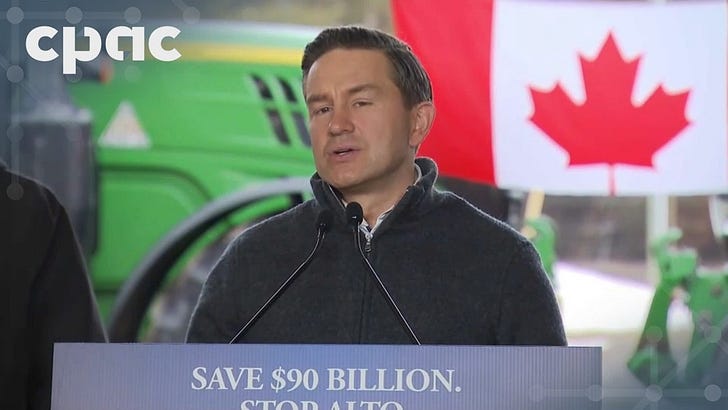
Pierre Poilievre’s latest nation-building idea is a doozie: cancel Alto, the high speed rail link under development for the Quebec City-Toronto corridor. It is not clear why the Conservatives are so intent on keeping us in the dark ages of public infrastructure, but it is clear that if Poilievre sees any form of opposition to a government initiative anywhere, on any subject, for any reason, he’ll jump on it.
As a country, we have been systematically destroying our domestic mass transit infrastructure for decades. Pierre Trudeau created Via Rail, then slashed its routes by 20% and funding by 40% just three years later. Then Brian Mulroney slashed Via Rail with even greater ferocity, cutting it by more than half in 1989. The Chrétien government then cut the Atlantic, Via’s service that ran through Sherbrooke, Quebec to St John, New Brunswick, which happened to be the only two ridings still represented by Progressive Conservative MPs after the 1993 election.
Meanwhile, federal funding for inter-city buses that connected small communities across the country have been slashed repeatedly by governments of all stripes, with regional governments taking over where they are able to. Even Greyhound, the company most closely identified with inter-city buses in North America, gave up and left Canada altogether five years ago.
Throughout it all, Canada has never seriously implemented any kind of coordinated transit system. You cannot open a website or an app, enter two addresses, and make a booking that links municipal or regional buses to inter-city buses or trains to municipal or regional transit systems at the other end. It is up to each traveler to sort out all the different services and connections, tickets, passes, and tokens.
The opportunities are there. In 2011, I traveled around western Europe with a single consolidated EURail pass, one of two such competing services, that let me take virtually any train virtually anywhere across several countries for two weeks, most without additional fees or reservations required. I used it to travel from London to St. Moritz to Venice, starting in the UK and stopping in Belgium, Holland, Germany, France, Switzerland, Italy, Austria, and even dropping in on Liechtenstein, and that for under $800. I could plan all my moves through the German national carrier, Deutsche Bahn’s BlackBerry application, regardless of country or carrier. We could do it here. We just… don’t.
It might be in part because we have so little infrastructure to integrate. Our country is built around the automobile because our country builds the automobile. Driving anywhere is easy. And we have convinced our population that due to our vast distances and low population densities, flying in Canada must be obscenely expensive yet completely necessary while public infrastructure — other than over one million kilometres of roads — is out of the realm of possibility.
It is, of course, an attitude question. Many people who travel from Toronto to Ottawa, as an example, will fly, seeing the one hour flight as a short trip. The time to travel to, through, and from airports rarely factors, but door-to-door time by train or car can be equal or better than flying, and that is before we bring in a project like Alto. Worse, there are at least six flights a day between Montreal and Ottawa lasting just 45 minutes gate-to-gate and reaching a cruising altitude of 12,000 feet as the flights simply aren’t long enough to reach any higher. At that altitude and duration, it is not even necessary to pressurise the cabin. It is the height of absurdity.
Canada has studied high speed passenger trains for generations and there is no guarantee that Alto won’t turn into yet another generational study. Each generation, the projected cost increases exponentially. And each time, Canada balks not only at the direct cost, but at the impacts to the country’s well-heeled oil, automotive, and aviation industries, and succumbs to the NIMBY movements of those on whose land such infrastructure must necessarily cross.
Which takes us back to the Conservative leader. It was the Conservative government of Stephen Harper, that he was a part of, that started reinvesting in passenger rail service, restoring previously cancelled capital funding. It was Stephen Harper’s own parliamentary secretary, Deal del Mastro, who pushed for the very corridor that Alto is exploring.
When he came out earlier this week to announce that a Conservative government would oppose and cancel Alto, he abandoned any remaining principle or ambition he has for Canada. Worse, it is not about the infrastructure, or even the impacts to individual farms whose lands risk being bisected by it.
He could have come out and said he wanted to consider how to build such modern infrastructure in a way that minimises new corridors, reduces impact to land owners and farmers, or any of a dozen variations of that theme. He could have said that it is ridiculous that we are only considering high speed rail between Quebec City and Toronto, when the Edmonton-Calgary-Lethbridge corridor could gain equal benefit from such modern infrastructure.
But that is not what he did. He did simple, shallow, division politics as he always does. He saw a NIMBY movement rising in large part thanks to social media algorithms amplifying small pockets of resistance, and he saw an opportunity to oppose, for the sake of opposing. To look for division where little exists, and build on that division for short-term political benefit. Long term vision? Pah! Not for these Conservatives!
Canada has struggled for generations to modernise our infrastructure, repeatedly and destructively failing to arrive at national consensus on how to move forward, falling into short term political traps like this.
In 1994, lest we forget, Ontario premier Bob Rae announced the expansion of Toronto’s subway line westward along Eglinton. A year later, Mike Harris came in on his “common sense revolution” messaging, cancelled the expansion and, to make sure that such ambition dare not be tried again in the future, had the tunnels already dug filled back in.
Poilievre’s opposition is in the same vein. Not only does he want to stop all progress, he wants to ensure any actual achievements are rolled back to the starting line.
To what end?