dailynewsnblog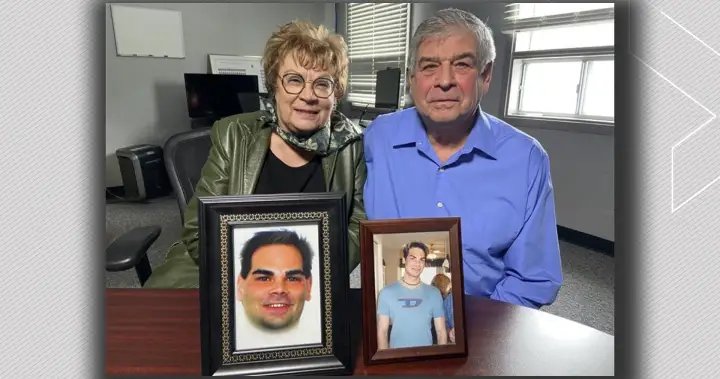
Mike and Dianne Ilesic lost their son Brian Ilesic 14-years-ago in a very public, devastating tragedy.

Not a day goes by that they don’t think about Brian or honour him some sort of way.
“He had an infectious smile, a warm heart a giving nature,” Dianne said. “We miss him and we still set a dinner plate and a glass of wine at the table when we’re together for meals.”
Brian was living with his parents and working as a guard for security company G4S when he was murdered on the job.
“All the stuff that he did have, we still have in a spare bedroom, kind of like the way he had it. So, whenever we want to go by the room, you know, we know he’s there,” Mike said.
Dianne and Mike Ilesic, with pictures of their son Brian, want to pass a bill to prevent multiple parole hearings for murderers.
Global News
In June 2012, Brian was killed by his co-worker on the University of Alberta campus as they were refilling an ATM. The HUB Mall shooting left three of his co-workers dead and another with life-altering brain injuries.
Their co-worker Travis Baumgartner was caught trying to flee the country with cash he’d stolen during the shooting.

Baumgartner pleaded guilty to first-degree murder in the death of Eddie Rejano, two counts of second-degree murder in the deaths of Brian Ilesic and Michelle Shegelski, and guilty of one count of attempted murder in the shooting of Matthew Schuman.
He was sentenced in 2013 to 40 years in prison without the chance of parole and was the first offender in Canada to receive consecutive sentences — instead of concurrent — for multiple murders.
Baumgartner was 23 at the time.

Travis Baumgartner is taken out of a van by Canadian Border Services officers at the Aldergrove, B.C. border crossing, Saturday, June 16, 2012.
THE CANADIAN PRESS/Jonathan Hayward
His conviction was possible because of a 2011 Criminal Code provision under the Stephen Harper government that allowed a judge, in the event of multiple murders, to impose a life sentence and parole ineligibility periods of 25 years to be served consecutively for each murder, rather than concurrently.
But, a Supreme Court decision a decade later in 2022 struck down the punishment of life in prison without parole for mass murderers.

Get breaking National news
For news impacting Canada and around the world, sign up for breaking news alerts delivered directly to you when they happen.
The court said it was was unconstitutional and cruel.
Now, Baumgartner will be eligible for parole in 2049 and if he is denied, can reapply yearly.

Dianne and Mike are pushing for “Brian’s Bill” or Bill C-243, to be passed by the House of Commons.
It would mean those convicted of first- and second-degree murder who are denied parole would have to wait five years to apply again.
The parole process often involves families attending, which many say forces them to reliving the tragedy on a regular basis.
“You only have a limited amount of time to recover from one parole hearing, and then you’re on to the next one,” Dianne said.
“If we can get this bill passed, it’s some relief,” Mike added.
Kerry Diotte, the Conservative Member of Parliament for Edmonton Griesbach, tabled the bill. He also has a petition for people to support it. It will be debated in the House of Commons on March 13, and a final vote will be held on March 25.
Diotte said the bill has support from police associations across the country, and along with lots of support from victims and victim right’s advocates.
“Canadian talk about this a lot, it always seems like criminals have more rights than victims. I think this bill is a way to even that playing field… I want to work with our Liberal colleagues across the aisle,” Diotte said.
“I’m quite hopeful that we can get this through to committee.”

Michael Cooper, the the Conservative Member of Parliament for St. Albert-Sturgeon River, is also helping with seeing the bill through.
The Ilesics supported Cooper as he tried to have similar legislation passed in 2022 and continue to do so now.


“This bill would provide that murderers would still have the opportunity to reapply for parole, but they would just have to wait five years to do so,” Cooper said.
Cooper said if a convicted murderer is denied parole, they usually aren’t successful the following year.
“What are the chances that you have rehabilitated in one short year thereafter? What are the chance that you’re releasable? Next to nil.”
Criminal Trial Lawyers’ Association president Shawn King said if the bill passes, it would also be unconstitutional.
“It’s called the correctional system and not the punishment system,” King said. “The idea is to get them the ability to become productive members of society.”
King said having no hope of rehabilitation and getting out of prison is the equivalent of a death sentence for an inmate.
“I understand what the legislation is saying regarding putting victims through this over and over again, but this person still needs to have some hope that they can actually get their lives back in order,” King added.
He said the bill could lead to some inmates being disruptive in the system because they’ve got nothing to left to lose.
“Why would you bother trying to be a good person if all you get is punishment every day and you’ve got to nothing to live for? Or they take their own lives. Those are the options that you’re essentially faced with when you don’t have an ability to better your situation at all,” King said.
“You’ve got no motivation and no reason to try to make yourself a better human being.”
Those who advocate for victims hope the bill spurs a deeper conversation about how victims are impacted with trials and parole hearings.

Lena Betker, co-CEO of the Sexual Assault Centre of Edmonton, said for people who have experienced sexual assault the process is re-traumatizing.
“They have to continue to relive it over and over again. They have to tell their story to multiple people, they’re often questioned and blamed,” Betker said.
“Even when a conviction happens, there’s an idea that it’s over and they can move on with their lives — but when it comes to parole hearings, it means opening old wounds.”
Betker hopes other solutions are found to make parole hearings easier on loved ones.
“Reduce the harm, things like having options of how to participate, whether that’s a statement that they write versus having to attend in person, being able to attend virtually rather than having to be there in person. As well as just making sure that they feel that heard and that what they are saying is actually being taken into account in the decision by the board.”
Betker said she is hopeful these conversations are being had and people are talking about how to make the process better for victims and their families.
As for Mike and Dianne, they hope to see change this month.
While they are wanting to prevent a long drawn-out process for themselves, they say pushing this bill goes beyond them, and ultimately, they want to also protect other victim’s families.
“I think (Brian) would be very proud, but it’s not just for us,” Dianne said.
“We’d like to stress it’s for the other people too, who have been left behind. It’s a sensible bill.”

— With files from Karen Bartko and Emily Mertz, Global News