dailynewsnblog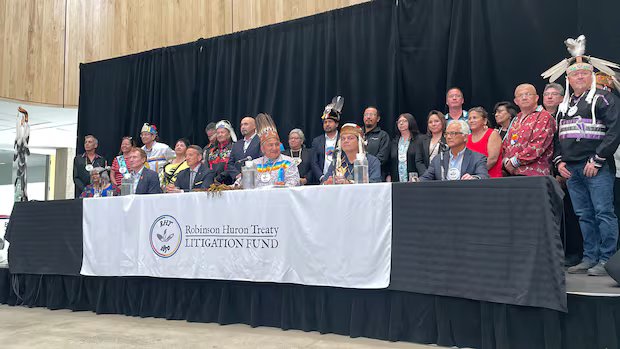
Lawyers who had over $500 million in legal fees struck down by an Ontario court are appealing the decision, arguing the case could have wider implications.
In 2023, lawyers with the firm Nahwegahbow Corbiere negotiated a landmark $10-billion settlement for 21 Anishinaabe First Nations, for breaches by the Crown of the 1850 Robinson-Huron Treaty.
Two of the First Nations disputed the $510 million in legal fees that their lawyers claimed. In October 2025, a Superior Court of Justice decision determined the amount — based on an agreed five per cent cut of the settlement — was neither fair nor reasonable. Justice Fred Myers ruled that it be reduced by $487 million.
In factums recently submitted to the Court of Appeal, lawyers hired by Nahwegahbow Corbiere argue the decision will have a “chilling effect” on other cases, particularly for lengthy and complex cases involving “under-resourced” groups.
“I think in terms of access to justice for communities that are really in difficulty, where the case would never go to trial otherwise, I think this case has enormous implications,” said Toronto-based lawyer Brian Gover, who is representing the law firm in its appeal.
The lawyer representing the group challenging the fees refutes that argument, and maintains that the total was unreasonable.
Contingency fees — legal fees based on a percentage of a case’s payout — are common. But some in the profession say with more large cases and the potential for massive paydays for lawyers, the agreements are being put to the test. And they believe cases like this one could set a precedent for how contingency fees are handled going forward.
Contingency fees explained
Contingency fee agreements mean clients don’t have to pay lawyers upfront, instead paying an agreed percentage of the eventual settlement or award, often around 15 to 30 per cent, if the case is successful.
These kinds of agreements are commonly used in personal injury law and class actions, but they’re still relatively new in Ontario, following a Court of Appeal decision in 2002. They are not permitted in criminal or family law.

Historically, there have been concerns about lawyers potentially taking on lawsuits purely to enrich themselves, said Suzanne Chiodo, an assistant professor at Osgoode Hall Law School who specializes in class actions and access to justice. But she says the agreements also have great benefits.
“Anyone who’s ever had to pay a lawyer’s bill will tell you that contingency fees are a gift from the gods,” Chiodo said. “It’s a huge access-to-justice issue.”
That issue is central to this appeal.
Case could affect future of partial contingency fees, says lawyer
The Robinson Huron Treaty Litigation Fund, comprised of 21 First Nations, first retained Nahwegahbow Corbiere in 2007. In 2011, the group signed an agreement that included a partial contingency fee.
While the lawyers were paid throughout the course of their work, they charged a reduced hourly rate, in the end totalling more than $17 million. In addition, the fund agreed to pay a contingency fee of 15 per cent for the first $100 million of an eventual settlement, and five per cent on any amount above that.
“The fact is this is the only way the case could proceed,” said Gover, noting the agreement meant both client and counsel had “skin in the game.”
While the contingency fees ended up totalling $510 million, the lawyers agreed to return half that amount to the litigation fund, for purposes including promotion of the Anishinaabemowin language and supporting elders.
The majority of the First Nations agreed to the total amount, but two — Garden River First Nation and Atikameksheng Anishnawbek — did not, and challenged it in court.
Justice Myers noted a lack of applicable case law, due to the “unusual” agreement, in which “only a small portion” of the firm’s fees were at risk, as they were guaranteed at least some payment through the hourly billing. That limited risk is a key part of the reason why he deemed the fees unreasonable.
In the factum filed with the Court of Appeal, the lawyers argue the risk they took on was not just financial. They say there was also “significant reputational risk” for the Indigenous lawyers, “whose professional standing as Aboriginal law specialists and community ties were deeply invested in the outcome.”

Gover said he believes few lawyers would have taken on such a complex case, if from the outset the fees were set at just 0.4 per cent of the settlement, which is what the legal team’s total compensation now amounts to.
“I wonder what the future of partial contingency fee agreements is after the decision, if they can be routinely set aside on the basis that the lawyers have de-risked the situation by entering into arrangements of that kind,” Gover said.
He argues it could mean reduced access to justice for other marginalized groups aiming to address historic wrongs.
Lawyer Michael Rosenberg, who is representing Garden River First Nation and Atikameksheng Anishnawbek, disputes that argument.
“There does not appear to be any shortage of capable lawyers willing to prosecute these cases, and it would seem that there is little danger of a chilling effect,” Rosenberg wrote in an email to CBC News.

Another key element of Justice Myers’s decision is that the lawyers did not encourage outside legal advice, which he says could have resulted in a very different agreement from the outset.
Gover insists Nahwegahbow Corbiere’s clients were well-informed, and that as leaders of sophisticated First Nations, they were used to working with lawyers.
“People went into it with their eyes open,” Gover said.
How much is too much?
In a statement to CBC News, Garden River First Nation Chief Karen Bell said she decided to challenge the fees “in pursuit of fairness and integrity, to ensure it was the beneficiaries that reaped the benefits and not a legal firm.”
$510 million is more than what most of the individual First Nations received from the settlement.
In his decision, Justice Myers wrote that lawyers are not entitled to a “windfall.”
But in other cases, large fees have been approved. Last year, the Ontario Court of Justice approved more than $900 million in contingency fees for lawyers who spent decades litigating against tobacco companies.

University of Toronto law professor Mayo Moran points out in that case, the lawyers received no payment for 26 years.
“In order to justify really extraordinary fees, you’d have to … have the lawyers taking an extraordinary, almost outlandish degree of risk.”
Moran and Chiodo say they expect courts to continue to grapple with issues related to the reasonableness of fees, and determining if these agreements are fair. Chiodo says the Court of Appeal’s decision in this case could help address some unanswered questions.
“These ‘mega-fund’ cases are coming up more and more, but that doesn’t mean that the … case law is settled.”