dailynewsnblog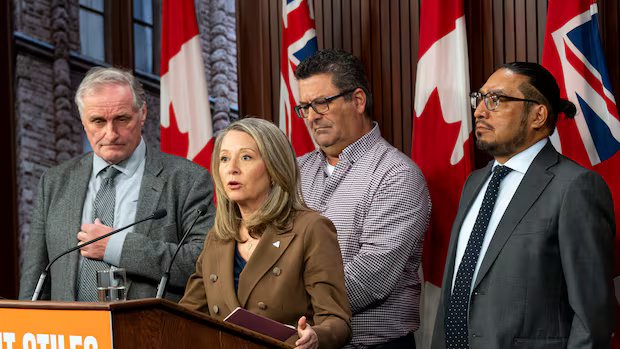
NDP members of provincial parliament are embarking on a nine-day road trip across northern Ontario to raise awareness about ongoing safety concerns along the Highway 11-17 corridor.
Highway safety has been top of mind in the region following a recent string of fatal collisions, where eight deaths were reported in a 10-day period.
“Northern highways are lifelines. They are the connection between people and their health care, people and their jobs, people and their families — and right now, unfortunately, they are simply not safe,” Ontario NDP leader Marit Stiles said Tuesday morning at a press conference at Queen’s Park, shortly before the road trip began.
For years, northern Ontario MPPs have been calling on the province to make critical improvements to highway infrastructure in the region, as well as more oversight for transport truck drivers and training schools.
“We have raised these issues repeatedly. The government has continued to ignore it, ignore us, and so we are going to take this on the road,” Stiles said.
Among those participating in the road trip, called “Our Roads, Our Safety,” are NDP MPPs Guy Bourgouin, France Gelinas, Sol Mamakwa, John Vanthof, Lise Vaugeois and Jamie West.
Stiles said she will be joining them for a few of their stops, which include North Bay, Sudbury, Sault Ste. Marie, Timmins, Kapuskasing, Thunder Bay and Kenora.
The Ontario Provincial Police (OPP) North West Region recently provided statistics to CBC News about collision incidents and fatalities on northern Ontario’s highways between 2020 and 2025.
During this time frame, 10,661 collisions were reported on Highway 11 and 8,960 incidents occurred on Highway 17.
That period saw 116 deaths on Highway 11 and 123 deaths on Highway 17, the OPP said.
“People are grieving the losses — the losses of family, friends because of the fatal collisions on dangerous northern highways,” Kiiwetinoong MPP Sol Mamakwa said during Tuesday’s press conference, held shortly before the MPPs hit the road.
CBC News reached out to Ontario’s Ministry of Transportation and received an emailed statement.
“Our government has always supported commuters in the north and will continue to make critical investment to ensure our northern roads are safe,” said Dakota Brasier, director of media relations for minister Prabmeet Sarkaria.
“We are twinning key sections of Highways 11 and 17 to improve road safety, rebuilding and widening critical corridors to protect northern families, and cracking down on dangerous driving and impaired drivers.”
The province is spending nearly $600 million on northern roads, bridges and highways, “with over $350 million to make Highways 11 and 17 safer,” Brasier said.
Single-lane highways, fake licenses
Highway 11-17 is the region’s major connector to the rest of Canada; when it’s closed, motorists are left without alternatives.
“[If] that alone isn’t enough motivation for all levels of government to come together and decide that actually fixing those highways, making those highways safe is a nation-building project, I don’t know what else is,” Stiles said.
As the province continues to push for development in northern Ontario’s Ring of Fire, “I don’t know how anybody’s going to get anything done right now when the highway is as unsafe as it is,” she added.

Ontario will spend millions to expand and fast-track construction of roads into the mineral-rich Ring of Fire, aiming to begin opening sections by 2030. CBC’s Shawn Jeffords breaks down the project and the new timeline.
Last year, MPPs Bourgouin, Vanthof and Vaugeois put forward Bill 49, known as the Northern Highway 11 and 17 Safety Act, 2025.
The bill, which was defeated in November, proposed changes to the Highway Traffic Act and Public Transportation and Highway Improvement Act — including more traffic enforcement and for scales and inspection sites on Highway 11-17 to be open at least 12 hours a day.
The bill would have seen the ministry of transportation assume responsibility for issuing certificates to transport truck drivers rather than third-party examination centres.

Trucking is the lifeline of Canada’s economy, and as the country faces a shortage of drivers, Marketplace uncovers shocking details about how some unqualified new recruits are finding their way onto our roads.
In explaining the bill’s purpose, Bourgouin mentioned a CBC Marketplace feature from October 2024 which reveals problems with the truck driving industry, such as fraudulent licenses being issued by independent training schools.
Bill 49 would have also designated responsibility back to the ministry for winter maintenance of the Highway 11-17 corridor.
“People don’t realize that it’s only two, single-lane highways and hardly shoulders,” Bourgouin said. “No rest stops, no washrooms for people to use.”
Meanwhile, community leaders, including the Northwestern Ontario Municipal Association and Federation of Northern Ontario Municipalities, continue to call for the highway to be twinned as well as what’s called a two-plus-one system.
This consists of a central passing lane that alternates direction every few kilometres and a median that prevents head-on collisions.
“These [municipal] organizations, they’re fighting the same fight we are,” Bourgouin said, “but it falls on to deaf ears.”