dailynewsnblog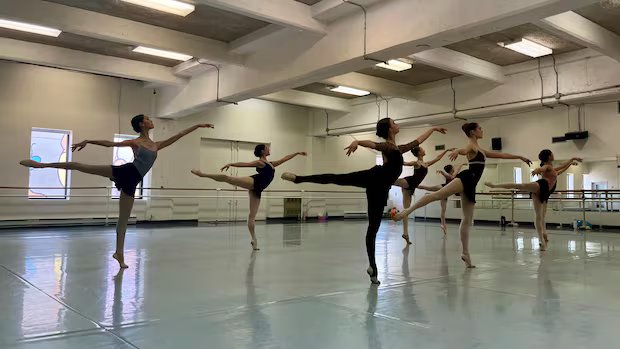

Listen to this article
Estimated 3 minutes
The audio version of this article is generated by AI-based technology. Mispronunciations can occur. We are working with our partners to continually review and improve the results.
At 9 a.m., some students begin their training by stretching. By 9 p.m., many of them are still here.
“My parents wanted me to try soccer,” said Léo Lussier, with a smile. “But when I started dancing, it just clicked.”
For years, he has travelled from Montreal’s South Shore to the city’s Plateau neighbourhood to train at the École supérieure de ballet du Québec (ESBQ). His days now stretch across technique classes, conditioning sessions, rehearsals and academic studies — often 10 to 12 hours inside the building.
He is one of more than 160 students enrolled at the ESBQ, the only professional classical ballet school in North America offering training in French.

For many students, it’s more than a school.
“It’s really like my second home,” said Héloïse Léveillé, who spends six days a week here. “I see my teachers and classmates more than I see my family.”
Victoria Villegas Azuaje agrees. She’s been dancing here since 2012.
“I know this building like the back of my hand,” she said.
This year marks the school’s 60th anniversary — a milestone administrators say should be celebratory. Instead, they’re warning of financial strain.

Executive director Alix Laurent says government funding has barely changed in three decades.
“In 1994, the school received $1.3 million,” he said. “Today, it’s $1.4 million.”
The school is asking Quebec for an additional $1.1 million annually, starting next year, to maintain what it describes as a high-performance training environment.
Artistic director Anik Bissonnette — a former principal dancer — says ballet training has evolved significantly.
“It’s not taught the way it was when I trained,” she says. “There are many more elements now that are essential to properly develop a dancer.”

Students receive not only ballet technique classes, but also physical conditioning, injury prevention support, mental preparation and access to specialized guidance.
“When you look at Olympic athletes, they are surrounded by teams,” Bissonnette said. “Dancers are athletes too. Seventy per cent of their training is mental.”
‘Where do we cut?’
Without additional funding, Laurent says difficult decisions may lie ahead.
“If we don’t have the means,” he said, “where do we cut? The pianist? Strength training? Support services?”
In a written statement, Quebec’s Ministry of Culture and Communications says it recognizes the school’s “strategic role” in training the next generation of dancers and promoting Quebec’s cultural influence.
The ministry notes that the ESBQ already receives one of the largest subsidies granted under its Program for the Operating Assistance of Arts Training Organizations (PAFOFA). Funding is determined through standardized, Treasury Board–approved criteria that take into account the realities of arts training institutions.
School administrators argue that rising operational costs — including specialized staff and updated training methods — have outpaced stagnant base funding.
For students, the issue feels personal.

The École supérieure de ballet du Québec is the only professional classical ballet school in North America offering training in French. It says it needs an additional $1.1 million a year starting next year to maintain its current programs.
“It would be sad to think we’re one of the last generations to experience this,” Villegas Azuaje said with a sigh.
Lussier nods.“Dancing means everything to me,” he said. “I hope the next generation can have the same opportunity.”
For now, the studios remain full, the music continues, and students push through another rehearsal.