dailynewsnblog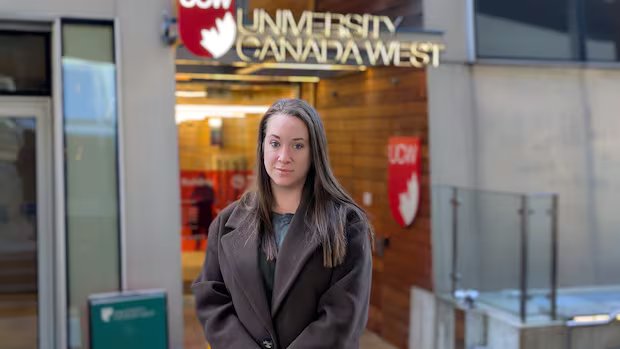
Mira Burgess didn’t have to wonder where her money went.
More than $37,000 in fraudulent credit and debit card transactions showed up at one place — paid to a private university, just a few kilometres from her Vancouver home.
“I know where the money is,” said Burgess. “And nobody will help me get it back.”
- Got a story you want investigated? Contact Erica and the Go Public team gopublic@cbc.ca
For months, neither the university, her bank nor police would help reverse the charges — leaving her on the hook for thousands of dollars in a growing tuition scam until Go Public started investigating.
The scam targets international students — and unwitting credit card holders like Burgess — and is now surfacing in cities across the country.
Fraudsters promise discounted tuition in exchange for an upfront payment. They collect and keep the student’s money, then “pay” the school using stolen credit and debit cards. The student believes their tuition is covered — until the fraudulent payment is flagged.
In Burgess’s case, scammers used her debit and credit cards to make 25 fraudulent charges. On her statements, the charges appeared as payments to UCW — University Canada West — an accredited private institution in downtown Vancouver that primarily caters to international students.

A legal expert says fraud victims like Burgess often have few options in these situations beyond hiring a lawyer — which can be an expensive option.
“It’s just unfortunate that consumers are put in a position where their only recourse is to resort to investing in legal advice,” said Anique Dublin, a Toronto lawyer who specializes in consumer protection. “It feels like everybody was failing this poor woman.”
‘I went into a full panic’
Burgess’s financial nightmare began last fall.
She was working at home when she got a call that appeared to be from TD’s fraud department. The number had been spoofed.
A woman on the line said someone had made fraudulent charges on Burgess’s credit card, and instructed her to open her TD Banking app, to reverse them.
“She was very empathetic,” said Burgess. “And was like, ‘I know this is very stressful.'”

A tuition scam has left a woman with $37,000 in bank charges. Mira Burgess had no connection to the school that had her money. The bank, the school, and the police offered no help until Go Public got involved.
Instead, Burgess was unknowingly approving the transactions.
The next day, when the fraudsters called back, her husband — listening on speaker phone — urged her to hang up.
“I went into a full panic,” she said. “Very emotional, because I couldn’t believe I just got scammed.”
She contacted TD immediately, and was told the bank would try to stop the charges. It was too late. She filed a dispute, and repeatedly called back for updates.
That’s when she learned all the charges had been at University Canada West, a school she had driven by many times but never attended.
“I was shocked,” said Burgess. “I also thought, ‘Okay great, it’s traceable. The dots are connected from my bank to the university and I am going to find a way to get it back.'”
It wasn’t that simple.

Finger pointing
TD Bank declined to request a chargeback from the university, saying Burgess had helped facilitate the fraud.
She appealed to TD’s senior customer complaints office. In a letter declining her appeal, a spokesperson told Burgess that customers are responsible for “understanding who they are interacting with.”
Dublin says that response is inappropriate.
“That seems like an unreasonable position for the bank to have taken, in circumstances when they confirmed she was a victim of a scam,” she said. “In those situations it’s unreasonable to say the person was grossly negligent.”

When Burgess asked University Canada West to return the money, the school said it could not do so without a chargeback request from TD.
She then turned to Vancouver Police. She says an officer initially told her — incorrectly — that the money was likely untraceable and too difficult to investigate. When she explained the payments were all made to the university, she says he told her there was little he could do and he was too busy to hunt down students who may have fallen for the scam.
Burgess says he suggested she start at square one and request that TD do a chargeback request.
“This is the problem with these fraudulent schemes,” said Dublin. “The constant stance by the police. ‘What do you want us to do?’ ‘It’s a civil matter.’ ‘Go to court.’ It’s unacceptable but unfortunately I’m not surprised.”
Go Public asked the Vancouver Police Department why they closed this case. A spokesperson wrote that investigations like this are “inherently difficult to prosecute, as perpetrators are often located overseas” and that they must allocate “limited resources to investigating cases that are most likely to result in criminal prosecution.”
Growing problem
The tuition scam appears to be spreading.
The University of Regina said several international students reported tuition fraud in January 2025. A spokesperson said the school wants to remind students that “there are no authorized businesses or persons who will pay for your tuition upfront or offer discounts.”
Regina police issued a fraud warning, saying 23 victims lost more than $125,000.
Police in Edmonton, Winnipeg and Ottawa have also received similar reports.
And Nanaimo, B.C., police heard from Jonathan Etkin last August, after fraudsters put almost $22,000 worth of charges on his credit card for payments at the University of Calgary and Ontario’s Fleming College.
Like Burgess, he received a call that appeared to be from his bank — in his case, RBC’s fraud department.

He provided texted verification codes, believing he was stopping fraudulent transactions.
When he realized he’d been scammed, he asked RBC for help, but records show his request was repeatedly rejected.
“They all gave me essentially the same response,” said Etkin. “Which is, ‘There’s nothing we can do about it … you shouldn’t give out your information to anyone on the phone.'”
Etkin later received a phone call from RBC, saying as a “one-time” exception the bank had issued a chargeback of over $15,000. The bank has not reversed the $6,200 charge from Fleming College.
Fleming College did not answer any of Etkin’s emails until Go Public made inquiries. A spokesperson recently wrote that the school is “sympathetic” to Etkin’s situation and is “reviewing the details” of his case.
Calls for stronger protections
Last year, the Liberal government proposed changes to the Bank Act, which they said would help protect consumers against bank fraud, but critics argue those changes don’t go far enough.
“It shouldn’t be this easy to have a fraud or a con artist step in and separate you from your money,” said interim NDP leader Don Davies, who sits on the all-party finance committee and is Burgess’s MP. “And then have the banks walk away saying there’s nothing they can do.”
Last month, Davies proposed additional changes to the Bank Act, including measures that would hold banks liable for fraud except in cases where customers were proven to be grossly negligent — similar to legislation in the U.K.
Consumer groups such as the Public Interest Advocacy Centre, Democracy Watch and Option Consommateurs have made calls for similar protections.

But Conservative and Liberal members of the committee voted against Davies’s amendments, as well as similar proposals put forward by the Bloc Québécois.
“I think they’re doing the bidding of the banks, instead of standing up for Canadian consumers,” said Davies.
Go Public asked dissenting MPs why they voted against the amendments.
The Office of the Minister of Finance responded that the government’s approach to combatting financial fraud is “exhaustive” and that addressing it “requires shared input, effort, and responsibility – not a piecemeal approach.”
Conservative finance critic Jasraj Singh Hallan said the proposals needed more study and it would have been “irresponsible” to pass them in a “rushed amendment.”
For its part, as March is “fraud prevention month” in Canada, the Canadian Bankers Association recently released a toolkit and “scam-spotting quiz” to help customers learn how to spot red flags.
TD offers compensation as ‘goodwill gesture’
After Go Public contacted TD Bank, the bank told Burgess the charges would be reversed as a “one-time goodwill gesture.” A spokesperson said TD would use the case “to improve the client experience, as well as our internal processes.”
Dublin, the consumer lawyer, believes the timing is telling.
“I don’t think it came from the goodness of their heart,” she said, “I think they knew they should have returned the money under these circumstances.”
Burgess says she’s relieved to no longer face $37,000 in debt. But says she also wants others to be aware of the scam.
“I feel disappointed in myself that I fell for something,” said Burgess. “But need to share my story with other people, so that it doesn’t happen to others.”
Submit your story ideas
Go Public is an investigative news segment on CBC-TV, radio and the web.
We tell your stories, shed light on wrongdoing and hold the powers that be accountable.
If you have a story in the public interest, or if you’re an insider with information, contact gopublic@cbc.ca with your name, contact information and a brief summary. All emails are confidential until you decide to Go Public.
Read more stories by Go Public.
Read about our hosts.