dailynewsnblog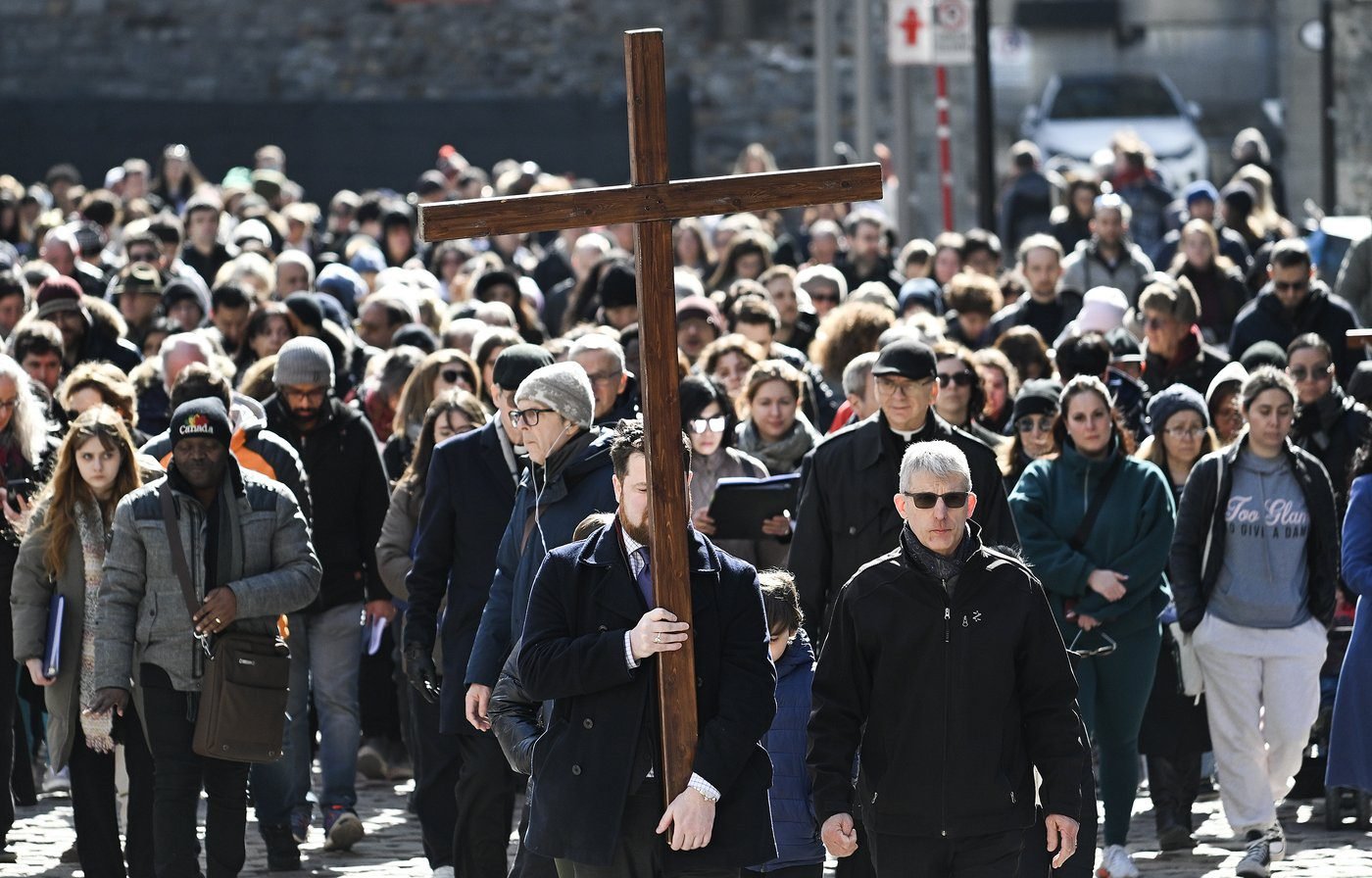
MONTREAL — Christians across Quebec are about to face a new legal landscape on Good Friday, only a day after the provincial legislature adopted a law that could crack down on their annual Way of the Cross processions.
In Montreal, several hundred people are expected to join Archbishop Christian Lépine in a march of “prayer, reflection and silence” that winds its way through the streets behind a large crucifix, stopping at several historic churches in a commemoration of Jesus’s journey to the cross.
But the Easter weekend tradition will likely become harder to organize in future years, now that the province has passed a law to ban public prayer.
The Quebec government adopted legislation on Thursday, extending a ban on wearing religious symbols in public workplaces to daycare workers, prohibiting prayer rooms in public institutions, and banning public prayer without explicit municipal consent.
“No public road … or public park may be used for the purposes of collective religious practice unless a municipality authorizes, exceptionally and on a case-by-case basis, such a use in its public domain by resolution of the municipal council,” the text of the law reads.
Martin Laliberté, the head of the Assembly of Quebec Catholic Bishops, believes the new law turns religious people into second-class citizens.
He notes that street closures and public demonstrations happen all the time, including for sporting events, protests, and cultural events.
“If we do it for religious reasons, we don’t have the right,” he said Wednesday in an interview. “So people in society who are believers become second-class citizens who don’t have the right, like any other citizen, to demonstrate (when it’s) in the name of their faith.”
He said organizers of Way of the Cross and other marches have always co-ordinated with local officials and respected municipal rules, but never before had to seek express permission to hold their events.
“It was a right, and now it’s not a right any more,” he said. The new law, he said, leaves churches relying on the goodwill of city councils, who can decide whether or not to grant permits for the event.
Laliberté says senior Catholic leaders are concerned the new law goes far beyond the effect on ceremonial processions. He notes that the legislation invokes powers that allow the province to override some sections of the Charter and shield the secularism law from court challenges.
“We have rights, according to the Charter, which say you have a right to express your faith publicly,” Laliberté said.
But with the new law, he said people don’t have this right any more.
“That’s a big shift for us.”
Laliberté said the Quebec Catholic bishops participated in consultations on the new law, where they expressed particular concern with the public prayer ban and the expansion of the religious symbol prohibition. He said politicians appeared to listen, but were unwilling to adopt the changes.
He said he believes the new law has “no utility,” because the government already has all the tools it needs to protect secularism.
The Quebec government did not respond to a request for comment by publication time.
John Zucchi, national director with Montreal Way of the Cross procession organizer Communion and Liberation Canada, says organizers always communicate with police about the event, but have been told in the past that it’s not necessary to inform the city.
He says the event last year drew nearly 1,000 people, who walk in silence behind a person carrying a crucifix to different churches, where there is singing, gospel readings and poems.
Unlike many church events, he says attendance has gone up in recent years, and numbers have roughly doubled since the COVID-19 pandemic.
“I think people are struck by the soberness of the event, by the simplicity of it and by the quiet dignity that surrounds the event,” he said. “It’s not meant to be clamour or something loud. It’s a meditation from start to finish.”
Zucchi says he shares the views of religious leaders who are concerned about the law, but isn’t worrying yet about its impact on the march in Montreal. “We’ve only encountered goodwill with the city, with the police service … and count on that continued goodwill in the future,” he said.
He also questioned what events will count as “public prayer.”
“With the case of a procession done in silence, what constitutes prayer?” he asks.
This report by The Canadian Press was first published April 3, 2026.
Morgan Lowrie, The Canadian Press