dailynewsnblog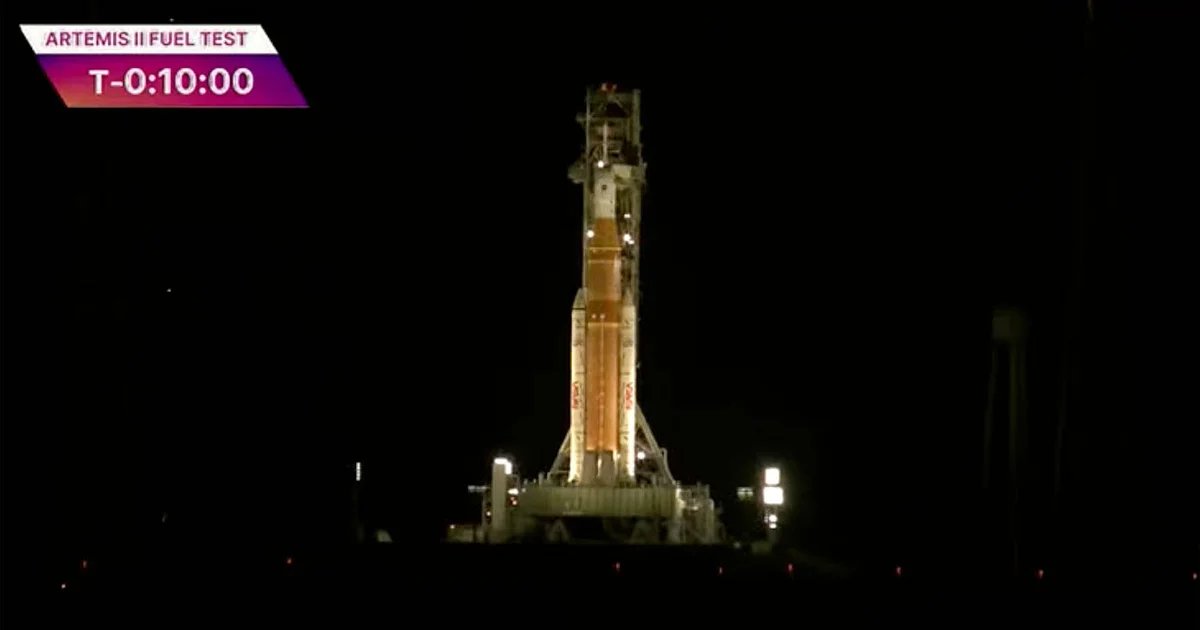
A dress rehearsal countdown for NASA’s Artemis II moon rocket, intended to clear the way for a possible February launch, ran into a variety of problems and ultimately was called off early Tuesday because of an out-of-limits hydrogen leak. Shortly after, NASA announced the long awaited flight to send four astronauts on a trip around the moon, was being delayed to March at the earliest.
“With the conclusion of the wet dress rehearsal today, we are moving off the February launch window and targeting March for the earliest possible launch of Artemis II,” NASA Administrator Jared Isaacman said in a post on X.
“We fully anticipated encountering challenges,” he said. “That is precisely why we conduct a wet dress rehearsal. These tests are designed to surface issues before flight and set up launch day with the highest probability of success.”
Artemis II commander Reid Wiseman, Victor Glover, Christina Koch and Canadian astronaut Jeremy Hansen, in pre-flight medical quarantine at the Johnson Space Center in Houston, had hope to fly to Florida Tuesday to begin final preparations for launch. Instead, they will remain in Houston and rejoin family, friends and co-workers.
The practice countdown began Saturday evening — two days late because of frigid weather along Florida’s Space Coast — and after a meeting Monday morning to assess the weather and the team’s readiness to proceed, Launch Director Charlie Blackwell-Thompson cleared engineers to begin the remotely-controlled fueling operation.
NASA 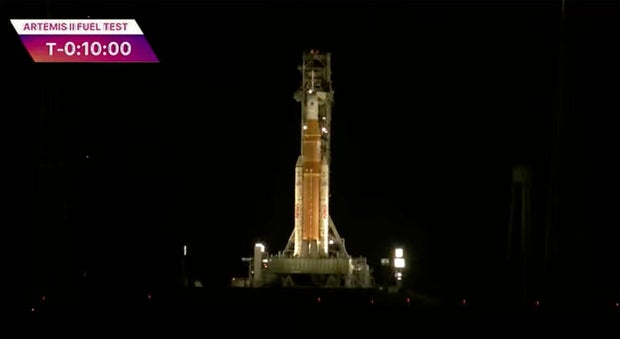
The test got underway about 45 minutes later than planned, but it initially appeared to be proceeding smoothly as supercold liquid oxygen and hydrogen fuel were pumped into the Space Launch System rocket’s first stage tanks. Shortly after, hydrogen began flowing into the rocket’s upper stage as planned.
But after the first stage hydrogen tank was about 55% full, a leak was detected at an umbilical plate where a fuel line from the launch pad is connected to the base of the SLS rocket’s first stage. After a brief pause, engineers resumed fuel flow but again cut it off with the tank about 77% full.
After more discussion, engineers were able to press ahead by stopping the flow of hydrogen, “allowing the interface to warm up for the seals to reseat, and adjusting the flow of propellant,” NASA said in a blog post.
With all the rocket’s tanks full and in “stable replenish,” a five-member closeout team was dispatched to the pad to ready the Orion crew capsule for a simulated crew arrival and then to close and test the two hatches leading into the spacecraft.
The countdown was originally timed for a simulated launch at 9 p.m. EST, But troubleshooting the hydrogen leak, communications dropouts and other issues caused the test to run longer than planned. As of 10 p.m., the countdown was in an extended hold at the T-minus 10-minute mark.
The count finally resumed just after midnight only to be stopped a final time at T-minus five minutes and 15 seconds when the automated Ground Launch Sequencer detected an increase in the leak seen earlier and stopped the clock for good.
“The team will fully review the data, troubleshoot each issue encountered during WDR, make the necessary repairs, and return to testing,” Isaacman said. “We expect to conduct an additional wet dress rehearsal and then target the March window.”
Five launch opportunities are available next month, beginning March 6 and ending on March 11.
The SLS is the rocket NASA plans to use to send Artemis astronauts to the moon aboard Orion crew capsules. It is the most powerful operational launcher in the world, a towering 332-foot-tall rocket powered by two strap-on solid fuel boosters and four main engines burning liquid oxygen and hydrogen fuel that generate 8.8 million pounds of thrust at liftoff.
The SLS rocket’s first and so far only mission came in 2022 when it was launched on an unpiloted test flight. In the campaign leading up to launch, engineers ran into a variety of problems ranging from fuel leaks to unexpected propellant flow behavior in the launch pad’s plumbing. Launch was delayed for months while engineers worked to resolve the problems.
For the rocket’s second launch, multiple upgrades and improvements were implemented and Blackwell-Thompson said last week she was optimistic the fueling test would go well.
“Why do we think that we’ll be successful? It’s the lessons that we learned,” she said.
“Artemis I was the test flight, and we learned a lot during that campaign, getting to launch,” she said. “And the things that we learned relative to how to go load this vehicle, how to load LOX (liquid oxygen), how to load hydrogen, have all been rolled in to the way in which we intend to load the Artemis II vehicle.”
Most of the fixes and upgrades appeared to work as planned. But leakage at the tail service mast umbilical, a problem during the first Artemis flight in 2022, cropped up again the second time around.