dailynewsnblog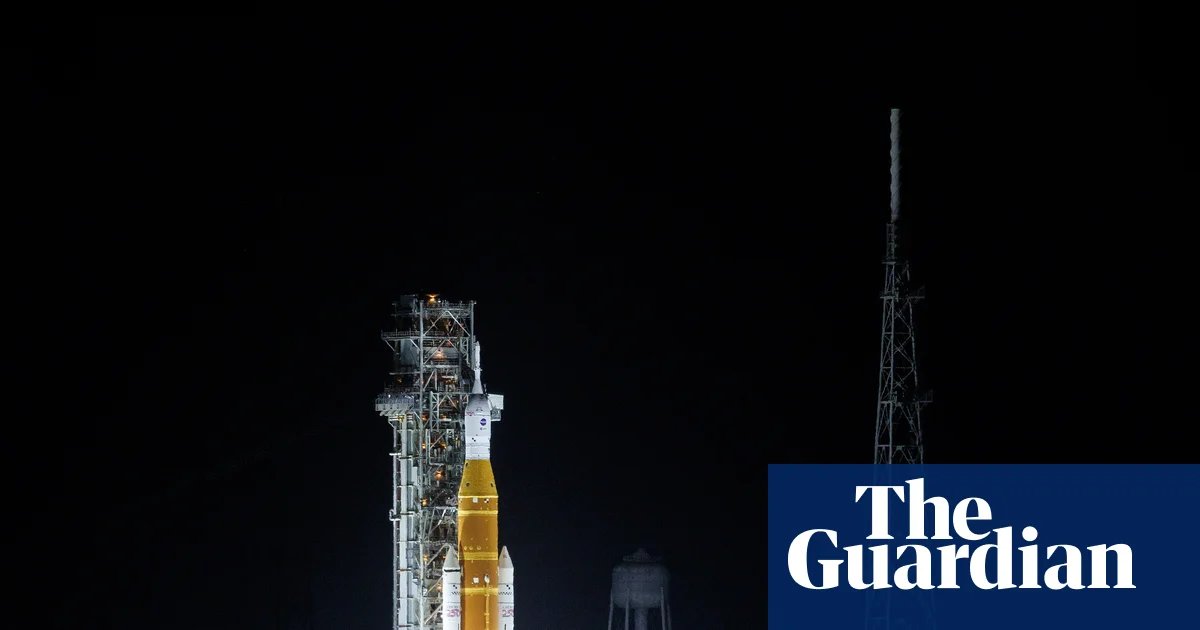
Nasa said on Friday it was planning to launch its delayed Artemis II moon mission on 6 March after successfully completing a fueling test that had caused it to stand down earlier this month.
Jared Isaacman, the space agency’s newly confirmed administrator, cited “major progress” since the original so-called wet dress rehearsal in which engineers discovered liquid hydrogen leaking from the space launch system (SLS) rocket on its Florida launchpad at Cape Canaveral.
The mission’s four astronauts, three Americans and one Canadian, were entering a second period of quarantine on Friday in anticipation of the new target launch date, which Nasa announced “with caveats” because it said there was still much preparatory work to do after Thursday’s fueling test.
“I felt like last night was a big step in us earning our right to fly. So, [it] felt really good. Very proud of the team,” the Artemis launch director, Charlie Blackwell-Thompson, told a Friday early afternoon press conference.
Nasa has several dates available in early March to launch Artemis, which will conduct a 10-day trip around the moon, but not land. The flight will take humans further into space then ever before and, according to Nasa, the mission will fly about 4,700 miles (7,600km) beyond the far side of the moon, surpassing the distance record set by Apollo 13 in 1970. The mission will test systems for future deep-space exploration.
The mission is in preparation for Artemis III, scheduled for 2028, which will be the first human landing on the moon since the final Apollo program flight in December 1972.
The successful fueling test was a welcome bright spot for Nasa, which acknowledged in a damning report published on Thursday a succession of failures on Boeing’s ill-fated Starliner capsule that left two astronauts stuck on the International Space Station for nine months.
The space agency said the first crewed test launch of Starliner in June 2024 was part of what Isaacman designated a “Type A mishap” – its most serious classification – in the report.
The Nasa astronauts Suni Williams and Butch Wilmore finally returned to Earth in March 2025 after an extended stay on the International Space Station (ISS) caused by severe technical failures on Starliner, including faulty thrusters and helium leaks that became apparent upon docking.
The stricken capsule was sent back in September empty, and Williams and Wilmore became part of the ISS until they eventually came home on a SpaceX Dragon spacecraft in what Donald Trump portrayed as a “rescue mission”.
“The agency failed them,” Amit Kshatriya, Nasa’s deputy administrator, told a press conference on Thursday afternoon, describing its decision to accept Boeing’s assurances at face value that the capsule was safe and ready to launch.
“Our responsibility is to them and to all the crews that are coming and to the crews that we’re about to go fly.”
Those astronauts include the four who are set to climb on board Artemis II next month: Nasa astronauts Reid Wiseman, Victor Glover and Christina Koch, and Jeremy Hansen of the Canadian Space Agency.
The Starliner report details an often “chaotic” and at times adversarial relationship between agency officials and Boeing executives, including a reluctance on both sides to entertain dissenting views, and growing mistrust.
“While Boeing built Starliner, Nasa accepted it and launched two astronauts to space,” Isaacman said in a statement accompanying the report, acknowledging it had been overly keen to secure an alternative to SpaceX for crew transportation.
“Beyond technical issues, it is clear that Nasa permitted overarching programmatic objectives of having two providers capable of transporting astronauts to-and-from orbit, influence engineering and operational decisions, especially during and immediately after the mission. We are correcting those mistakes.”
Investigators found shortfalls in Boeing’s building and testing of Starliner, and blamed for its downfall “an interplay of combined hardware failures, qualification gaps, leadership missteps, and cultural breakdowns that created risk conditions inconsistent with Nasa’s human spaceflight safety standards”.
The agency, Isaacman said, “will not fly another crew on Starliner until technical causes are understood and corrected”.
Boeing responded to the criticism in a statement saying it was “grateful” to Nasa for the investigation and opportunity to contribute to it.
“In the 18 months since our test flight, Boeing has made substantial progress on corrective actions for technical challenges we encountered and driven significant cultural changes across the team that directly align with the findings in the report,” a spokesperson said.
“Nasa’s report will reinforce our ongoing efforts to strengthen our work.”