dailynewsnblog
There are many details about the EPO/CoLA orbit in the research paper, but critically, its closest point to the Moon lies just 100 km above the Moon’s surface (the apolune distance is 6,500 km). For many landing sites, the paper notes, a Human Landing System vehicle can perform a single burn to reach a much lower orbit.
As part of his change in plans, Isaacman said the Space Launch System rocket’s upper stage would be “standardized” for Artemis IV and beyond. That means the first lunar landing mission will use a new upper stage, likely the Centaur V built by United Launch Alliance. This will have more propulsive capabilities than the current rocket, so it is possible that for Artemis IV, Orion could reach an even more favorable orbit (i.e., closer to the Moon, requiring less energy to reach the surface) than EPO/CoLA.
Can Starship be accelerated?
At the end of the day, it’s helpful to find new orbits and relax requirements where appropriate. But it will still be up to the lander contractors to deliver the goods, and for NASA, the sooner the better.
Last November, Ars looked at several ways Starship might be brought online faster as a lunar lander. Perhaps the biggest problem with using Starship as a lander is the need to fly multiple uncrewed tanker missions to refuel Starship in low-Earth orbit before it transits to the Moon and awaits a crew aboard Orion. This necessitates an estimated one- or two-dozen launches.
The best solution we could come up with was flying an optimized, expendable Starship tanker stage that would maximize propellant delivery per flight. When asked about this, though, SpaceX founder Elon Musk shot down the idea. Once Starship begins flying at rate, Musk believes, a dozen or more tanker missions per lunar flight will not pose a major impediment.
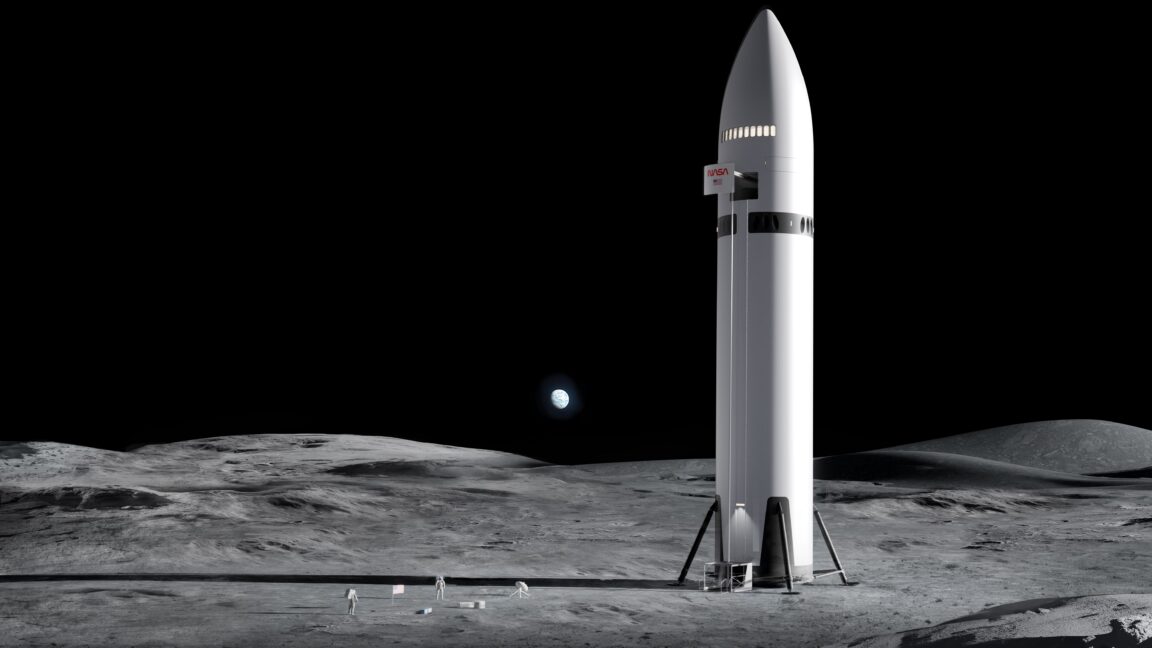
So it should come as no surprise that SpaceX has not proposed significant changes to its Human Landing System hardware. In response to NASA’s desire to accelerate the Artemis timeline, the company has indicated that it will prioritize the Human Landing System more as part of the Starship program. The company also suggested that eliminating the requirement to dock in near-rectilinear halo orbit could open up new mission plans, including potentially docking with Orion in orbit around Earth rather than the Moon.