dailynewsnblog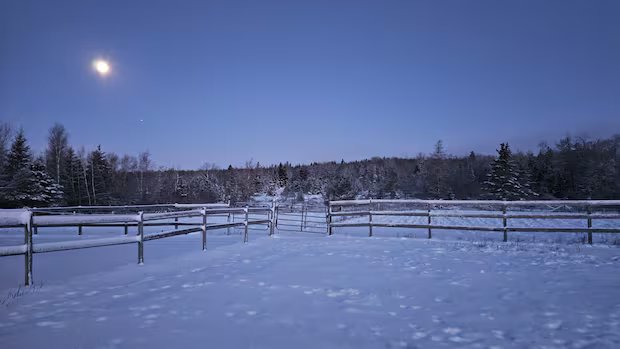

Listen to this article
Estimated 5 minutes
The audio version of this article is generated by AI-based technology. Mispronunciations can occur. We are working with our partners to continually review and improve the results.
Farmers in Nova Scotia are hoping the snowfall this winter will help them recover from last year’s serious drought.
Much of the province has seen an average or slightly above-average amount of snow so far this winter, and it has lasted on the ground in most areas since mid- to late January.
Alicia King, the president of the Nova Scotia Federation of Agriculture and a farmer who lives outside Antigonish, N.S., said farmers were worried at the end of last year that there would be little snow to replenish the water table.
“The snow is definitely a good thing,” she said. “I’ve been quite happy to see the coverage that we have.”
King said the snow acts as an insulating blanket to protect the soil and crops, and also will add much-needed moisture to the ground as it melts.
“We’re all hoping, anxiously waiting, I guess, for spring to see what kind of bud formations we have on some of our crops, what kind of growth we start to get and hoping for a much, much brighter future as far as 2026 as compared to the 2025 drought that we saw.”
Nova Scotia received less than 40 per cent of its normal precipitation, and the southwestern part of the province experienced a one-in-50-year drought in 2025. Several towns in the province experienced their driest three-month period on record.
Fruit trees damaged by drought
Emily Lutz, the executive director of the Nova Scotia Fruit Growers’ Association, said last year’s drought was very tough on fruit-producing trees such as apple trees.
“Some trees actually lost all their leaves, were completely defoliated and just looked like brown sticks sticking out of the ground,” she said. “Their apples were tiny and shrivelled up and yellow.”
Trees can abort their fruit in order to preserve their energy to be able to survive the winter, Lutz said, and many trees entered winter in a weakened state.
She said drastic swings in temperature can be damaging to fruit trees, so this winter’s consistent temperature will help them survive.
“Luckily, we didn’t see a polar vortex. We didn’t see any huge temperature swings. And then, with the amount of snow we’ve had, which is a good amount and does seem to be consistent and plentiful, that will create a slow melt into the spring and the ground will become saturated,” Lutz said.
Average snowfall so far
Most of the province has seen average or above-average snowfall this winter, said Ian Hubbard, a meteorologist with Environment and Climate Change Canada.
From December to the end of February, Yarmouth has seen 152 centimetres, compared with the 30-year average of 153.8 centimetres.
Greenwood has seen 236.6 centimetres, compared with the average of 193.9 centimetres.

Halifax Stanfield International Airport has had 205.2 centimetres — above the normal amount of 151.8 centimetres.
Sydney has had 239.5 centimetres, compared with the average of 265.4 centimetres.
Although it may seem as though the snow has stuck around much longer than usual this year, Hubbard said most parts of the province have only had snow on the ground steadily since Jan. 19.
Fast vs. slow melt
The key now is how fast all the snow melts.
Barret Kurylyk is an associate professor in the department of civil and resource engineering at Dalhousie University who studies hydrogeology.
He said snow tends to be more efficient than rain at recharging groundwater because in the summertime, moisture from rain gets routed back to the atmosphere through evaporation or transpiration from plants.
But if the ground is still frozen when a melt occurs — or if there’s a heavy rain on snowpack — the moisture can just run off rather than being absorbed into the soil.
“The amount of snowpack matters, how long it takes to melt matters, but it also really matters what the condition of the ground is as the snow melts,” Kurylyk said.
Slow, gradual melts allow the water to migrate down into the aquifer to replenish its supply.
“It’s like a big sponge, right? It just soaks it up if it can,” he said.
According to Agriculture Canada, Nova Scotia was still in a moderate to severe drought as of Jan. 31.
“We actually tend to have, in some of the province, the lowest water levels occur close to wintertime or even in winter, because basically all the potential recharge — that’s the amount of water that goes vertically down to the water table — that’s being stored as snowpack,” Kurylyk said.
As for the rest of the winter, Hubbard says the month of March is expected to be warmer than normal, starting with the end of this week.
MORE TOP STORIES