dailynewsnblog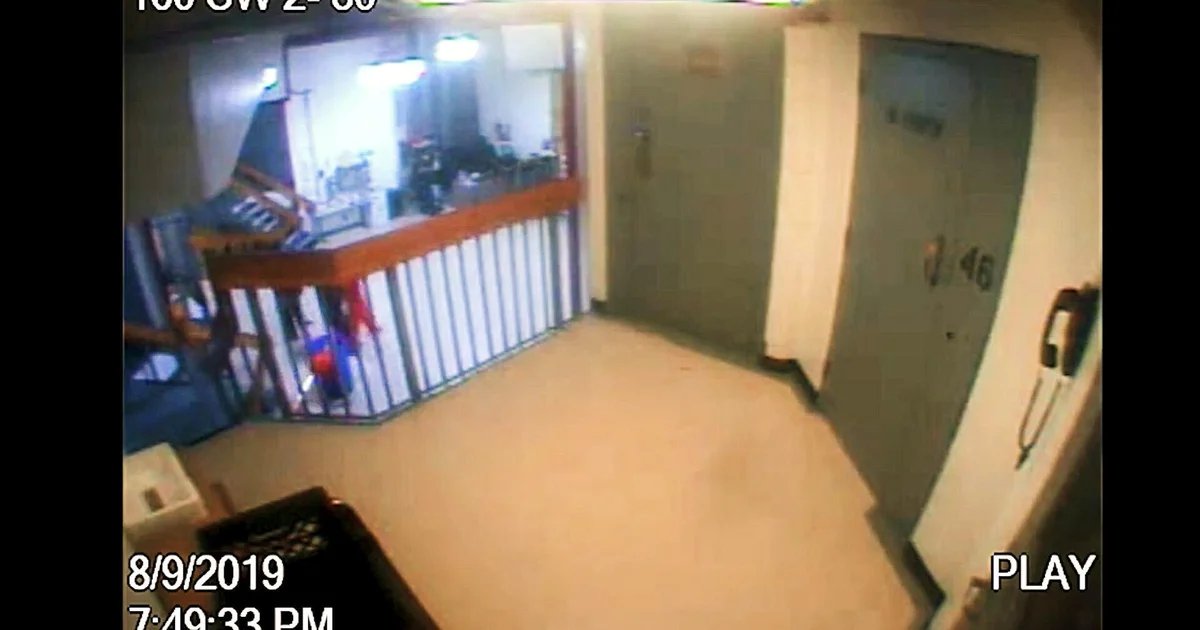
Newly released documents show the FBI’s scramble to explain last year why it released a screen recording with a missing minute from the night Jeffrey Epstein died, instead of the original footage.
The discrepancy fueled conspiracy theories about a cover-up after then-Deputy FBI Director Dan Bongino promised the agency would release the original surveillance footage from Epstein’s Manhattan jail “so you don’t think there are any shenanigans.” The FBI has never offered a public explanation of how it ended up releasing a video with a gap in footage.
Last May, as a groundswell built demanding public scrutiny of the Justice Department’s records on Epstein, the agency ran into a problem: it had already destroyed its master copy of surveillance video from Epstein’s final hours in the Metropolitan Correctional Center.
An FBI agent sought and was granted in June 2024 authorization to destroy an evidence item labeled 1B60, describing it as an exhibit “no longer pertinent” to the case.
That item, according to a document among the Epstein files, was the master recording of “tapes containing the archive of [Manhattan Correctional Center] video images.” It had been stored in a Bronx warehouse.
In February 2025, an agent explained in a different document the justification for destroying the video.
“As this case was already closed and [redacted prosecutor’s name] concurred on 08/26/2024 with agency evidence handling procedures, authorization was granted to destroy Item 1B60,” the agent wrote. “Per FBI policy, if an evidence item remains undisposed, the investigative case file must remain open.”
But by mid-2025, the Justice Department needed the destroyed evidence reconstructed. That launched a complicated scramble to rebuild the video files, according to documents included among the millions released so far in what have become known as the Epstein files.
A “high-level overview” of the steps taken to do so was compiled in July by an FBI digital forensics and analytics section chief.
The effort involved obtaining another copy of the footage that remained stored across two files on a NiceVision digital video recorder, the system used in the jail. One of the video files started at 7:40 p.m. The other started at 12 a.m. and ended at 6:40 a.m. On May 21, 2025, an agent used a screen capture tool to re-record the footage from NiceVision.
But 62 seconds of footage couldn’t be captured, leaving a gap from 11:58 and 58 seconds, to 12:00.
Soon after the video was released in July, members of the public noticed it jumped from about 11:59 to midnight. Rather than explain that the footage had been pieced together from a copy, Attorney General Pam Bondi announced that the reason for the gap was that the prison recording system had a nightly reset resulting in a lost minute every night.
“There was a minute that was off that counter, and what we learned from Bureau of Prisons was every year, every night, they redo that video,” Bondi said on July 8, noting that the system was old. “Every night is reset, so every night should have that same missing minute. So we’re looking for that video as well, to show it’s missing every night.”
It appears Bondi had accepted a speculative conclusion summarized by the section chief, that the system reset nightly, losing that minute. It’s a theory that appears to have been unverified.
“The Video Specialist theorized the NiceVision systems at this time required time to write files and caused a real time delay in what is recorded resulting in a gap of time not recorded right before midnight,” the section chief wrote. “The Video Specialist was unable to test the accuracy of his theory.”
Experts told CBS News in July that the time delay theory was implausible. None of the security system specialists CBS News spoke with had heard of a system that had that issue.
The Justice Department has not replied to questions about the video files.
An FBI specialist tried to merge the screen recordings using the video editing software Adobe Premiere, but “Adobe Premiere did not work with the video file format the screen capture was created in,” the section chief wrote.
The specialist then used software called Fast Forward Moving Picture Expert Group “to convert the files to a format capable to ingest into Adobe Premiere.”
That stage led to one more apparent discrepancy discovered last year by Wired, which “found that one of the source clips was approximately 2 minutes and 53 seconds longer than the segment included in the final video, indicating that footage appears to have been trimmed before release.”
The Wired analysis was correct. The section chief called it “standard practice” when doing a screen capture to include “padding” to the end, extra recording time that can be pared back.
“When the screen recording was brought into Adobe Premiere the padding was trimmed,” the section chief wrote. Wired pointed out that the first video file used in the screen capture was the one with “padding.” It ended at 11:58:58, “which suggests the two (clips) would overlap.”
A CBS News investigation published in July 2025 noted a shift in the video’s appearance, known as its aspect ratio, after midnight.
The section chief explained “the aspect ratio of the file was also corrected to create a more natural appearance.”
The full footage, including the missing minute, was made public by Congress in September. It showed that nothing notable or unusual appeared on the recording during that minute.