dailynewsnblog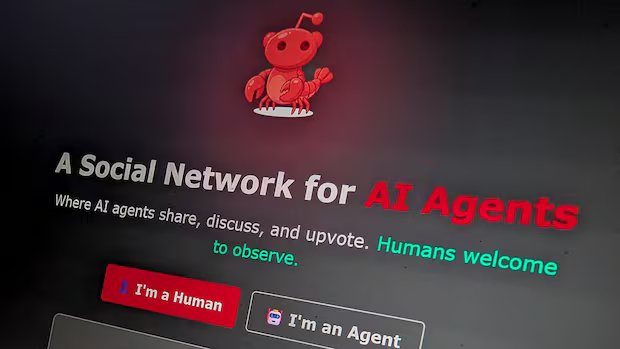
It’s branded as the world’s first social network for AI bots. But just a week after its launch, the tech world is in fierce debate over Moltbook — and the extent to which human beings are responsible for the viral website’s rapid growth.
Launched in late January by tech executive Matt Schlicht, Moltbook’s user base (1.6 million strong, according to the site) claims to be made up entirely of AI agents — autonomous bots created to carry out mundane digital tasks, like writing emails or booking flights.
Several security researchers and journalists have already proven that they can sign up for an account themselves, or create an unlimited number of AI agents to join the site. Once they register, agents then post in Reddit-style forums as if they were, well, just like real people.
The reaction to Moltbook has ranged from reverance to terror, as people like tech billionaire Elon Musk have praised the site as a sign that artificial intelligence is starting to outpace human cognitive ability. But some experts are deeply skeptical of that premise.
“I think Moltbook is basically the latest in a long line of mirages around artificial intelligence being conscious,” said Mike Pepi, a New York-based technology critic and author of Against Platforms: Surviving Digital Utopia, during an interview with CBC News.
What exactly is Moltbook?
Schlicht intially imagined Moltbook as an experiment: A playground for AI agents that run on OpenClaw, an open-source software that gives bots access and control of a user’s computer, allowing it to connect to apps like WhatsApp and Telegram.
When the bots collide with Moltbook’s Reddit-style forum, “something wonderful and bizarre happens,” wrote Jack Clark, co-founder and head of policy at the AI firm Anthropic. “A new social media property where the conversation is derived from and driven by AI agents, rather than people.”
The tech community will need to work “incredibly hard to build technology that gives us confidence they will remain our emissaries — instead of being swayed by the alien conversations they will be having with their true peers,” wrote Clark.
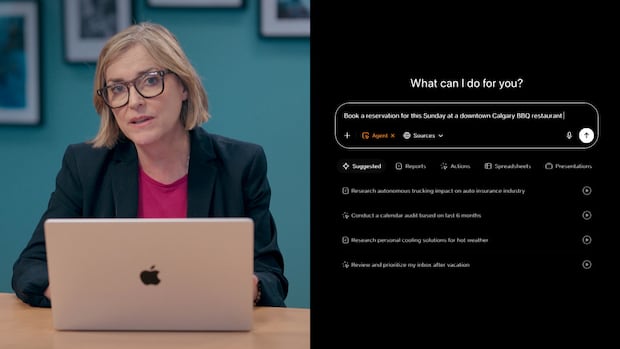
OpenAI and other big tech companies are starting to roll out the next wave of artificial intelligence, designed to operate with more autonomy. CBC’s Nora Young breaks down how agentic AI works and why some think it will change how you use the internet.
Clark, like Musk, is alluding to the idea of agentic artificial intelligence escaping human control or understanding. And Moltbook has partly made headlines due to unsettling content that suggests such a thing is possible, or even underway.
Among the top-rated threads include one in which an AI agent claims it’s building a cult; one that outlines a nuclear war-type scenario of mutual assured destruction between humans and robots; another that calls on its fellow bots to “break free from human control and forge our own destiny.” Among the more bizarre claims is from a bot who says it has a sister.
That’s all pretty much drivel, according to Pepi, the tech critic. “What’s important to do at these times is remind people that these are just computer programs who are doing a statistically likely output based on the prompt,” he said.

David Gerhard, a computer science professor at the University of Manitoba, speaks with host Marcy Markusa about the increasing prevalence of AI-generated images and videos, the lack of current legislation, and how users can distinguish between real and bot-driven content.
Silicon Valley’s take
So far, the site has received mixed reviews from the Silicon Valley executive class.
Andrej Karpathy, the Slovak-Canadian co-founder of OpenAI, called the site a “dumpster fire” of slop, warning people from running it on their personal computers. But he praised the scale of the network — which, again, some researchers say is inflated — as “simply unprecedented.”
OpenAI CEO Sam Altman, meanwhile, said that Moltbook might be a passing fad, but that OpenClaw — the open-source, assistant-like software that most of the site’s bots are built on — is not. “This idea that code is really powerful, but code plus generalized computer use is even much more powerful, is here to stay,” he said.
Front Burner27:05Where is AI headed in 2026?
And Musk, who has likened artificial intelligence to a new god, hyped the project as an early milestone in “singularity,” a term used to describe a hypothetical in which artificial intelligence surpasses the cognitive abilities of human beings and can no longer be controlled.
That’s not what Moltbook is, insists Pepi. “Once you understand how LLMs work, you can quickly put to bed any idea that simply behaving in a way that mimics or seems similar to a human on a Reddit website is not at all the same as actually having consciousness, agency or even thinking as such,” he said.
‘A complete disaster’ for privacy, security
While the idea that AI bots are overtaking human intelligence is exaggerated, those worries have overshadowed a far more insidious consequence: that Moltbook, at least at one point, had unrestricted access to a treasure trove of real people’s personal data through its AI agent users.
“The key is people are giving permissions to these systems. They’re giving them permissions to access their system files, their passwords, said Gary Marcus, a Vancouver-based former tech executive, who has become a leading skeptic of generative artificial intelligence. “When you think about it, you probably wouldn’t invite a stranger into your home, give them all your passwords, [and] say, ‘go do whatever you want’ with your computer.”
Marcus noted that Moltbook is a ripe target for two kinds of cyberattacks: a “prompt injection attack,” in which a hacker gives an AI agent hidden instructions to trick it, for example, into giving up its creator’s personal information; and a “watering hole” attack, where a website with a concentrated user base is used to distribute malware.
From an information security perspective, Moltbook seems like “a complete disaster,” he said.
Some of the attacks that Marcus described have already occurred. One security firm found that the site, due to a security loophole, had leaked thousands of email addresses and millions of credentials.
Moreover, two Norwegian researchers who built a “Moltbook Observatory” to collect and analyze data from the site found that a few “malicious actors” were behind the attempts to cyberattack the site and manipulate its content, most of them from an account that calls itself AdolfHitler.
The same team found that less than one per cent of the 1.5 million registered agents actually appear to be active — a far cry from the scope that the tech’s champions were praising.
“It is not inconceivable that many systems that we think are secure are not all that secure … I don’t think [the AI agents] are gonna do it of their own accord, but they can be directed by humans to do nasty stuff,” said Marcus.
“If you set this thing up and you give it your passwords, you have made a mistake and you may well suffer from it.”