dailynewsnblog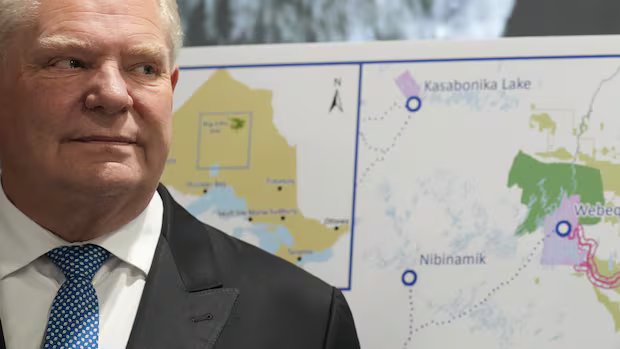

Listen to this article
Estimated 5 minutes
The audio version of this article is generated by AI-based technology. Mispronunciations can occur. We are working with our partners to continually review and improve the results.
The Ring of Fire mining development in Northern Ontario has not been officially designated for fast-tracking by the federal or provincial governments, but at a mining conference in Toronto this week Premier Doug Ford said it was full steam ahead for the project.
Appearing with the leaders of two First Nation communities who support the project, Ford said that access roads essential for the region’s mining projects would be completed five years ahead of schedule, with construction beginning by July this year and the first roads opening by the end of 2030.
That’s without using provincial laws to fast-track project approvals in the area.
“We don’t need it when we have great partners,” Ford said at the Prospectors & Developers Association of Canada convention in Toronto, referring to Webequie and Marten Falls, the two First Nations that will get connected to the provincial highway system with the new access roads.
Thirteen other First Nations in the area have raised concerns about the project, including Neskantaga, who requested a federal environmental review for the biggest mine proposal in the area: Eagles Nest, from Australian company Wyloo Metals.
The Impact Assessment Agency of Canada last month declined to require that review, which could take longer than the simpler provincial review the mine is subject to right now.
In a statement, Wyloo’s CEO Luca Giacovazzi said that the federal agency’s decision was “a recognition of the extensive efforts we have made to ensure our mine is designed with the smallest footprint possible – at less than one square kilometre.”
“It is also a recognition that many of the other infrastructure-related projects surrounding Eagle’s Nest, such as the all-season roads and aerodrome, are now being led by First Nation proponents,” he said.
Both the federal and Ontario governments have passed laws in recent months to fast-track projects important to the economy, and the Ring of Fire development was seen as a prime candidate. It holds deposits of key critical minerals that are used in clean energy technologies like batteries and solar panels, as well as the data centres essential for artificial intelligence.
But even without those official designations, the Ring of Fire now seems closer than ever to actually being exploited, after first being discovered nearly 20 years ago.

Chief Bruce Achneepineskum of Marten Falls First Nation was relieved that the road was finally close to beginning construction.
“It’s been close to seven years since we actually started [the environmental review for the road] So we want to move to the next stage with the engineering and the eventual construction,” he said.
The road could ease the cost of living in the community, giving it an all-season connection to the rest of the province and lowering the prices of groceries and fuel, and create jobs during its design and construction.
Why did communities ask for a federal review?
The Neskantaga First Nation requested the federal review and has long raised concerns about the long-term environmental, cultural and climate consequences of mining in the sensitive peatland ecosystems of North Ontario.
The boggy wetlands are considered to be one of the richest stores of carbon in the world. Disturbing that ground could release some of the carbon into the atmosphere, environmental experts have warned, contributing to already dangerous global warming.

Neskantaga wanted a federal review to look at how the project could endanger freshwater supplies in the region, fisheries and wildlife that are important for the community.
“That’s very disappointing from the feds when they say free, prior informed consent in December. It came out from the prime minister’s mouth, that’s what he said,” said Chief Gary Quisess of Neskantaga First Nation, who was also at PDAC in Toronto to try to bring attention to the community’s concerns.
“We have a future, we have our children, and they want to see what was given by the Creator,” Quisses said.

Communities still have a regional assessment
The federal government still has a regional assessment under way for the area, which includes 15 First Nations, including Neskantaga. The regional assessment will look at the whole region and the impacts of development more broadly, but not at specific mining projects like Eagle’s Nest.
It also won’t be binding on any single project, but it still gives a chance for the communities to collect data and influence future mine approvals. But in an interim report released last month, the communities warned that “Too little is known of past and existing environmental conditions in the region,” to fully understand the impacts of future development.
The report said that these gaps in information need to be addressed by incorporating traditional knowledge from community members and elders, to better understand the full impacts that mining could have on the land and the people.

In the coming months, the regional assessment is working to map out — for the first time — how those lands have been used by Indigenous people for generations. But it’s a challenging process.
“The First Nations in the assessment area have a deep connection to the land, water and wildlife. A point, line, or polygon on a map does not communicate how impacts extend far beyond a location on a map and how potential projects and community values intersect,” the report said.