dailynewsnblog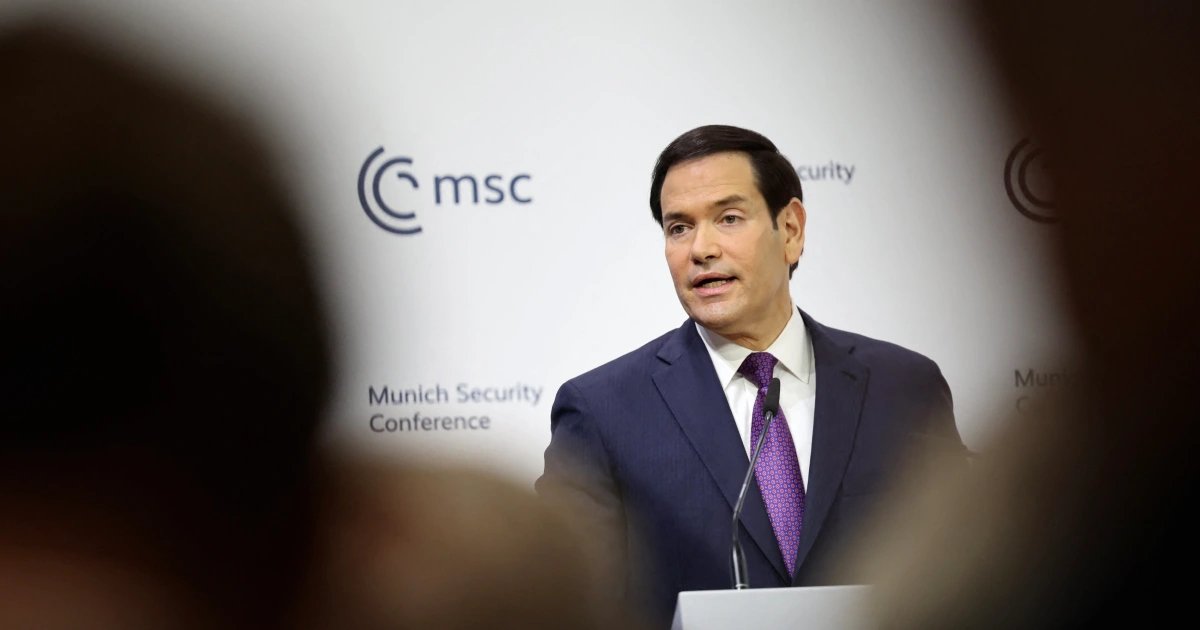
Secretary of State Marco Rubio sought to paper over cracks in the relationship between the U.S. and Europe in a speech at the Munich Security Conference, though foreign diplomats were less convinced that real change would follow.
His direct appeal to Europe on Saturday is a marked change from President Donald Trump’s disparagement in Davos last month, where the leader claimed parts of Europe were being “destroyed” and said the U.S. had “never gotten anything” from the NATO alliance.
Rubio received a standing ovation for his warmer words in Munich, telling the largely European audience “in a time of headlines heralding the end of the transatlantic era, let it be known and clear to all that this is neither our goal nor our wish, because for us Americans, our home may be in the Western Hemisphere, but we will always be a child of Europe.”
In a speech aimed at reducing tensions stoked over Greenland and threats of further tariffs, America’s top diplomat said the U.S. is not abandoning its oldest allies.
“The United States of America will once again take on the task of renewal and restoration, driven by a vision of a future as proud, as sovereign and as vital as our civilization’s past,” he said. “And while we are prepared, if necessary, to do this alone, it is our preference, and it is our hope to do this together with you, our friends here in Europe. For the United States and Europe, we belong together.”

The conference’s chairman, former German Ambassador to the U.S. Wolfgang Ischinger, who had opened the gathering Friday with harsh criticism of the administration’s policies, praised Rubio from the stage, telling him, “You heard a sigh of relief to what I interpret as a message of reassurance about our partnership.”
Rubio’s speech was notably more diplomatic than Vice President J.D. Vance’s harsh attack on European culture and politics at the same event one year ago. European leaders were relieved that the White House decided to send Rubio to the event, which in the past has usually been attended by vice presidents.
But Democratic senators and some foreign diplomats in the hall were skeptical that the speech reflected any real change in the Trump administration’s stance.
Rubio strongly criticized Europe’s migration and climate policies in his speech, warning that “unprecedented” levels of mass migration threaten “the cohesion of our societies, the continuity of our culture and the future of our people.”
He also hit out at what he sees as the failures of the United Nations, saying the body has “played virtually no role” in major world events from Gaza to Ukraine as he defended U.S. interventions in Venezuela and Iran.
He said the U.N. “was powerless to constrain the nuclear program of radical Shia clerics in Tehran that required 14 bombs dropped with precision from American B-2 bombers, and it was unable to address the threat to our security from a narco-terrorist dictator in Venezuela. Instead, it took American special forces to bring this fugitive to justice.”
Rubio was due to meet briefly on Saturday with Ukraine’s President Volodymyr Zelenskyy, who has already met with the large bipartisan U.S. Senate delegation.
Speaking in Munich on Saturday, Zelenskyy said that Russia was paying a high price for the war in troop casualties and expressed hope about bringing an end to the conflict, though he said it often feels like the sides are talking about “different things” during negotiations.
Rubio said Saturday that “we don’t know” if Russia is serious about ending the war, telling the conference: “The good news is that the issues that need to be confronted to end this war have been narrowed. The bad news is they’ve been narrowed to the hardest questions to answer.”
Last night Trump again put the burden on both sides, telling reporters, “It takes two to tango.”