dailynewsnblog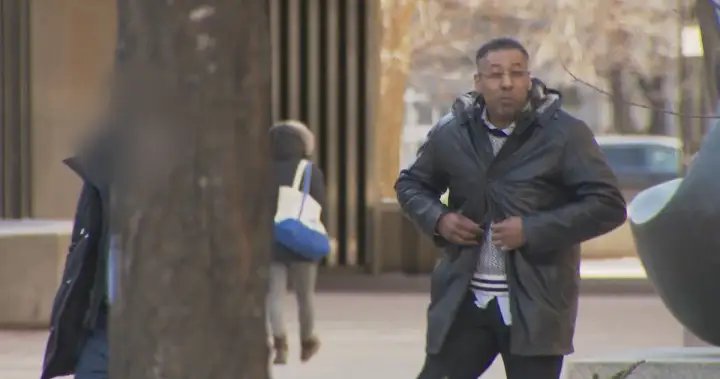
A man found guilty of kidnapping a 14-year-old Toronto boy over his half-brother’s drug debt that triggered a province-wide Amber Alert has been sentenced to 11 and a half years in prison.

Samir Abdelgadir, 45, stood up and waved to his friend as he was handcuffed and led out of a downtown courtroom Thursday after Superior Court Justice Sandra Nishikawa handed down the sentence. Abdelgadir was tried by judge alone.
On March 4, 2020, the boy, whose name is protected by a publication ban, was kidnapped shortly after leaving his home to go to school on Driftwood Court near Jane Sreet and Finch Avenue.
Three men grabbed the boy and forced him into a Jeep as he screamed and struggled to resist. Two other vehicles, a white Mercedes and a black Tahoe, accompanied the Jeep to and from the Driftwood Avenue complex where the teen was kidnapped.
The boy was driven to a vacant house on Edgeforest Road in Brampton where he was bound and blindfolded.
At trial, the teen’s half-brother admitted that he had stolen 90 kg of cocaine from people for whom he worked. While the teen was held at the house, the kidnappers called and sent messages to the half-brother demanding that he return the cocaine that he had stolen.
Thirty-six hours after the teen was taken, he was released in a vacant lot in Caledon, where he was later located by police. The Jeep was found near the Forks of the Credit in Caledon. Two men admitted to setting the Jeep on fire but testified at trial that they believed it was for an insurance fraud scheme.
Nishikawa found that Abdelgadir was an associate of kilogram-level traffickers named Giovanni Raimondi and Scott McManus. She called it a “coordinated, planned event among a number of individuals.” The half-brother testified he regularly delivered cocaine to Abdelgadir.
“As one of the principals of the drug operation, Mr. McManus had a strong motive for the kidnapping,” the judge said.
“I did not find that Mr. Abdelgadir was the mastermind of the plot to kidnap the teen and hold him for ransom for the return of 90 kilograms of stolen cocaine or the proceeds thereof. I found that Mr. Abdelgadir knew in advance of the plan to kidnap the teen that morning and drove the Tahoe as backup at the ready, to assist if needed.
“He played an integral role in the kidnapping, which is a continuing offence, by ensuring that it took place. After the teen was forced into the Jeep, Mr. Abdelgadir drove away from Driftwood Avenue in tandem with the Jeep and the Mercedes. He did not drive to the house on Edgeforest where the teen was eventually held. At no time, did Mr. Abdelgadir attempt to assist the teen regain his liberty.”

Get breaking National news
Get breaking Canada news delivered to your inbox as it happens so you won’t miss a trending story.
She pointed out that four days after the kidnapping, Abdelgadir met with one of the two men who set the Jeep on fire.
“I found it was reasonable to infer that the meeting was to discuss damage control, including the destruction of the Jeep.”
The judge noted the harmful and lasting impact that the kidnapping had on the boy and his family, as outlined in their victim impact statements.
Nishikawa said the teenaged boy described how his life completely changed from one day to the next. After the kidnapping, the teen could not sleep on his own, because when he tried to sleep, he relived every detail of the abduction.
“He has difficulty finding words to describe the experience, stating, ‘There was so much aggression directed towards me that I thought I was going to die and that feeling has never left me,’” Nishikawa said.
The teen’s mother also passed away after the kidnapping before the trial and said his support system has been lost. The teen’s mother said in his victim impact statement that his son’s kidnapping made him feel that he failed in his mission to protect him, and that he does not know how to repair that.
In considering her sentence, Nishikawa took into account Abdelgadir’s lack of criminal record, an impact of race and culture assessment (IRCA) that was done, a pre-sentence report, and aggravating and mitigating factors.
Abdelgadir was born in North Sudan into a Muslim family. When he was 19, he moved to Mississauga where he lived with his aunt and later with his mother. He moved to Hamilton where he attended McMaster University and served as vice-president of the African-Caribbean Association. He lost his father’s financial support during this time.
According to the author of the pre-sentence report, Abdelgadir turned to selling marijuana after being unable to find employment. He also reported being harassed by police in Hamilton.
The IRCA report states that Abdelgadir has been imprisoned up to 20 times for long periods of time on previous charges, including drug possession, cocaine possession and curfew violations.
In the report, Abdelgadir emphasized that his stagnation was not the result of lack of ambition or ability, but rather the consequence of systemic racism, repeated police targeting, and unjust criminalization that disrupted his educational and employment trajectory.
The IRCA report states that Abdelgadir blames the current charges on systemic racism and police targeting.
The author of the pre-sentence report notes that Abdelgadir does not accept responsibility for the offence and believes he was unfairly prosecuted. “He is described by the Officer as ‘reluctant or unable to consider the impact his behaviur has had upon others,’” said Nishikawa.
The Crown had asked for a 16-year penitentiary sentence whereas defence suggested a five-year sentence would be more appropriate.
Nishikawa pointed out that the mandatory minimum for kidnapping involving a person under 18 years old is five years. The maximum sentence is life imprisonment.
The judge noted that the teen was taken as leverage to extort from his half-brother either the return of the stolen drugs or repayment.
“It is an agreed fact that the teen heard the driver tell the person in the backseat that if the teen moved, he should shoot him. I find that the teen believed that the men who kidnapped him had a firearm. However, based on the evidence before me, I cannot find beyond a reasonable doubt that a firearm was used,” said Nishikawa.
Nishikawa found it aggravating that the victim was a 14-year-old Black boy in Grade 9, living in an economically disadvantaged neighbourhood. The teen was not involved in the drug trade nor any other illicit conduct.
She also noted that the parents did not know their son was missing until after school because school authorities failed to report his absence to his parents. As a result, the parents did not contact police until over nine hours after the teen had been kidnapped.
“The harm caused to the teen is immeasurable. His life changed forever the day Mr. Abdelgadir and others decided to kidnap him as leverage for his brother’s actions,” said Nishikawa.
The judge noted that while Abdelgadir expressed sympathy to the teen at the sentencing hearing with the harm caused and the loss of his mother, he continues to deny his involvement in the kidnapping.
“Needless to say, Mr. Abdelgadir has not expressed remorse. I note that a lack of remorse is not an aggravating factor but the absence of a mitigating factor,” she concluded.
After subtracting enhanced credit for 260 days spent in pre-sentence custody, harsh conditions spent in pre-sentence custody and credit for time spent living under house arrest, Abdelgadir has 9.5 years left to serve on his sentence.
The teenaged boy and his family were not in court Thursday.