dailynewsnblog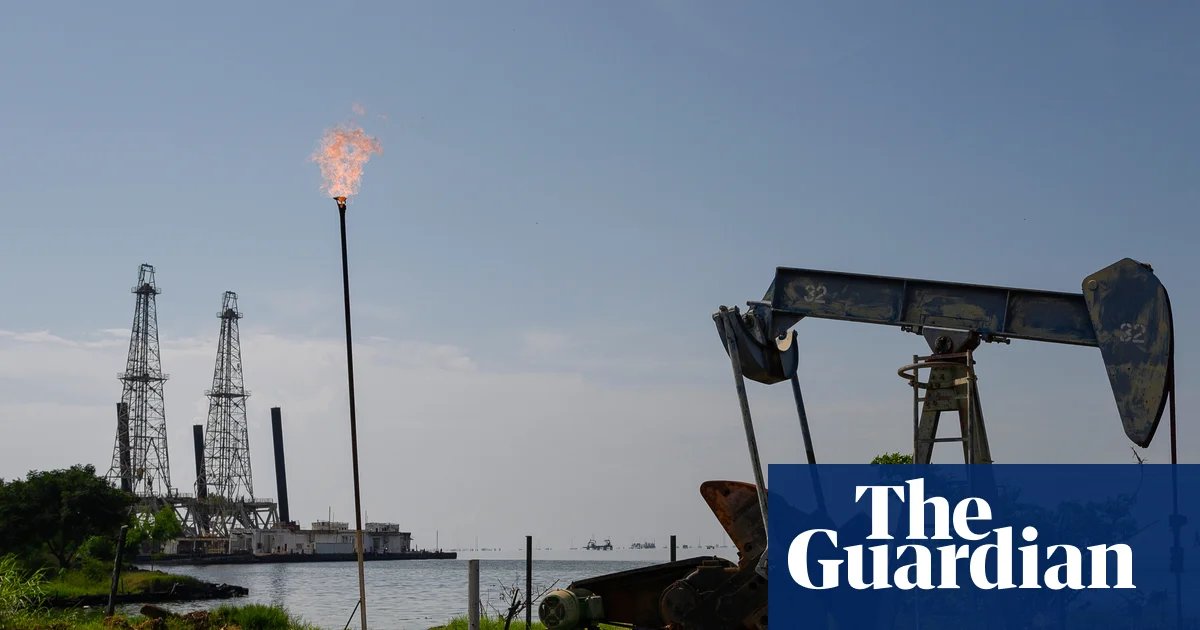
Venezuela’s dictator, Nicolás Maduro, says the real motive behind the massive US military buildup in the Caribbean is oil: his country has the largest proven reserves in the world.
The US state department denies this, insisting that the airstrikes on boats that have killed more than 80 people and the vast military deployment off South America are part of a campaign against drug trafficking.
Either way, Donald Trump seems bent on regime change in Venezuela – a country whose main allies are China, Russia and Iran, and one that has endured a deep economic collapse that triggered the region’s largest migration crisis.
However, Trump has proved happy to reach an understanding with authoritarian leaders elsewhere, and airstrikes on small boats in the Caribbean are unlikely to have much impact on the flow of drugs – most of which enter the country through Mexico – leading critics of the US president to conclude that there must be another motive at work.
Colombia’s leftist president, Gustavo Petro – who is himself in an increasingly bitter feud with Trump – has described the three-month campaign against Caracas as “a negotiation about oil”, arguing that Trump “is not thinking about democratising Venezuela, much less about drug trafficking”.
But analysts familiar with how Venezuela’s oil sector operates say it is not that simple.
“I think oil may be one of the motivations [of the military buildup], but not the main one. It’s just part of the picture,” said Francisco J Monaldi, director of the Latin America Energy Program at Rice University’s Baker Institute for Public Policy, in Houston.
First of all, “Venezuela is a very small player at this point,” he said.
The country has almost a fifth of all known global reserves – but it accounts for less than 1% of world production. Most of Venezuela’s reserves are “heavy sour” crude, which is more difficult and expensive to extract. Meanwhile, its oil sector has been hamstrung by decades of corruption, mismanagement and underinvestment.
Monaldi estimates that current output of just under 1m barrels a day could rise to 4m or even 5m a day – but doing so would require about $100bn in investment and would take at least 10 years.
After a strike by oil workers in the early 2000s, Maduro’s predecessor and mentor, Hugo Chávez, dismissed large numbers of workers at the state-owned Petróleos de Venezuela Sociedad Anónima (PDVSA) and consolidated government control of the company.
His government later decreed that PDVSA must hold at least 51% ownership and operational control of all exploration fields, driving away multinationals that had long operated in the country, such as ConocoPhillips and Exxon-Mobil.
Production then went into a steep decline, especially after the US, during Trump’s first term, imposed sanctions banning imports of Venezuelan oil. Joe Biden eased those restrictions in the hope that Maduro would allow a democratic transition, but after last year’s elections – widely believed to have been stolen by Maduro – Trump reinstated the sanctions
Even during sanctions, however, the US-based oil giant Chevron never fully suspended its operations in Venezuela, maintaining them albeit at drastically reduced levels.
Trump revoked Chevron’s licence, but reversed course in July, ordering that instead of being transferred to Maduro’s regime royalties should be used to cover operational costs and pay down a longstanding Venezuelan government debt to the US company.
Although the Maduro regime’s lack of transparency is reflected in the oil sector, analysts estimate that PDVSA currently holds 50% of operations; Chevron, 25%; 10% is in joint ventures led by China; 10% by Russia; and 5% by European companies.
Since Trump’s recent easing of restrictions, Chevron has been importing between 150,000 and 160,000 barrels a day to the US.
“I believe the main beneficiary of a political change in Venezuela would be Chevron,” said José Ignacio Hernández, a legal scholar and researcher of Venezuela’s oil industry who works with the consultancy Aurora Macro Strategies.
But Hernández, who was a member of Juan Guaidó’s team, when the opposition figurehead declared himself interim president in 2019, also rejects the idea that oil is the main focus of the US campaign.
“The oil sector in Venezuela is destroyed … It’s not an attractive market in the short term, especially for a country like the US, which already has the world’s largest production,” he added.
Hernández pointed to recent reports that during talks with US envoys, Maduro offered to open up all existing and future oil and gold projects to US companies. “If Trump wanted to strike a monopoly deal over Venezuela’s oil, he would have accepted Maduro’s offer,” said Hernández.
Monaldi said that even if there were a change of regime and a US-backed candidate took office, the final decision on whether to invest in Venezuela’s oil would ultimately lie with the companies, which would weigh political and economic stability above all.
“Venezuela has massive resources, a lot of infrastructure and fields that are already developed; one would not go there and explore from scratch … But, at the same time, there are tons of potential obstacles: the political risks, the country’s history, the fact that the oil is less valuable,” he said.
“So the obstacles are mostly above ground.”