dailynewsnblog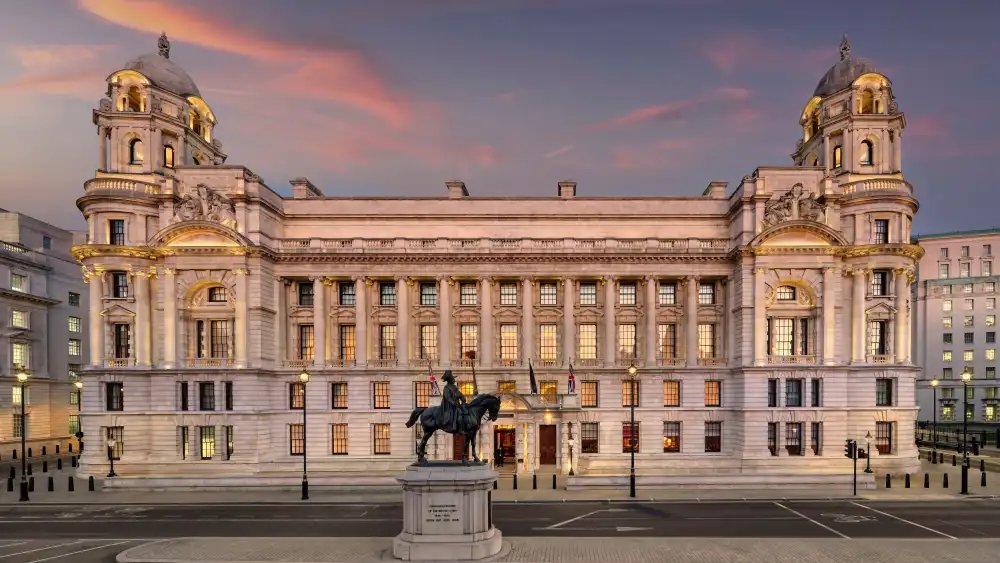
If these walls could talk.
Destinations that once required top-secret security clearance are on the rise among well-heeled travelers. The cell blocks where convicted anarchists Nicola Sacco and Bartolomeo Vanzetti were once imprisoned, the old offices where Winston Churchill plotted Britain’s defense during the World Wars and the Vietnam War bunker that allegedly protected actress and activist Jane Fonda are just a few of the unique locations that now serve as some of the world’s more intriguing luxury hotel properties.
As the hospitality world embraces a new, golden age of travel, high-end chains and boutique hotels are catering to an insatiable sense of adventure among seasoned travelers by marketing spaces that have an incredible backstory including old prisons, embassies, central banks and government ministries that have become enticing real estate ventures for developers and hoteliers alike.
Charlotte Dent, head of product at London-based luxury travel tour operator Scott Dunn, says there is strong demand for destinations with historical underpinnings.
“The reason our guests love these properties is due to the romance in sleeping where history was made. These conversions, whether former embassies or government buildings, offer guests a sense of place and narrative that newer hotels cannot replicate,” Dent said.
Adding, “Guests love seeing the original architecture, and the feeling of stepping into a part of the past. It creates an emotional resonance that today’s travelers, especially those seeking authentic, Instagram-worthy experiences, deeply crave.”
Jennifer Rubinstein, a luxury travel adviser at Embark Collectives, agrees that the enthusiasm for historic sites, ones often shrouded in mystery, is due to a craving for a deeper experience and compelling storytelling.
“The appeal isn’t about these places being spooky — it’s about them being genuinely interesting and authentic. This trend extends beyond hospitality into other areas like fashion, where people often gravitate toward vintage handbags or jewelry with rich histories rather than mass-produced items.”
Raffles London at the OWO, The Old War Office

Raffles London
Courtesy of Raffles London at the OWO
In 2023, the U.K.’s Old War Office became home to Raffles Hotels & Resorts London location. Originally designed as a testament to Britain’s military prowess by William Young in Edwardian Style at the beginning of the 20th century, it once housed 2,500 military and government officials, including Winston Churchill who worked in the building between 1919 and 1921 as Secretary of State for War.
The ebullient statesman’s former office is on the site where the Palace of Whitehall once stood before being destroyed by a fire in the 17th century, and has become the Churchill Suite, part of a majestic property that now features a Guerlain Spa, fine dining facilities and the well-named Spy Bar — an homage to the spies who occupied two former rooms that were numbered 006 and 007 in the early 20th century. The rooms also functioned as high security storage vaults for identity papers and mission reports of MI5 and MI6 agents.

Inside the Old War Office during the first half of the 20th century.
The Imperial War Museum
Hoshinoya Nara Prison, Japan

The entrance of the Nara Prison where Hoshino Resorts has created guest rooms by turning prison cells into a sanctuary.
Courtesy of Hoshinoya
A night in prison will take on a whole new meaning when Hoshino Resorts opens its latest property in the converted Nara Prison in April. Designed by Keijiro Yamashita, the prison first opened in 1908 during the second half of the Meiji period, also known as Japan’s industrial heyday. Most of the construction work was carried out by prisoners, and the bricks used were supplied from kilns they built themselves. It will feature 48 suites, including an expansive suite comprised of 10 solitary cells integrated into one space. The new hotel is near Nara Park, home to the magical sika deer. Known to bow to tourists in exchange for crackers, the sika deer is believed to be divine messengers for more than 1,300 years and are protected as natural monuments.
The Sofitel Legend Metropole Hanoi, a Vestige of the Vietnam War

Poolside at the Sofitel Legend Metropole Hanoi.
Courtesy of the Sofitel Legend Metropole Hanoi
The Sofitel Legend Metropole Hanoi was originally founded as the Grand Métropole Hotel at the start of the 20th century. In 1899, a French entrepreneur named Gustave-Émile Dumoutier petitioned Hanoi’s local government, then a colonial possession of France, to develop a stately hotel on the corner of Henri-Rivière boulevard. In the years that followed, the Grand Métropole Hotel subsequently hosted a roster of prominent visitors, including famous actors such as Charlie Chaplin, who reportedly spent his honeymoon there. The historic Vietnamese revolutionary Ho Chi Minh is said to have used the hotel as a covert meeting spot during the First Indochina War. A bomb shelter that once protected famous visitors like Joan Baez and Jane Fonda from air raids during the Vietnam War was closed after conflict but was later rediscovered during the renovation of the Bamboo Bar in 2011. It reopened in May 2012 and is now open for tours.
The Liberty Hotel, Formerly Boston’s Charles Street Jail

The Liberty Hotel Boston
Courtesy of The Liberty Hotel
The Liberty Hotel is a 298-room luxury hotel located in Boston’s charming Beacon Hill neighborhood. The now upscale address was built in 1851 at the historic Charles Street Jail. At the turn of the century, the prison reportedly housed convicted anarchists Nicola Sacco and Bartolomeo Vanzetti (whose conviction remains debated to this day) and Mayor James Michael Curley, who was once convicted of fraud. Closed in 1990, the landmark reopened as a hotel in 2007 after a major revamping, which features 18 original cells, and today the property is managed by the Marriott Luxury Collection. A hot spot for the city’s fashionable set, the hotel is also known for its fine dining establishment Clink that features the historic structure’s original brick walls and jail cell facades.
The Chancery Rosewood, London, the Former U.S. Embassy

The Chancery Rosewood is set within the historic former U.S Embassy on Grosvenor Square in London.
Courtesy of Rosewood Hotels
Top-secret security clearance is needed no more to enter the Grosvenor Square shrine to cross-Atlantic diplomacy. Originally designed by modernist Eero Saarinen and home to the U.S. Embassy, the Chancery Rosewood was recently revived under the vision of David Chipperfield Architects. Today the brutalist-inspired facility features 144 suites, designed by Paris-based Joseph Dirand.
The site where U.S. relations with the U.K. were executed for much of the 21st century now boasts eight bars and restaurants and a dynamic rooftop bar with room for 300 to dine al-fresco. It was opened as a hotel in September 2025, and while the classified documents have been removed, a vestige of America’s prowess remains in the form of a golden eagle sculpture crafted from aluminum from B-52 fighter jets.
The Corinthia Rome, the Former Central Bank of Italy

The site of the Corinthia Rome, the former Bank of Italy.
Courtesy of Corinthia Hotels
The site where the Maastricht Treaty was discussed and the euro was debated, the historic site of Italy’s central bank, the Bank of Italy, will open its doors once more — this time as a Corinthia Rome hotel. Situated in Piazza del Parlamento, the landmark destination will open in February.
Built in 1914 by architect Marcello Piacentini, the building served as a prominent financial institution for much of the 20th century. It was bought by the Reuben Brothers in 2019 and spans 9,700 square meters over seven floors. Original features such as marble panelling, frescoes and carved wood have been carefully preserved and new interiors have been envisaged by G.A. design firm for its 60 rooms including 21 suites and a spa located in the former bank’s vault. The opening will also usher in arrival of famed chef Carlo Cracco to the Eternal City.

Inside the new Corinthia Rome.
Courtesy of Corinthia Rome
The Four Seasons Hotel Istanbul at Sultanahmet, the Ottoman Capital’s First Jailhouse

The Four Seasons Hotel Istanbul at Sultanahmet
The Four Seasons Hotel Istanbul at Sultanahmet
“There is no water as important as the water of life,” reads the verse of a Sufi poem written on a fountain outside the Four Seasons Hotel Istanbul at Sultanahmet. The verse is a somber reminder of the luxury property’s shadowed past. It was the Ottoman capital’s first prison and was designed by Mimar Kemaleddin Bey in 1918 and remains an example of Turkish neoclassical architecture.
Novelists such as Orhan Kemal, Kemal Tahir, Sebahattin Ali, Necip Fazıl Kısakürek, Aziz Nesin, as well as American Billy Hayes, the author of “Midnight Express,” were among its famous guests, although the latter reportedly stayed there for just one night. After the coup d’état in 1980, the building reopened as a military jailhouse for political prisoners. In 1996, the Four Seasons turned the property into an urban oasis, with breathtaking vistas and floral paths. Its privy balconies overlook the Bosphorus river and sit just steps away from the blue Mosque and the Hagia Sophia.

The Four Seasons Hotel Istanbul at Sultanahmet
Courtesy of The Four Seasons Hotel Istanbul at Sultanahmet