dailynewsnblog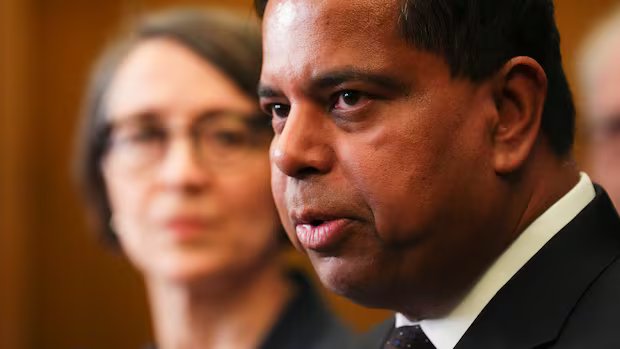
David Hicks has been trying to get rid of his father’s rifle — but hasn’t had much luck telling the federal government that.
“It’s very frustrating,” said the Ottawa man. “If they’re going to do it, they need to do it properly.”
Executor of his father’s estate, Hicks has been trying to declare the semi-automatic firearm he inherited with the Liberal government’s banned gun compensation program. He wants to be in compliance with the law — and get some money for his widowed mother.
Hicks said he called when the program first opened in January — and followed up multiple times in the two months since with little response. He said he was initially told that as an executor for an estate he had to go through a different process and would be contacted within 10 business days — which came and went.

“Eventually someone did contact me and said that they would send me some paperwork to fill in to presumably register for the program. That was over a month ago. Nothing arrived,” Hicks said.
As he waited, he watched the deadline to declare go by. Owners of any of the 2,500 banned makes and models had until March 31 to sign up if they want to be compensated.
“It just seems preposterous that they set up the program, they want to take these things off the streets. And here I am willing, able, wanting to participate,” he said.
“I’ve tried many times. I’ve talked to many people, talked to my MP and here I am, the day after the program ended and still no success.”
Lower than budgeted-for numbers
Hicks’s frustrations are far from the only ones aimed at the program, which has so far seen low uptake, pushback from gun owners and provincial governments and some police forces declining to take part.
The federal public safety minister’s office said more than 67,000 assault-style firearms have been declared by 37,869 firearm owners across Canada.
That’s just under half of the 136,000 firearms the government had budgeted for when it set aside aside $248.6 million for the program. The precise number of banned firearms in Canada is unknown due to the end of the long-gun registry in 2012.
PolySeSouvient, the country’s most vocal gun control advocacy group, called the uptake “disappointing though far from catastrophic.”
“This is arguably a ‘half-empty, half-full’ situation with respect to the buyback program,” said the group in a statement.
“One could infer that about half of prohibited weapons owners have ignored the calls of the gun lobby. These will be the ones that will be financially compensated, while the other half will not.”
The ban and buyback program have been the cornerstone of the Liberals’ public safety agenda, first under former prime minister Justin Trudeau and now Prime Minister Mark Carney. The government has long argued the prohibited guns are meant for warfare, not civilian use.
But the policy lacks broad support.
While generally applauded by groups like PolySeSouvient, it has faced backlash from many gun owners — including hunters and sport shooters — plus the Conservative Opposition who argue the move punishes law-abiding Canadians instead of going after criminals.
Speaking on the day of the deadline, Liberal MP Nathalie Provost — a survivor of the 1989 École Polytechnique massacre and well-known gun control advocate — put the declaration figures at the feet of the gun lobby and Conservative Party.
She accused them of sowing confusion.
“That’s a very, very big issue,” she said. “People who would have liked to register are not because they are confused.”
Tracey Wilson, vice-president of public relations for the Canadian Coalition for Firearm Rights, said it’s “typical for the Liberals to blame everybody but themselves for their failed programs.”
She said the low uptake shows gun owners are rejecting the program, not confused about it.
“I think the Liberals should go back to the drawing table and have a look at their program and figure out why it failed,” she said.
Collection phase faces hurdles
The federal government is showing no sign of doing that and instead is moving to the collection part of the program.
Public Safety Canada said it will assess declarations this month and then give instructions on how participants can make an appointment to turn in their firearms for compensation
The collection stage, expected to run from spring through early fall 2026, lacks buy-in from many local police and fierce opposition in some provinces — raising questions about whether it will accomplish the government’s goal of abolishing assault-style firearms in Canada.
Public Safety said it will dispatch mobile collection units staffed by the RCMP to regions lacking local participation.

(Alex Brandon/The Associated Press )
The premiers in Manitoba, Ontario, New Brunswick, Nova Scotia, Newfoundland and Labrador, Prince Edward Island and Yukon have all turned their back on the program.
The governments in Alberta and Saskatchewan have gone further — setting up legislative barriers essentially preventing Ottawa from collecting firearms in those two Prairie provinces.
Federal Public Safety Minister Gary Anandasangaree called their moves “regrettable.”
“It means that the citizens who are law-abiding and who have enrolled in the program, regrettably will not be eligible for compensation,” he said.
Supreme Court will hear challenge to ban
In a statement, the public safety minister’s office warned that “participation in the compensation program is voluntary, but compliance with the law is not.”
Individuals who did not declare their outlawed firearms have until Oct. 30 to dispose or permanently deactivate their guns.
Casting further uncertainty over the buyback rollout is the Supreme Court’s decision last month to hear challenges, including from Wilson’s group, to the policy.
No hearing date has been set yet.
Wilson said her group will seek an injunction to extend the amnesty period until after the Supreme Court justices reach a decision.
Anandasangaree’s office said it will still complete declarations for owners who opened a case but had a technical problem.
Hicks is holding out for that Hail Mary.
“Crossing my fingers,” he said. “Up to this point, I haven’t had any success.”