dailynewsnblog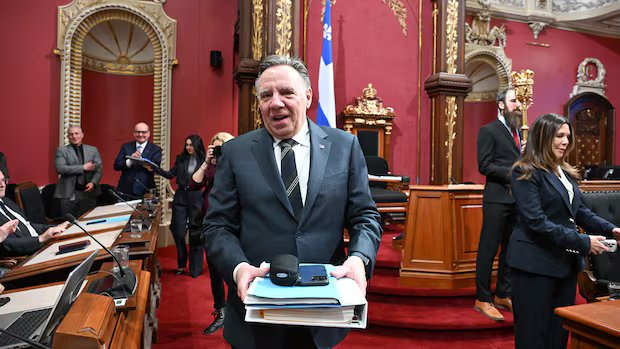
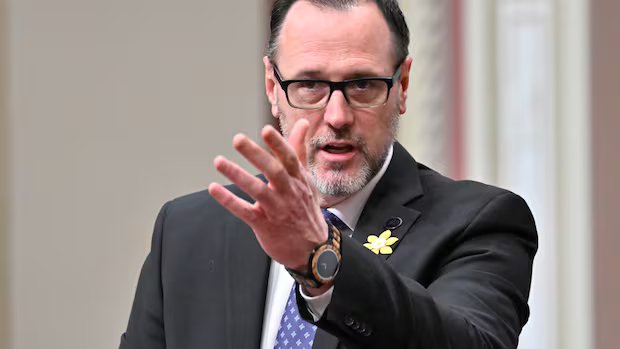
François Legault is attending his last question period as premier at the National Assembly Thursday morning before leaving office next week.
He will stay on as MNA of L’Assomption after the Coalition Avenir Québec party chooses a successor to replace him — as party leader and premier — on April 12.
Walking into the National Assembly on Thursday, Legault told reporters this moment was emotional and “not easy.”
“Life is a lot about relationships with people so that is what is most difficult — leaving people,” he said, adding that the sentiment applied to the reporters present as well.
He shook the hands of several and wished them good luck before making his way into question period.
When asked if this was a definitive goodbye, he laughed and said “Oh yes.”
Legault’s premiership was driven by, among other things, a desire to protect the French language and Quebec’s identity, which he often did via legislation that targeted immigrants.
One such bill — Bill 9 — which introduces a new layer of secularism to Quebec by prohibiting public daycare workers from wearing religious symbols at work and bans most public prayer, was adopted after question period on Thursday.
Quebec’s broader secularism law, Bill 21, is currently being challenged at the Supreme Court of Canada.
Legault ‘worried’ about Montreal in last speech
Speaking after a round of tributes delivered by members of the Opposition, Legault took some time to reflect on his time as premier.
He said one of his biggest regrets was that his father, who died young, was never able to see his accomplishments. His own career, Legault said, was possible thanks to his education, which he highlighted as his greatest priority.
He spoke about Quebec’s role in the economy, saying there’s still a lot of work ahead to shield its industries from competition from the rest of Canada and especially from the United States.
“The truth is that even today, despite everything we’ve done, there are less entrepreneurs that have the means to invest in big projects in Quebec than in the rest of Canada,” he said, adding that the province still needs the Quebec government to fund its ambitions.
Legault then turned his attention to the question of identity. Four centuries ago, he said, it seemed improbable that the French language would survive in Canada for so long.
“When I look at Montreal, I’m worried,” he said. “There is a decline and I think that every deputy here has a responsibility to reverse that decline.”
Speaking about immigration, he said Quebec has the right to protect its values.
“It’s true that our nation is evolving but we have the right to wish for Quebec to remain Quebec.”
He ended his speech by speaking on hope, pointing to the instability in today’s politics.
“I understand that people are worried, pessimistic, but we have to be careful not to become cynical,” he said. “Cynicism cannot replace hope.”

Opposition leaders highlight Legault’s love for Quebec
During a period reserved for tributes for the outgoing premier, the legislative leader of the Quebec Liberal Party André Fortin called Legault a “self-made man” who “gave everything to Quebecers during a very difficult period in our history.”
“Never before have Quebecers been so captivated, day after day, by the words of a political leader,” he said.
The co-spokesperson for Québec Solidaire Ruba Ghazal said she was in CEGEP when Legault first entered Quebec’s political scene as an MNA for the Parti Québécois (PQ) in 1998.
He served under that party’s banner until 2009 and, after a short hiatus, returned to politics as the founder and leader of the CAQ in 2011. When he became premier in 2018, he disrupted the dominance of the Liberals and Péquistes in Quebec politics up until that point.
“You literally marked Quebec’s recent history,” said Ghazal of Legault, who was re-elected in 2022.

He rose from Quebec’s business world to shatter the province’s binary political dynamic of sovereignists and federalists. But François Legault leaves behind a controversial legacy as he concludes his more than seven years as premier.
For Paul St-Pierre Plamondon, the leader of the PQ, Legault’s genuine love for Quebec was never in doubt.
He said the premier vouched for Quebec’s collective autonomy within Canada and inspired it to “dream better” and raise its head.
When Legault became premier, St-Pierre Plamondon said he normalized discussions on Quebec’s political future, which at the time was under “a government that denied the precarity of the French language and who grew increasingly suspicious of our defense of our identity.”
On top of applauding Legault’s success in creating a new party and bringing it to power within seven years, St-Pierre Plamondon also applauded his valour and work ethic over the last eight years, where several “abnormal” events shook geopolitics.
“I am certain this is not the end of a deep commitment toward Quebec,” he said.
Future of CAQ
The two candidates to replace Legault as party leader and premier are Christine Fréchette and Bernard Drainville.
Speaking outside the National Assembly, the latter said Legault was the one who convinced him to return to politics in 2022. He had previously served as the MNA for Marie-Victorin under the Parti Québécois’s banner from 2007 to 2016.
“Even those who don’t like him have to acknowledge that creating a new party — that hadn’t been done since René Lévesque,” said Drainville referring to the founder of the PQ.
Fréchette echoed him, saying the creation of the CAQ is probably Legault’s greatest legacy.
“It’s a political party that, in my opinion, best reflects the image of Quebecers,” she said.
Whether the CAQ will survive without Legault at its helm is the big question as the province counts down to the October election.