dailynewsnblog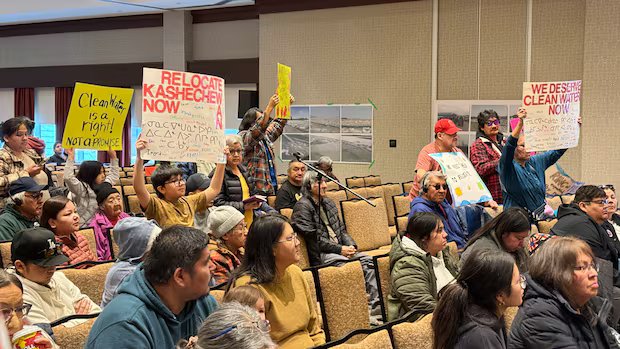
Kashechewan First Nation Chief Hosea Wesley says he takes back a call he made earlier in the month for Indigenous Services Canada Minister Mandy Gull-Masty to resign.
The Cree First Nation, located near the James Bay coast in northern Ontario, has been in a state of emergency since Jan. 4 when issues with the water treatment plant led to orders not to use the tap water.
On March 5 Wesley called for Gull-Masty’s resignation because she hadn’t visited the community since he declared the state of emergency, nor had she met with the 2,000 residents who had to leave Kashechewan.
But on Saturday, Gull-Masty held a town hall meeting in Niagara Falls, Ont., where a large number of Kashechewan evacuees are now living out of hotel rooms.
Wesley said it was frustration on his part that led to his criticism of Indigenous Services Canada’s response to the crisis.
In addition to the issues with the water treatment plant, the community has long called for the federal government to help relocate the community, which is located in a flood plain. Every spring the risk of flooding forces residents to evacuate to other communities in Ontario, such as Timmins and Kapuskasing.
“I truly believe that Kashechewan First Nation and the government of Canada will work together to resolve this issue. A long outstanding issue, ” Wesley said, following the town hall meeting.

At the meeting, evacuees took turns to voice their frustration and anger at the government response.
Some talked about the toll living away from home has had on their mental health, and the impact yearly evacuations has on their children.
There were also calls for the federal government to fast-track relocation plans.
“She’s not doing her job. She’s not helping the First Nation People. She’s ignoring people,” Susan Wynne, a member of Kashechewan’s band council, told CBC News before the town hall.
“That’s what I feel. I’m angry. I’m mad.”

Leona Metatawabin, a single mother of five, said the evacuation separated her family. Three of her children are in Niagara Falls, with her, and two are in Kapuskasing with her mother.
“They miss their home and their comfort zone,” she said.
“My youngest is not handling this evacuation really well. She’s also grieving.”
Chief Wesley said six people from the community have died since he first declared the state of emergency on Jan. 4, and one more was in critical condition on March 14.
He said out of respect for the families, he could not provide more details on their causes of death. But he believes at least three of those people would still be alive if the water plant failure and evacuations had never happened.
After Wesley declared a state of emergency, lab results confirmed a parasite called cryptosporidium was present in Kashechewan’s tap water due to the problems with the water treatment plant.
Community leaders confirmed 85 people from Kashechewan tested positive for the parasite, which can cause gastrointestinal issues.
In most cases people get better on their own, and it was later confirmed the vast majority of people who were sick have since recovered.

After the town hall meeting, Gull-Masty told CBC News she could understand the frustration from the Kashechewan evacuees.
“When you are away from your home for almost 70 days, yes, you will feel frustrated,” she said.
“You’re living in conditions that are maybe uncomfortable. You know, there’s family, there’s stress, there’s many things going on.”
Gull-Masty said she initially had plans to visit Kashechewan on Jan. 28, but those were cancelled due to the death of a community member.
She added that her meeting with Wesley and Mushkegowuk Council Grand Chief Leo Friday on March 14 was positive.
“This is a continued conversation and we’ve committed to working together,” Gull-Masty said.
“It wasn’t my favourite day last week to hear that kind of feedback. But I know that comes from a place of frustration, and I’m here to be as supportive and open as I can with this file.”
Gull-Masty said the federal government will continue to partner with the community on long term plans to relocate to higher ground.
She said a recent feasibility study found that one area preferred by the community would not be suitable for certain municipal infrastructure, as it would still be prone to flooding.
Wesley has called for the federal government to establish a task-force to help speed up the relocation efforts.
With regards to the water treatment plant, it will be a minimum of eight weeks before contractors are able to complete repairs.
In the meantime, he said there are efforts to find longer-term accommodations for evacuees.