dailynewsnblog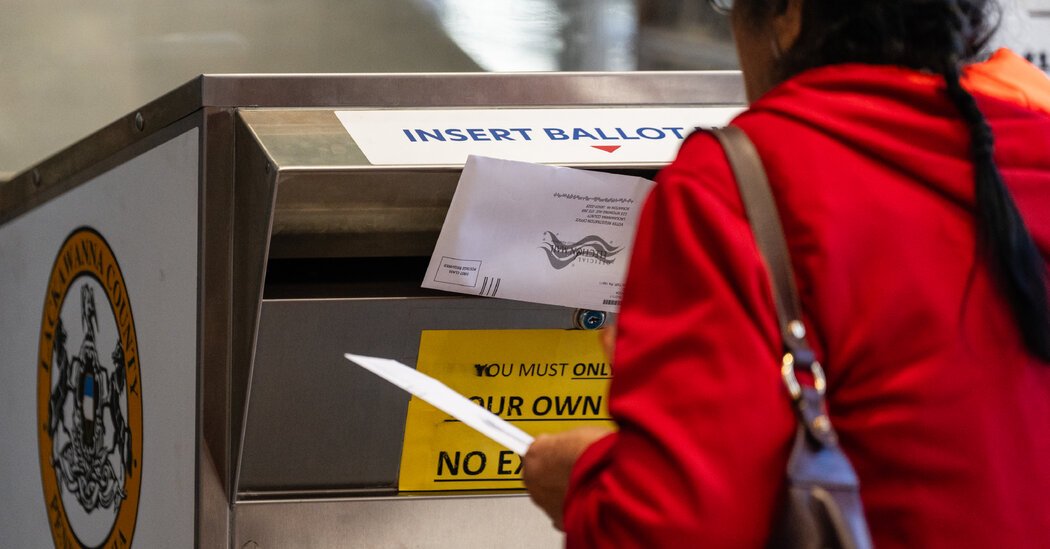
The Supreme Court will hear a challenge on Monday to Mississippi’s rules for counting mail-in ballots, in a case that could upend the way that states handle mail-in ballots throughout the country.
In the case, the Republican National Committee and Mississippi’s state G.O.P. are challenging a law that allows state officials to count ballots that have been postmarked by Election Day but arrive up to five business days later.
The question before the justices is whether federal laws setting a date for an Election Day prohibit state lawmakers from putting in place their own rules to allow for late-arriving ballots to be counted.
The outcome could have sweeping consequences for voters in the midterm elections. A ruling by the court striking down Mississippi’s law could call into question similar measures in at least 18 other states and territories.
A larger group of states allow military and overseas ballots to be counted after Election Day, and it remains unclear what effect a ruling against Mississippi’s law would have on those ballots.
A decision in the case is expected by the end of June or early July, ahead of the November vote.
The case is part of a broader political battle over the use of mail-in ballots, which surged during the Covid-19 pandemic, setting off a string of legal challenges throughout the country.
President Trump has long opposed mail-in voting and has falsely claimed that the practice was a source of fraud and contributed to his defeat in the 2020 presidential election. He has encouraged Republicans to support legislation outlawing mail-in voting.
A Republican-backed measure that would severely restrict mail-in voting across the country has passed the House of Representatives and is being considered by the Senate. A bloc of hard-right Republicans is also pushing a separate proposal that would entirely ban mail-in ballots, with narrow exceptions for military service, travel, disability, medical issues and other hardships.
The Mississippi dispute marks the latest in a string of election and voting rights cases before the court this term, which began in October. In January, the justices cleared the way for a Republican congressman from Illinois to challenge his state’s rules governing vote counting, clarifying who is allowed to sue over voting rules.
The justices are currently considering two other major election-related matters — a Republican challenge to federal rules that limit how much political parties can spend in coordination with candidates and a challenge by a group of white Louisiana voters who claim that the state’s creation of a second majority-minority voting district violated the Constitution. That case will test a key provision of the Voting Rights Act, a landmark of the civil rights era.
Got a news tip about the courts? If you have information to share about the Supreme Court or other federal courts, please contact us.
The case before the justices on Monday focuses on a statute passed by Mississippi lawmakers in 2020, during the pandemic. The state law allows mail-in ballots postmarked by Election Day to be counted if they are received within five business days of the election.
In 2024, the R.N.C., the Mississippi Republican Party and individual voters sued to block those rules, arguing that Mississippi’s law conflicted with federal statutes establishing an Election Day for federal offices.
The challengers argued that the state law had led to valid ballots being diluted by late-arriving ballots and that it had disproportionately hurt Republican candidates and voters.
In July 2024, a federal judge, Senior U.S. District Judge Louis Guirola, a Republican appointee, upheld the state mail-in ballot rule. The challengers then asked the U.S. Court of Appeals for the Fifth Circuit to intervene. Later that fall, the Fifth Circuit reversed the lower court, finding that the Mississippi law violated federal law.
At that point, Mississippi officials asked the Supreme Court to reverse the appeals court and uphold the state law. In a brief to the court, state officials argued that the appeals court ruling, “if left to stand — will have destabilizing nationwide ramifications” and that it “would require scrapping election laws in most states.”
The Mississippi leaders asserted that under the “plain meaning” of the word “election,” Mississippi voters make their choice by casting and submitting their ballots by the date of the election, even if some of the ballots are not received by election officials until after that day.
Lawyers for the R.N.C. argued that state officials should not be able to accept ballots received after the federal Election Day. They pointed to the increasing number of states that accept ballots postmarked by Election Day but received after that, warning that the practice delayed the resolution of disputed election results and deprived the electorate of a “clear nationwide deadline.”
The Trump administration has weighed in, asking the justices to strike down Mississippi’s law.
“Elections have consequences,” lawyers for the Trump administration wrote in a brief to the court. “They also have a definition. And from the dawn of America, Election Day has meant the day the ballot box closes — and when election officials must be in receipt of all ballots.”