dailynewsnblog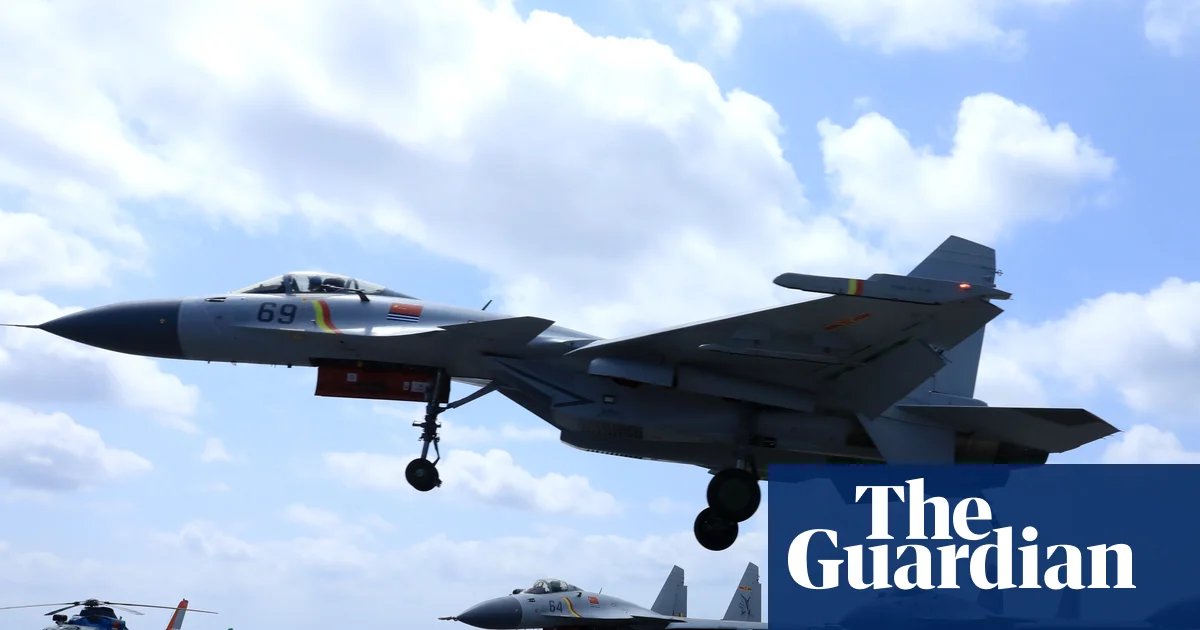
Japan’s prime minister, Sanae Takaichi, has vowed to “respond calmly and resolutely” after Chinese military aircraft were accused of twice locking radar on to Japanese fighter jets south-east of Okinawa’s main island at the weekend.
Takaichi told reporters on Sunday that Japan would take all possible measures to strengthen surveillance of maritime and airspace and closely monitor the Chinese military’s activities, amid worsening tensions between the two countries. On Sunday, China’s ambassador was summoned.
Chinese J-15 fighter aircraft from the carrier Liaoning locked radar on to Japanese F-15s twice – at 4.32pm and again about two hours later on Saturday, Japan’s defence ministry said. Visual confirmation was not possible due to the distances involved, it said, and no damage or injuries were caused.
It was the first time Japan’s defence ministry has disclosed such an incident, Japan’s Kyodo news agency reported. Fighter jets use their radar to identify targets as well as for search and rescue operations.
China’s navy said Tokyo’s claim was “completely inconsistent with the facts” and told Tokyo to “immediately stop slandering and smearing”. It said in a statement that aircraft from Japan’s self -defence forces (SDF) “seriously endangered flight safety” by repeatedly approaching its training zones. It did not mention a radar lock-on, according to Kyodo.
A Chinese foreign ministry spokesperson, cited by China’s Xinhua news agency, urged Japan to “immediately stop its dangerous moves of harassing China’s normal military exercise and training”.
Relations between Beijing and Tokyo have soured over the past month after Takaichi said an attack on Taiwan could trigger the deployment of her country’s self-defence forces if the conflict posed an existential threat to Japan.
Insisting that Japan could exercise its right to collective self-defence – or coming to the aid of an ally – Takaichi said Tokyo had to “anticipate a worst-case scenario” in the Taiwan Strait. The remarks prompted Donald Trump to urge Takaichi to avoid further escalation in a dispute with China
Japan has long wrestled with the question of how it would respond to a conflict between China and Taiwan, which lies just 100km from its westernmost island, Yonaguni, in the East China Sea.
The Japanese defence minister, Shinjiro Koizumi, said on Sunday that Saturday’s incident was “dangerous and extremely regrettable”.
China’s ambassador, Wu Jianghao, was summoned on Sunday afternoon, where vice-foreign minister Funakoshi Takehiro “made a strong protest that such dangerous acts are extremely regrettable”, the foreign ministry said in a statement.
Funakoshi “strongly urged the government of China to ensure that similar actions do not recur”, it said late on Sunday.
The two countries have a long-running territorial dispute over the Senkaku Islands, known as the Diaoyu in China. The tiny, uninhabited islands lie between Okinawa and Taiwan, the much larger self-ruled island that China also claims.
Tokyo is deepening cooperation with US allies in the Asia-Pacific region, where several countries have territorial disputes with China.
Beijing, for instance, claims nearly all of the South China Sea, and has been asserting control more strongly in parts of the strategic waterway despite an international ruling that its claim has no legal basis.
With Agence France-Presse