dailynewsnblog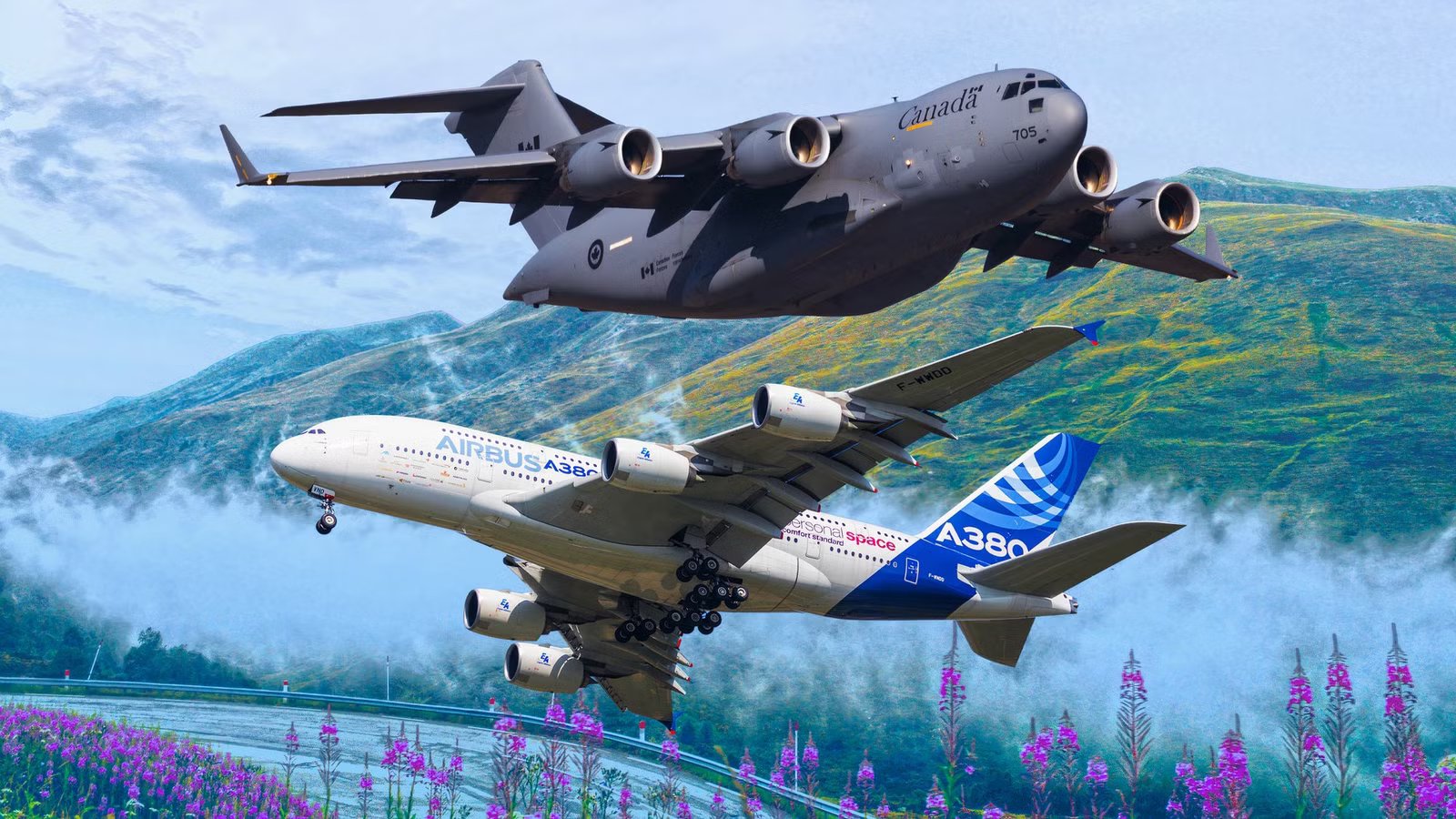
Commercial jet airliners are designed rather similarly to one another, with a circular or semi-circular tube, with a main deck for passenger seating, a lower deck for cargo, and a low wing mounted near the bottom of the aircraft with a dihedral angle. Airliners of the past may have had more variations, but with most modern commercial planes flying today, many differences come in smaller design choices or in size differences between different aircraft.
Military aircraft come in a wider range of shapes and sizes due to the greater variety of missions that these planes may be deployed for. Because they look so different and these types of aircraft aren’t often seen side-by-side, it’s not always clear how they compare to civilian airliners on size. The Boeing C-17 Globemaster III is one of the most successful military cargo planes, so how does it compare to the Airbus A380, the world’s largest passenger plane?
Examining The Designs Of The A380 & C-17

At first glance, the Boeing C-17 Globemaster III certainly looks huge. Originally designed by McDonnell Douglas, it’s a strategic transport aircraft designed to deliver outsized cargo close to battle lines, and can land on runways as short as 3,500 feet (1,067 m) or on rough/unpaved surfaces. It uses a high-mounted anhedral wing with large winglets and four Pratt & Whitney F117s, the military derivative of the PW2000 found on the Boeing 757.
The Airbus A380 entered service in 2007, 12 years after the C-17. Its basic design mimics that of other airliners, with a low-mounted dihedral wing and a conventional empennage (as opposed to the C-17’s T-tail design). What makes the A380 unique is that it has two full-length passenger decks along with the cargo hold, being the only airliner to do so. It also features four engines and has the widest wingspan, the highest tail, and the highest Maximum Takeoff Weight of any airliner.
The A380 is designed to haul more passengers than any other commercial aircraft, and to be efficient while doing so. Although the A380 failed largely due to its fuel burn against newer widebodies, it was competitive against the Boeing 777 and beat the 747 on per-seat costs. The C-17 Globemaster III, in contrast, was designed for freight capacity, and although it has carried passengers before, it was developed as a cargo plane first.
How Does The C-17 Compare To The A380?

The A380’s specs are some of the most famous of any airliner. It stretches 239 feet (72.73 m) long, has a jaw-dropping wingspan of 261 feet and nine inches (79.75 m), and its tail rises to 79 feet (24.09 m), taller than most small buildings. It’s also certified for an MTOW of 575 tonnes, which is more than any other passenger plane, while its lower deck is wide enough to comfortably fit 10 seats across in economy. Airbus has even proposed an 11-abreast layout, though no airline has ever selected this.
The Airbus A380 is certified to carry up to 853 passengers, though in reality, the highest-density A380 to ever fly is Emirates’ 615-seat layout. The Boeing C-17, by comparison, set a record when it carried 823 people while performing an evacuation flight out of Kabul, Afghanistan, in August 2021. However, the passengers were seated directly on the floor, and the C-17’s official maximum capacity with installed seats is only 134.
While the C-17 is a large aircraft, its length is only 174 feet (53 m), while its wingspan is 169 feet and 11 inches (51.76 m). Its tail rises to a height of 55 feet and one inch (16.79 m), and its MTOW is 265.3 tonnes. Its fuselage diameter is only slightly smaller, but this is the only metric in which the two come close. In reality, despite the similar fuselage size, the C-17 can best be compared to the Airbus A300, McDonnell Douglas DC-10, or Boeing 767-300ER in terms of dimensions.
A Look At The Role That The C-17 Plays

The Boeing C-17 does not need to be a huge aircraft because the United States Air Force already operates an A380-sized airlifter: the Lockheed C-5 Galaxy. The C-5 has been in service since 1970, and it has since served as the USAF’s largest aircraft, frequently carrying outsize cargo such as helicopters and tanks. The C-17, introduced over two decades later, was designed instead to be smaller, but more versatile, delivering similar cargo directly to the battlefield.
Its MTOW, while small in comparison to the enormous double-decker A380, is incredible for an aircraft of its size, and the design of its fuselage allows it to accommodate outsize cargo. Indeed, this figure is higher than the much larger Airbus A330 or Boeing 787, despite being sized closer to an A300 or 767. On account of its MTOW, it can carry an M1 Abrams tank, three AH-64 Apaches, or a single CH-47F Chinook.
|
Aircraft |
MTOW |
|---|---|
|
Boeing 777-200ER |
297T |
|
Airbus A350-900 |
283T |
|
Airbus A340-300 |
276.5T |
|
Boeing C-17 Globemaster III |
265.3T |
|
Boeing 787-9 |
254.7T |
|
Boeing 787-10 |
254T |
|
Airbus A330-900 |
253T |
The C-17 has a lower max payload and significantly smaller cargo hold than the C-5, but it still remains one of the USAF’s most capable aircraft. The C-17 is the workhorse of the USAF fleet, while the C-5 handles the most demanding missions. Furthermore, its short and rough field capabilities make it far more versatile than the C-5, making the Globemaster III a key component of the United States’ active military strategy.
Diving Deeper

The C-17 was developed in the 1980s/early 1990s as a replacement for the Lockheed C-141 Starlifter. McDonnell Douglas based the C-17’s design on its earlier YC-15, a prototype short takeoff and landing quadjet. Compared to the YC-15, the C-17 Globemaster III was scaled up significantly, with more powerful engines, swept wings, and large winglets, a rare feature on a high-wing aircraft.
As the C-17 was designed by McDonnell Douglas and later became a Boeing jet by name, it has some design elements that distinguish it from other Boeing aircraft. Visually, the C-17 shares the same cockpit windows and a similar nose design as the McDonnell Douglas DC-10/MD-11, save for the extra windows. What’s more, whereas Boeing favors using yokes, the C-17 uses a center stick connected to its fly-by-wire system.
The F117 engines produce over 40,000 lbs of thrust each, and the engines are mounted high enough that the risk of foreign object debris intake is minimal. The C-17 can use reverse thrust to move backwards, and can also perform a three-point turn. While the C-17’s unloaded range is 6,230 NM (11,538 km), it also has in-flight refueling, making the plane’s range essentially unlimited, and the C-17 is certified to cruise at up to 45,000 feet.
The Future Of The Boeing C-17

In the United States Air Force’s cargo fleet, the C-17 achieves remarkable payloads while also being capable of operating on a wide variety of surfaces. The Lockheed C-5 is far larger with an even higher lifting capacity, but is also less flexible. On the other end of the spectrum is the Lockheed C-130 Hercules, which is smaller than the C-17 but can operate on shorter runways and a wider range of surfaces.
The C-17 and C-130 have both been popular with foreign militaries, but the C-130 in particular has been around for decades, and so Airbus decided to throw its hat into the ring. On the surface, the Airbus A400M Atlas is a direct competitor to the C-130, with the most striking similarity being that both are turboprops. Size and capability-wise, however, the A400M is positioned between the C-130 and the C-17.
|
Aircraft |
Length |
Wingspan |
MTOW |
Entry-Into-Service |
Number Built |
|---|---|---|---|---|---|
|
Boeing C-17 Globemaster III |
174 feet (53 m) |
169 feet and 11 inches (51.76 m) |
265.3T |
1995 |
279 |
|
Airbus A400M Atlas |
148 feet (45.1 m) |
139 feet and one inch (42.4 m) |
141T |
2013 |
134 |
|
Lockheed C-130 Hercules |
97 feet and nine inches (29.79 m) |
132 feet and seven inches (40.41 m) |
70.3T |
1956 |
2,800+ |
The 279th and final C-17 left the Long Beach assembly plant in 2015. Since then, the A400M has been the closest equivalent, but with its lower operating costs and greater flexibility, the need for a more direct replacement has been minimal. For years, the A400M has been seen as a more cost-effective option. However, the current geopolitical climate has led to early discussions on restarting C-17 production, as the C-17’s greater capabilities are in higher demand today.
The Bottom Line

The Boeing C-17 is a large aircraft that can land almost anywhere in the world, but it’s not quite as huge as some of the world’s biggest military aircraft. It’s more similar in size to a KC-10 rather than a plane like the Lockheed C-5, and even the C-5 falls short in many dimensions compared to the colossal Airbus A380. Of course, the C-17 is meant to complement the C-5 by being the general workhorse, rather than the Hulk of the Air Force arsenal.
You’ll notice that, among large tactical military airlifters, the larger aircraft are more expensive to operate and less flexible. What’s more, only 131 Lockheed C-5s were produced across nine total years of production, while 279 C-17 Globemasters were built across 24 years of production, and the C-130 remains in production after having entered service nearly 70 years ago.
Generally, most militaries don’t quite require the size and capabilities of the C-17 when considering its costs, which is why the C-130 and Airbus A400M continue to be relatively popular. However, if the mission calls for the C-17, there is no other aircraft with its combination of size, capability, and flexibility, making it one of the most remarkable military jets of all time.