dailynewsnblog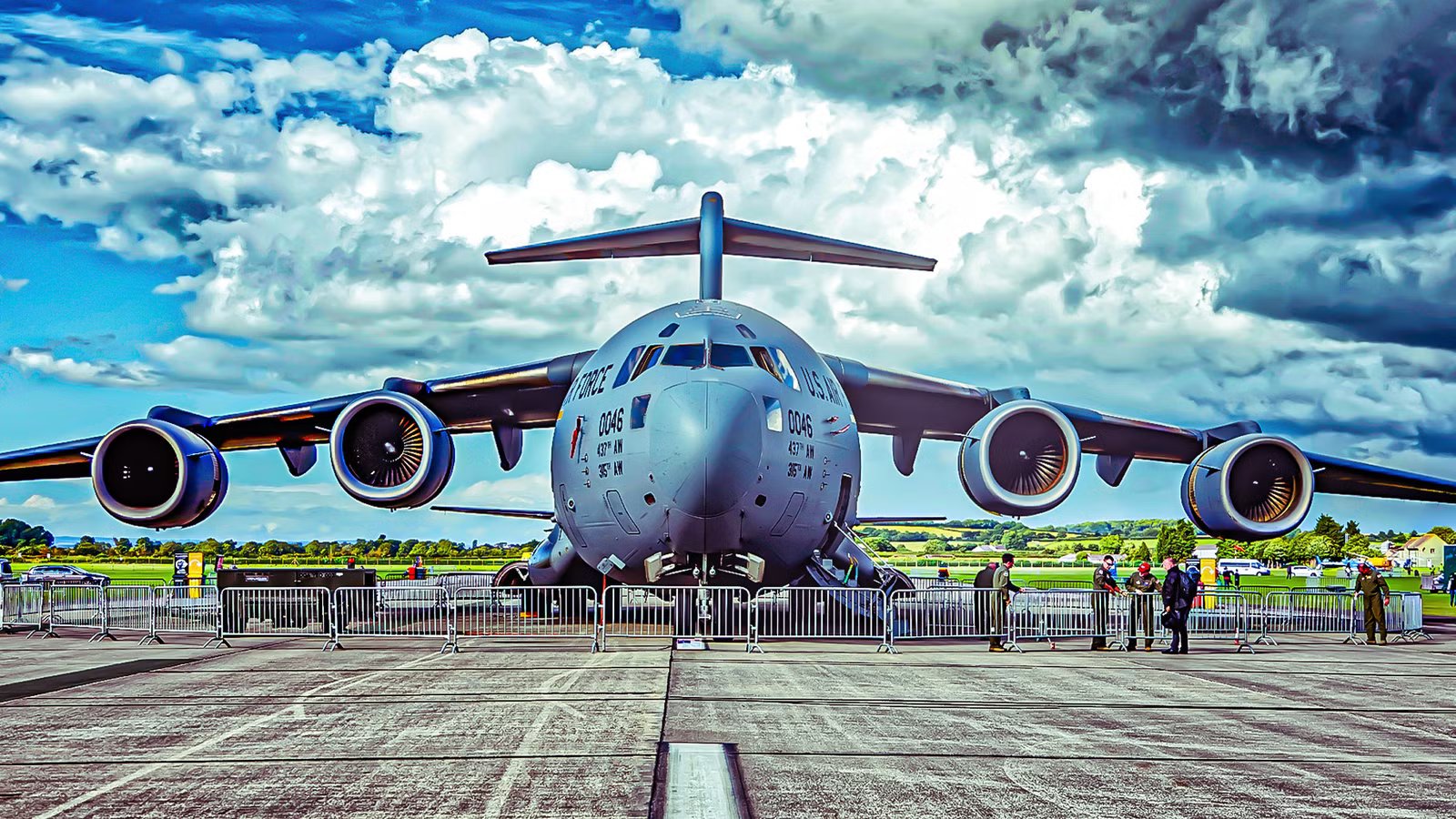
Anybody who has closely followed the aviation industry over the past decade has undeniably heard the fascinating claim that the United States Air Force’s C-17 Globemaster III fleet is powered by  Boeing 757 engines. It is a catchy line unto itself, but it mashes together three different ideas, such as those of the engine maker, engine family, and airframe use. This is sadly only half-true.
The C-17 Globemaster III is a highly capable cargo aircraft used by military operators, and it is powered by four Pratt & Whitney F117-PW-100 series turbofan engines. Where the Boeing 757 enters the story is its lineage. This unique variant carries the military designation for a variant that was derived from the Pratt & Whitney PW2000. The Air Force has noted that the F117 is based on the commercial PW2040 used on certain Boeing 757 models.
In other words, the C-17 does not literally have Boeing 757 engines under its wings but rather a Pratt & Whitney engine that shares common design elements with one of the principal variants that is used on the Boeing 757. This matters as claims that the ‘same engine’ can also imply that hardware, maintenance, and performance are identical across the engines used for both aircraft. These assumptions prove incorrect once one moves from airline service to ruggedized military transport.
A Brief Overview Of The C-17 Globemaster III

The Boeing C-17 Globemaster III is a strategic and tactical airlifter that was built to move outsized cargo and people quickly, then operate from shorter, rougher runways closer to the fight itself. The aircraft itself was introduced in the 1990s in order to replace aging C-141s and complement the larger C-5 Galaxy. It quickly became a workhorse for the United States Air Force and several allied operators.
A high-mounted swept wing, advanced high-lift devices, and powerful thrust reversers let the aircraft land and return to base on relatively short landing strips, even when the aircraft is heavy. The jet itself can carry a wide mix of loads, including armored vehicles, helicopters, pallets, or humanitarian supplies, and it can switch between missions with minimal reconfiguration.
The jet also supports the airdrop of equipment and paratroops, and it can be configured for aeromedical evacuation with a fully-staffed medical crew. The C-17 is powered by four Pratt & Whitney F117 turbofan engines, and these incredible powerplants offer strong climb performance as well as reliable fuel efficiency while in cruise. With a modern glass cockpit and robust defensive systems, the aircraft can support global operations.
From resupplying troops and units during combat to disaster relief, the C-17’s signature is its flexibility. The aircraft bridges intercontinental reach with the ability to deliver directly into austere airfields, reducing the overall need for intermediate hubs and additional ground support. The aircraft is typically crewed by a pilot, copilot, and loadmaster, with optional additional crew for specialized tasks. Operators value the aircraft’s maintainability.
The Boeing 757 In A Nutshell

The Boeing 757 is a narrowbody twin-engine aircraft designed for short and medium-haul routes, while also having the performance needed to fly long-and-thin missions, including a handful of transatlantic services. Originally launched in the late 1970s to be a successor to the popular but inefficient Boeing 737, the aircraft entered scheduled commercial service in the early 1980s.
The aircraft quickly developed a reputation for brisk takeoff performance, solid overall fuel efficiency for its generation, and unusually impressive operational flexibility. The aircraft was primarily built in two main passenger variants: the Boeing 757-200 and the 757-300. The jet typically seats between 180 and 240 passengers, depending on the chosen cabin layout. Airlines valued its strong range and payload combination, which made the aircraft incredibly useful for airlines that were looking to use it to serve high-demand domestic trunk routes.
The same can also be said of hot-and-high airports, and on longer flights from secondary cities that can’t consistently fill widebody jets. The Boeing 757 also shares significant cockpit commonality with the Boeing 767, ultimately helping airlines simplify training and scheduling procedures. The engines for the aircraft are either Rolls-Royce RB211-535 models or Pratt & Whitney PW2000 series units.
Production of the aircraft ended in 2004, and the Boeing 757 remains active, especially as a freighter and high-utilization passenger aircraft. The overpowered aircraft simply offers the ideal combination of runway performance, payload, and range that has been very hard to replicate precisely with newer narrowbodies. The jet’s supercritical wing and high thrust allow for steep climbs, and many operators use ETOPS approval to open new routes across the globe.

The Striking Differences Between The C-17 Globemaster & The C-5 Galaxy
From strategic airlift to tactical flexibility, delve into the unique roles of the C-5 Galaxy and C-17 Globemaster III.
What Exactly Are The Similarities Between Their Engines?

The linkage here is the family DNA of these two engines, not necessarily the hardware attached. The C-17’s Pratt & Whitney F117-PW-100 is the military development of the PW2000 series that powered many Boeing 757s. As a result, these two aircraft engines share the same fundamental turbofan architecture, which includes a high-bypass, two-spool design with a large fan that is driven by a multi-stage low-pressure turbine and a separate high-pressure compressor and turbine.
These share broadly similar cycle choices, including the aerodynamic layout of the gas path, which can produce similar spool-response feels and operating logic. Both engine families use full-authority digital engine control to meter fuel, manage variable geometry, and protect limits. Both of these were designed for modular maintenance, swapping major modules rather than stripping the whole engine for many shop actions.
You also see common systems’ logic. Examples include a gearbox-driven accessory section powering generators and pumps, alongside bleed-air extraction for aircraft systems. Even when military-specific parts may differ, it is the PW2000-derived core architecture that ultimately links the C-17’s F117 to Boeing 757 PW2000 variants. This is because they come from the same program lineage, although there are still fundamental differences across the two engine variants.
A Look At The Pratt & Whitney F117

The Pratt & Whitney F117-PW-100 is the engine that powers the Boeing C-17 Globemaster III, delivering the blend of cruise efficiency and short-field performance that a global airlifter needs. The aircraft uses a set of four F117s, each a military development of Pratt& Whitney’s PW2000 commercial turbofan engine. At its core, the powerplant itself is a high-bypass, two-spool turbofan with full-authority digital engine control.
It is designed for strong thrust response, cruise efficiency, and consistent performance across hot-and-high departures and heavy gross weights. What makes the F117 especially relevant is its mission tailoring for flights. Airlifters operate in rugged, frequent, short cycles, including takeoff, climb, descent, and landing. They often use dusty or temporary airfields, and thrust reversers were frequently used, along with high-tempo turnarounds.
|
Category |
Specification |
|---|---|
|
Certified thrust |
40,000 lbf (169.7 kN) |
|
Thrust reverser |
Directed-flow thrust reverse that is deployable in flight |
|
Control system |
Full-Authority Digital Electronic Control (FADEC) |
This engine is engineered for durability and efficient support. Modular construction, which enables faster maintenance and aircraft-specific customization, made the aircraft exceptionally attractive to major operators. The table above details some specifications for the F117 engine, according to specifications from the manufacturer Pratt & Whitney.
In the roughly 40,000-pound thrust class, the F117 pairs proven core architecture with military integration details, ultimately giving operators an engine family that is optimized for expeditionary reliability and sustained sortie rates all across the globe. The aircraft’s lineage also supports established industry supply chains, training pathways, and a deep maintenance base.
The Unique Nature Of The Pratt & Whitney PW2000

The Pratt & Whitney PW2000 is a high-bypass turbofan that was developed in the late 1970s and early 1980s as a next-generation engine for narrowbody aircraft, particularly for the Boeing 757. Delivering between 37,000 and 43,000 pounds of thrust, depending on the variant, it was Pratt & Whitney’s first commercial engine to feature full-authority digital engine control, which allows precise fuel metering by pilots and thus improves fuel efficiency.
From a structural perspective, the PW2000 is a two-spool design, comprising a single-stage fan, a low-pressure compressor driven by a three-stage low-pressure turbine, alongside a high-pressure compressor with 10 stages driven by a two-stage high-pressure turbine. This configuration offers the most efficient balance between overall thrust and fuel burn. The modular construction of the engine also allows airlines to replace sections on an individual basis.
The PW2000 was selected by multiple major carriers to power their Boeing 757 fleets, including both  Delta Air Lines and United Airlines, each of which accumulated millions of flight hours. The engine’s proven performance and reliability made it an ideal foundation for military adaptation, and it became the core of the F117 that powers the C-17 Globemaster III today.
The Bottom Line

At the end of the day, saying that the C-17 is powered by Boeing 757 engines would be quite a bit of a stretch, as its four engines are Pratt & Whitney F117-PW-100 turbofan models. These are built for the C-17’s military airlift mission and integrated alongside C-17-specific controls, accessories, and operating demands.
The reason the Boeing 757 keeps coming up is its heritage. The F117 is derived from Pratt & Whitney’s PW2000 family, which powers many Boeing 757s in commercial service. Therefore, an accurate takeaway involves the PW2000’s lineage, not identical engines that are fully interchangeable.