dailynewsnblog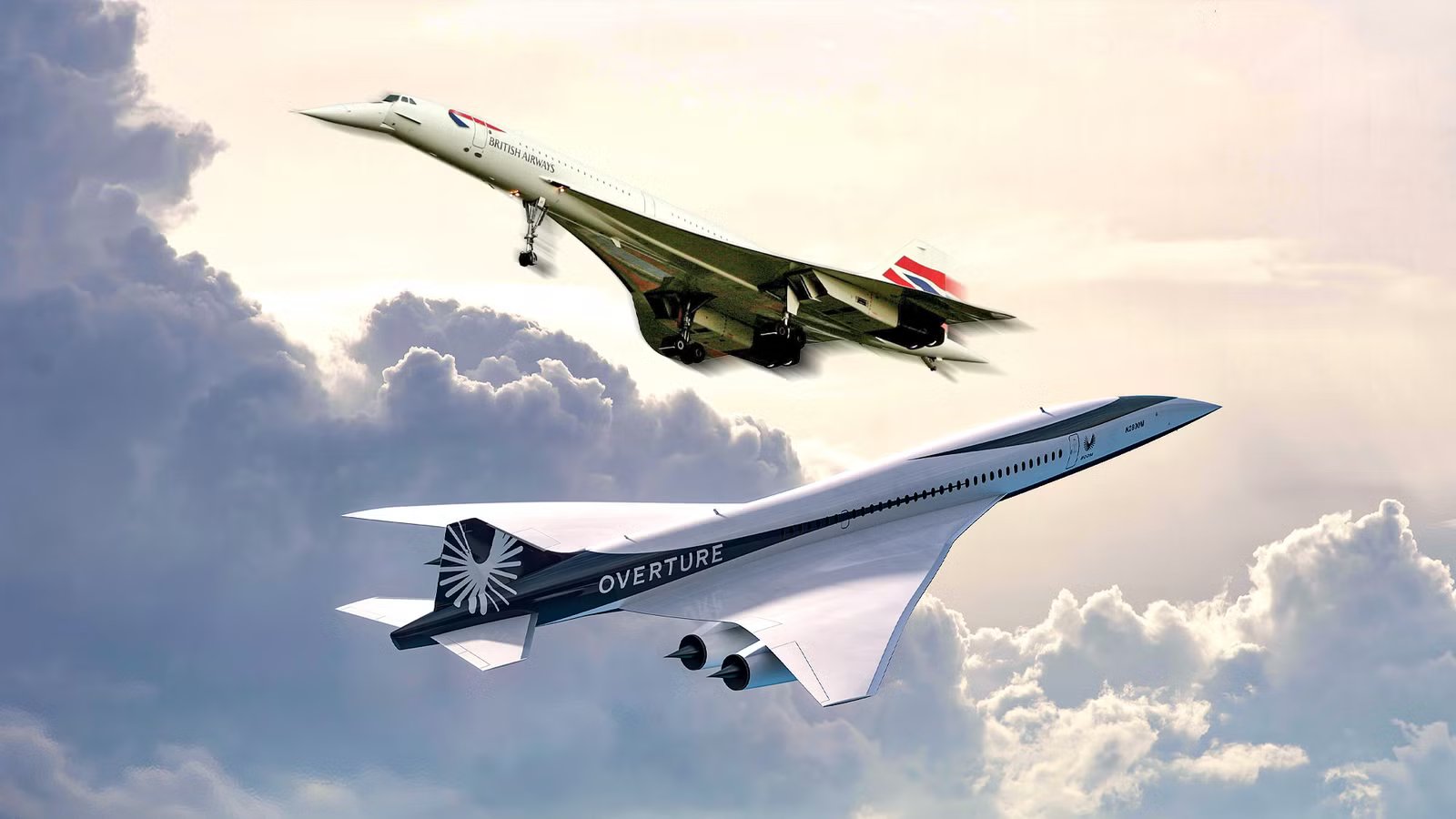
Supersonic flight is a form of travel that is neither accessible today nor viewed as particularly glamorous. Ever since Concorde was retired from service in 2003, all commercial flights have flown below the speed of sound, and flying generally takes the same amount of time that it did in the 1960s, or even more. With increasing congestion at airports and airspaces leading to worsening delays, flying has largely slowed down, and what’s more, public interest in supersonic travel is relatively low.
Within the aviation industry, however, manufacturers have slowly been working on a Concorde replacement, essentially since the day Concorde was retired. Several manufacturers have proposed new supersonic transport designs, primarily aimed at the private aviation industry, and then gone bust. Boom Technologies, on the other hand, founded in 2014, continues to market the development of a Concorde-like supersonic airliner, and despite being one of the most ambitious companies developing an SST, may be the one closest to making its jet a reality.
Overview Of Commercial Supersonic Flight

Since the start of flying, aviators and engineers have sought to go faster. But there seemed to be a point where planes stopped accelerating, and flying became more dangerous, a speed which was named the sound barrier. In 1947, Chuck Yeager flew past the speed of sound in the rocket-powered Bell X-1, and pilots keep setting new speed records. But while the sound barrier wasn’t a true barrier, supersonic flight revolved around a new set of aerodynamic laws, requiring changes in aircraft design and higher cost tolerances.
The 1960s were a time of relentless optimism for technology and the future, and although jet airliners had just become widespread, cutting times in half, many expected an even bigger leap forward by moving to supersonic flight. Of course, a supersonic airliner would be difficult to design, expensive to develop, and would burn huge amounts of fuel, which cut into some of the optimism. But there was similar skepticism about the viability of jet-powered airliners in the 1940s and 1950s.
After well over a decade in development, Concorde finally entered service on January 21, 1976, with Air France and British Airways. Concorde was actually the second supersonic transport to enter service, as the Soviet Union’s Tupolev Tu-144 entered service just a few weeks beforehand on December 26, 1975. Of course, the Tu-144 was quickly withdrawn from service, while Concorde would fly for decades. Although the aircraft failed to revolutionize air travel, it remains the most iconic and recognizable aircraft of all time.
The Design Of The Concorde

Boom advertises that its Overture supersonic transport will be capable of cruising at roughly Mach 1.7. While this is impressive, this is hardly groundbreaking, as the Overture’s 1970s-era predecessor cruised between Mach 2.02 to Mach 2.04 in service. This made Concorde one of the fastest planes to ever fly, able to outpace most combat jets like the Eurofighter Typhoon. This speed was ideal for reducing Concorde’s fuel burn, as flying close to the sound barrier burns more fuel than flying at significantly higher speeds.
Concorde featured four advanced Rolls-Royce/Snecma Olympus 593 turbojets equipped with an advanced system called “supercruise“, which allowed Concorde to switch off its fuel-thirsty afterburners while maintaining supersonic speeds. In addition, Concorde’s advanced delta wing was designed to be efficient at supersonic speeds while still being relatively effective during low-speed departures and arrivals. While Concorde flew at Mach 2.02 in regular service, the plane reached Mach 2.23 at 63,700 feet during testing in 1974.
Concorde was the most technologically ambitious project of the 20th century, and debuted an nearly immeasurable number of innovations, including fly-by-wire, fuel-based in-flight trimming, carbon brake discs, and more. In total, 14 examples flew in commercial service: seven for British Airways, and seven for Air France. In addition, Braniff International wet-leased Concordes from 1979 to 1980, flying subsonic from Washington-Dulles to Dallas/Fort Worth, and Singapore Airlines jointly operated a Concorde with British Airways in 1977, and later from 1979 to 1980.

What Was The Longest Concorde Flight?
It only took four hours and ten minutes for the supersonic airliner to cross the pond.
The Challenge For The Boom Overture

While the prospect of a supersonic transport is exciting, the Boom Overture is hardly groundbreaking. A supersonic airliner has already been done, and it was done over 50 years ago. In addition, Concorde had transatlantic range, and it flew faster than what the Boom Overture is projected to cruise at. Concorde already conquered the technical challenges, but what Concorde couldn’t overcome was poor operating economics and practicality. To succeed, the Boom Overture will need to be economical and practical.
Concorde was designed in the 1960s, when jet fuel was cheap, and the idea of burning extra gas to fly faster was appealing. But when it entered service in the 1970s, airlines were significantly more focused on lowering operating costs due to rising oil prices, and the mood never shifted back in favor of Concorde. Several airlines initially placed orders for Concordes in the 1960s, but would later cancel their orders. Air France and British Airways, as the national carriers of France and Britain, were more or less forced to take their Concordes and paid mere pennies for the planes.
While Concorde was the most exciting new aircraft of its day, focus would soon shift away from the world it could bring towards its impact on the real world. Environmentalists were concerned that hundreds of Concordes flying at 60,000 feet would produce enough emissions to destroy the ozone layer, and Concorde was one of the loudest planes ever produced when flying near the ground, as well as during cruise. Like any other supersonic plane, Concorde generated loud sonic booms, heard by anyone under its flight path, and virtually every government in the world banned commercial supersonic flights over land.
What The Boom Overture Will Need To Succeed

By the 1980s, British Airways and Air France were making money with Concorde by transforming it into an exclusive experience for the ultra-wealthy. This was effective in part due to the low volume of aircraft in service, and with only 14 in service, concern over its environmental impact had largely disappeared. But still, by the early 2000s, Concorde was becoming increasingly expensive to maintain, and its appeal had disappeared in part due to the tragic 2000 crash of an Air France Concorde near Paris-Charles de Gaulle, tarnishing Concorde’s previously spotless safety record.
Today, over 20 years after Concorde was retired from service, public interest in flying supersonic is generally low, meaning that the novelty of the experience won’t be enough to sell tickets. The Overture’s reduced flight times will only sell tickets if prices are low enough, which will rely on the fuel efficiency of the aircraft’s engines. As no jet engine is currently in production with the power and fuel burn needed for the Overture, an engine has to be developed from scratch.
|
Specifications |
Boom Symphony |
|---|---|
|
Manufacturer |
Boom Technologies |
|
Type |
Two-spool medium bypass turbofan |
|
Thrust |
40,000 lbf |
|
Fan diameter |
72 inches (182.88 centimeters) |
|
Afterburners |
None, uses supercruise |
|
Fuel type |
Up to 100% Sustainable Aviation Fuel (SAF) |
In 2022, Boom announced that it would develop its own in-house engine for the Overture. It’s named the Symphony, and it’s being developed in partnership with Kratos subsidiary Florida Turbine Technologies, GE Aerospace subsidiary Colibrium Additive, and StandardAero. The Symphony engine promises a medium bypass ratio, 40,000 lbs of thrust, supercruise, and a feature titled “Boomless Cruise”, which allows the plane to fly up to Mach 1.3 without producing an audible sonic boom, which would essentially allow it to fly over land if this feature comes to fruition.

United Airlines To Benefit As US Lifts Ban On Overland Supersonic Flights
The airline is looking to launch supersonic flights within the next decade.
The Feasibility Of The Boom Overture

The success or failure of the Overture program will rest on the Symphony engine. If Boom can design a fuel-efficient engine and deliver on promises like Boomless Cruise, we may see the return of supersonic flight. However, engines are the most complex component of any aircraft, and it’s essentially unprecedented in recent history for an upstart company to develop a competent jet engine in-house, while also developing a large airliner. The odds are against Boom.
In December 2025, Boom announced that it would develop an industrial gas turbine variant of the Symphony engine, targeted at AI data centers. While this appears to be an unusual pivot for the company, it’s not uncommon in the industry. The General Electric GE90 also has a gas turbine variant, as does the Rolls-Royce RB211. The benefit for Boom is, of course, the capital that will be raised through sales of this variant of the Symphony, as well as the in-service performance data that will be gathered.
|
Airline |
Boom Overture Firm Orders |
Boom Overture Options |
|---|---|---|
|
American Airlines |
20 |
40 |
|
Japan Airlines |
20 |
|
|
United Airlines |
15 |
35 |
|
Total |
35 |
95 |
Boom is promising that seats onboard the Overture will be sold at prices close to business class on subsonic airliners, whereas Concorde prices were closer to international first class. While expensive, there are routes with heavy premium demand today. All will rest on whether Boom’s Symphony can deliver on its lofty aspirations, and if so, whether airlines will pay the premium that Boom will surely charge for the ability to offer quicker flights than competitors.