dailynewsnblog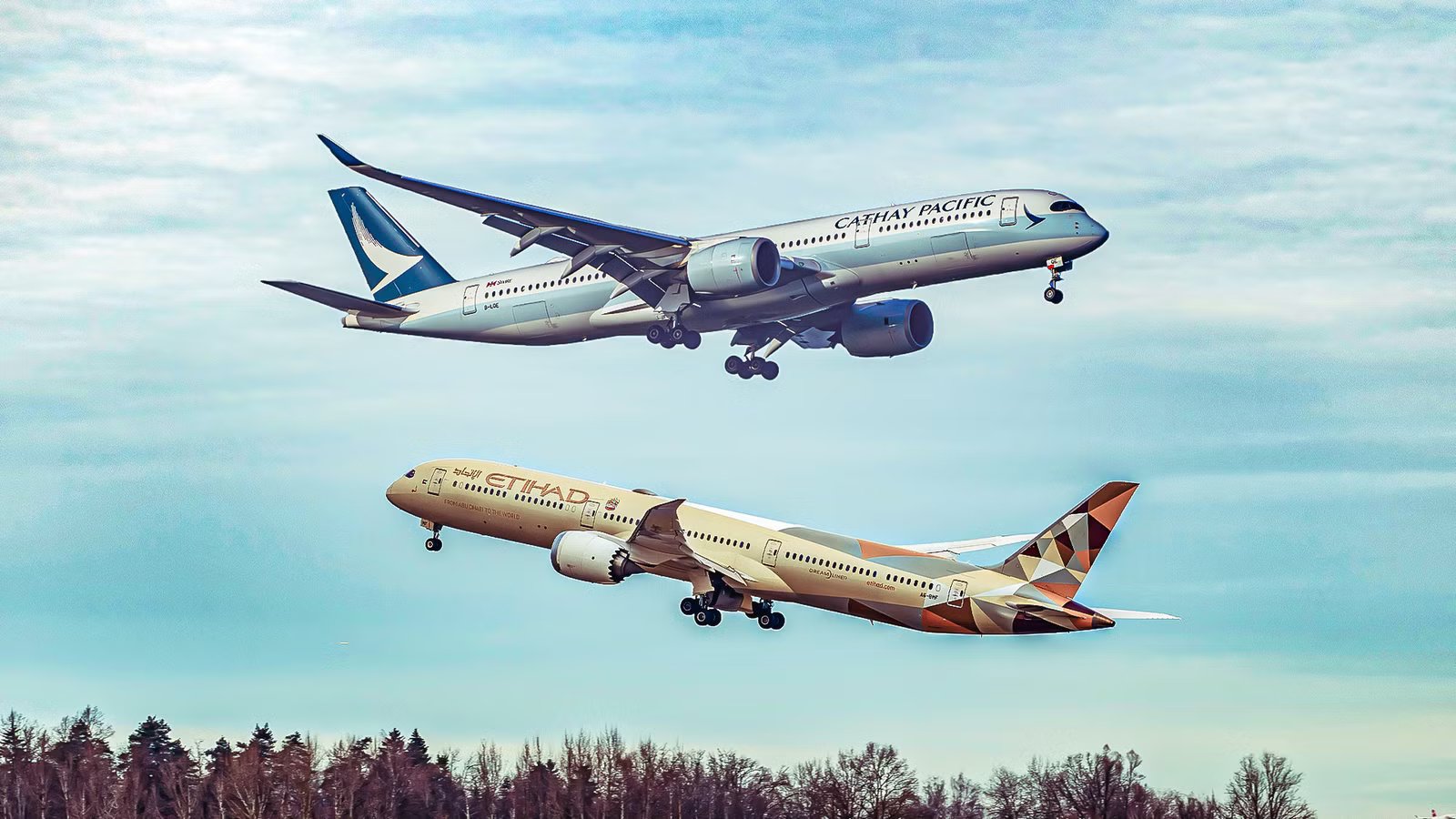
Modern widebody aircraft have made tremendous strides in becoming more resilient to turbulence, giving passengers a more comfortable experience and reducing the wear on the airframe that accumulates over thousands of flights. However, there is no perfect consensus on how this should be done. The Airbus A350 focuses on advanced software to augment the position of control surfaces in real time. That makes turbulent air easily flow off the wing. While the Boeing 787 matches this technology, it also includes an incredibly flexible wing that is superb at shrugging off turbulence.
For that reason, it is not true that the 787 is better at handling turbulence than the A350, because they approach turbulence with different philosophies. Learn more by reading the following article.
How Does Each Aircraft Deal With Turbulence?

Like all modern aircraft, the Boeing 787 and Airbus A350 both use a range of technologies to ease the turbulence that passengers feel, and reduce the load that turbulence places on the aircraft. The approach taken by the Airbus A350 is technological and software-based for active load alleviation, with few significant hardware adaptations to the fuselage and wing. The fly-by-wire system detects gusts and triggers spoilers to deflect the gust upwards and away from the aircraft. This reduces the additional lift on the aircraft and the stress imposed by additional bending of the wing. That creates an aircraft that feels firm and controlled, like a car that has had its suspension stiffened.
The Boeing 787 takes a different approach to gust load alleviation. Its wings have raked wingtips and impressive flexibility, allowing gust forces to be evenly distributed across the wings. Further spoilers are connected to the fly-by-wire system to fine-tune how the wing responds to the gust. Therefore, although it also uses corrective software, the 787’s wing structure has been built to shed turbulence, with a focus on structural design rather than software. All this yields a softer ride, akin to riding in a car with spongier suspension.
Watch the video embedded below for more on this:
Comparing the two, therefore, is more a case of personal preference than of one jet definitely dealing with turbulence better. Each pilot and passenger will enjoy how each aircraft flies, depending on what they consider important when flying through turbulent air. Furthermore, it would be challenging to collect data on this, as two turbulent airflows will never be identical.
The Importance Of Flexibility

A characteristic of aircraft that can deal with turbulence well is flexibility. Rigid structures don’t distribute force well. You can compare a glass cup to a plastic cup. When dropped, a glass cup experiences the force of the ground on a small point, causing it to shatter. Meanwhile, a plastic cup will bend on impact, spreading the force across more of its structure and is far less likely to break.
Aircraft wings are no different. The 787 wing is designed to bend when it travels through turbulence. That means aerodynamic forces that would have been dangerous for previous-generation aircraft will dissipate easily.Flexibility makes the ride smoother and reduces the cumulative strain turbulence places on the wings. That is particularly important because fatigue is the main cause of mechanical failures, accounting for 90% of failures in the aviation industry.
The table below details the wing specifications for the Boeing 787 according to the EASA:
|
Aspect Ratio |
9.59 |
|---|---|
|
Area |
4,058 square feet (376.91 square meters) |
|
Sweep |
32.2 degrees |
|
Wingspan |
197 feet 3 inches (60.12 m) |
|
Mean chord length |
20.58 feet (6.27 m) |
There is plenty of data available to support the idea that 787 wings are designed with bending in mind. Manufacturers have to perform destructive tests, where they bend the wing as far as possible until it breaks. Destructive test results have shown that a 787-9 has 25 feet (7.6 m) of maximum wing vertical displacement, compared with the A350’s 17 feet (5.2 m). The eight feet margin by which the 787 beats the A350 shows that Airbus’ jet is far more rigid.

The Boeing 787’s Unique Design That Reduces Turbulence Sensitivity
Flexible wings and modern tech enables the 787 to effectively fight turbulence in the skies.
Behind The 787’s Gust Load Alleviation

The 787 has cleverly designed wing structures to ease the impact of turbulence, but it also can match the Airbus A350 in terms of the complexity of the jet’s advanced anti-turbulence computer systems. Computer systems detect how air is moving over the wings and automatically deflect the control surfaces to achieve smoother flight.
Another crucial system is the Flaps Up Vertical Mode Suppression System (F0VMS), a technology that is exclusive to the Boeing 787-10. The EASA describes this technology as “novel”. It works by controlling the elevators when the jet’s flaps are up. That reduces the impact of aeroelasticity outside of cruise, a subtly different phenomenon to turbulence as far as passengers experience it. The technology was crucial for developing the 787-10, which is longer than the 787-9 but uses the same wing. Without F0VMS, Boeing would have had to install a heavier wing aboard the 787-10.
Comfort Inside The Cabin

Turbulence is far from the only factor that defines how comfortable passengers will be. Simple Flying’s Daniel Osipov analyzed how the cabin experience of the A350 and 787 stacks up. He found that the 787 is more spacious for passengers flying in premium economy and that the two jets are nearly identical in business class.
Meanwhile, economy class is usually far more comfortable aboard an Airbus A350. That is because the Boeing 787 was first marketed as an eight-abreast aircraft, which would permit 18.5-inch (46.99 cm) wide seats. However, Japan Airlines is the only carrier to have stuck to this layout, giving its passengers one of the world’s best 787 economy products. Every other 787 operator forces their passengers to endure the more cramped nine-abreast layout. Airlines have to use narrower seats to accommodate the additional person in this row, with 787 economy seats typically 17 inches (43.18 cm) wide. This seat width is comparable to the Boeing 777, which is a ten-abreast aircraft.
Meanwhile, the A350 is wider and was designed with nine-abreast seating in mind. A350 carriers can facilitate this number of passengers with 18-inch (45.72 cm) wide seats. The aisle is also wider than a 787. Airlines can implement a ten-abreast configuration aboard their A350s, which yields an even more cramped cabin than a 787. Yet, only a few budget carriers have chosen this option.
Meanwhile, premium economy passengers aboard a 787 can enjoy seven-abreast seating, while the A350 usually has eight-abreast seating, which is more cramped. The difference in business class is minor, with 787 seats and aisles in that part of the aircraft a touch narrower.

Why The Airbus A350 Has Such An Ultimate Passenger Experience
Discover why the Airbus A350 offers the ultimate passenger experience — quieter cabins, roomier seats, and comfort praised by flyers worldwide.
How Else Is The Industry Tackling Turbulence?

Defeating turbulence isn’t only the task of manufacturers. It is also a responsibility for carriers. One airline grabbing the bull by the horns is Emirates, which has taken an AI and data-driven approach. Emirates said, “We’re committed to doing everything possible to minimize unexpected severe turbulence encounters through working with partners who share our vision of using advanced technologies.”
One partner Emirates is working closely with is Lufthansa Systems, and Lido mPilot Weather Predictions. This tool draws on a range of metrological services to provide more accurate weather and convection data. The service uses this data to create strong turbulence predictions.
The carrier has also joined the International Air Transport Association’s (IATA) Turbulence Aware Program. Emirates, along with other carriers associated with the program, feeds a vast amount of real-time turbulence data into the network. IATA then builds a real-time and cohesive worldwide turbulence picture. Meanwhile, Emirates’ work in the AI sector comes through its partnership with Skypath. Remarkably, the two companies can now create accurate turbulence images even in areas where no aircraft are flying.
Turbulence Is Set To Become More Important In The Aviation Sector

Future new aircraft designs are expected to have an even greater focus on turbulence. That is because climate change is making turbulence worse. Research has shown a 55% increase in cases of severe turbulence between 1979 and 2020, thought to be because our warming planet changing wind velocity at high altitudes. Furthermore, an analysis of data from the National Transportation Safety Board by Forbes found that 163 passengers suffered severe injuries due to turbulence between 2009 and 2022. Those injured were usually members of cabin crew, moving through the aircraft when turbulence struck.
Changes due to climate change aren’t just about increased turbulence; they’re also different kinds of turbulence. An article by University of Reading scientists in Geophysical Research Letters claims that clear air turbulence will become more prevalent as climate change worsens. This is a phenomenon in which turbulent masses of air collide without producing any visual clues. Pilots have little warning before flying into such air. That means passengers are less likely to have their seatbelts on or be sitting down, and the risk of injury increases.