dailynewsnblog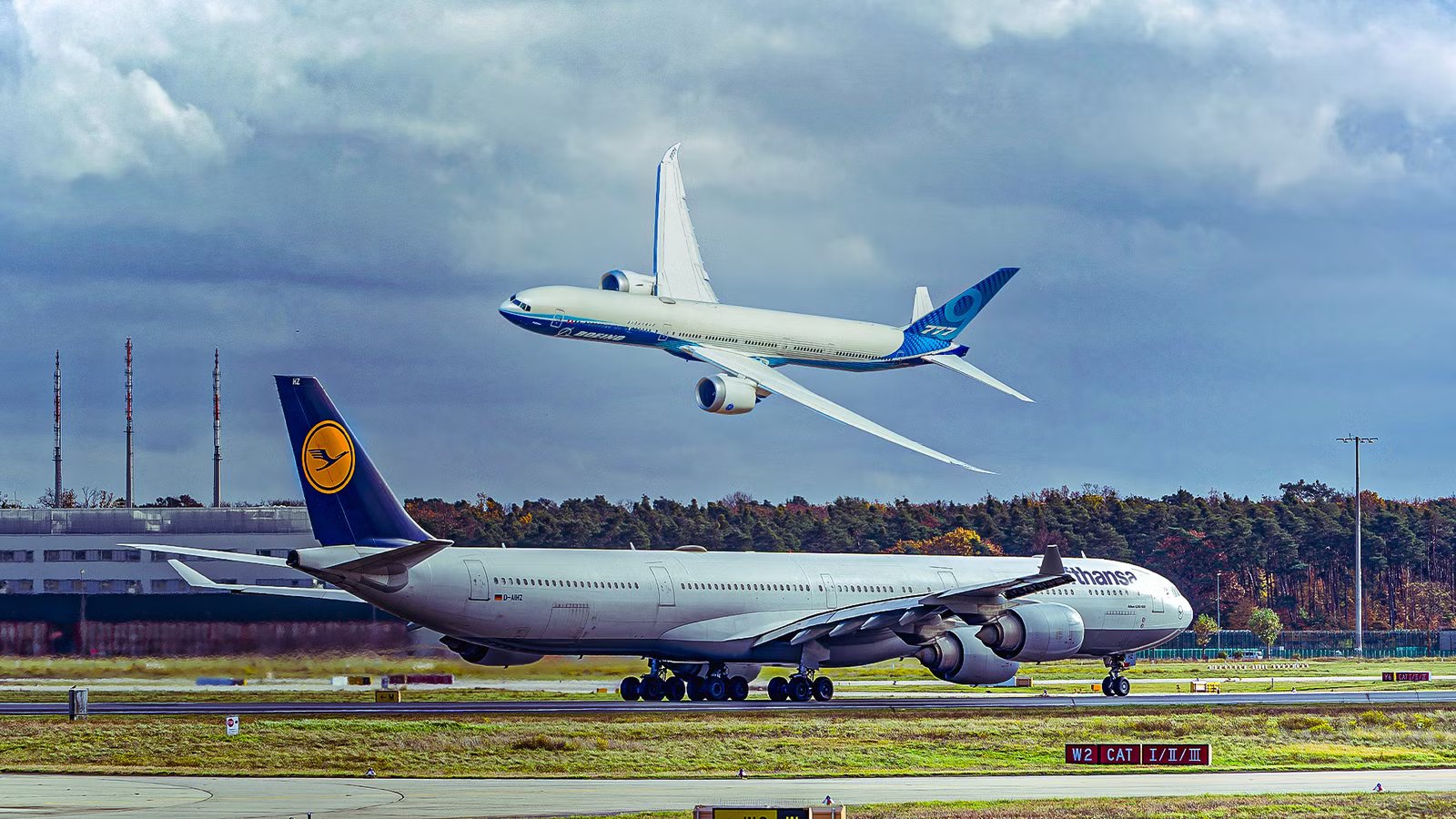
For years, the Airbus A340-600 held the title of the longest passenger aircraft in the world, which defined its very silhouette. Its slender, stretched fuselage earned it the nickname “the long pencil”, a visual marvel that seemed to defy the traditional proportions of widebody jets. However, as the aviation industry shifted its focus from four engines to two, the question of length resurfaced with the announcement of the Boeing 777X. Enthusiasts and passengers alike have wondered if this new big twin finally pushes the boundary further than the classic Airbus quadjet.
To understand this comparison, we have to look at the evolution of the stretch. This article will explore the technical measurements of the Boeing 777-9, the larger variant of the 777X family, and how it stacks up against the A340-600. What are the specific metrics that confirm which aircraft takes the crown, the design philosophies of two different eras of aviation, and what is the current operational reality of a jet that is breaking records before it has even entered commercial service?
Marginal Differences But Major Gains

In short, the Boeing 777-9 is longer than the Airbus A340-600, but only quite marginally. While the A340-600 held the title of the world’s longest airliner for nearly a decade, it was first surpassed by the Boeing 747-8, which entered service in 2011. The 777-9 has now pushed that record even further, measuring a staggering 76.72 meters or 251 feet 9 inches from nose to tail. In comparison, the Airbus A340-600 measures 247 feet 3 inches (75.36 meters). This gives the Boeing 777-9 a lead of approximately 4.5 feet (1.36 meters), over the legendary Airbus.
Now, for the first time, the title of longest aircraft belongs to a twin-engine jet rather than a four-engine quadjet. This is made possible by the incredible power of the GE9X engines, which provide enough thrust to lift a fuselage larger than even the 747-8. In markets where long-haul efficiency is the primary driver for airlines, this extra length translates to a cabin that can accommodate between 400 and 426 passengers in a typical multi-class layout, rivaling the capacity of older four-engine giants.
Historically, the A340-600 was the pinnacle of the long and thin design philosophy, intended to fly long distances with high passenger counts without requiring the massive infrastructure of a 747. However, the 777-9 has redefined those proportions. By stretching the existing 777-300ER fuselage by nearly 3 meters, Boeing has created an aircraft that is not only the longest twin-engine jet ever built but the longest passenger aircraft of any kind ever to reach the production line. For passengers, this means a cabin that feels seemingly endless, but critically, for pilots, it means managing a taxiing footprint that demands more precision than almost any other aircraft in the sky.
New Era For Widebodies

When the Airbus A340-600 was being developed in the late 1990s, the industry was still wary of flying twin-engine aircraft over the world’s most remote oceans. Four engines were seen as a prerequisite for safety and performance on ultra-long-haul routes, such as London to Singapore or Los Angeles to Sydney. Airbus designed the A340-600 to be a hub-buster, an aircraft that could carry a massive passenger load nearly as far as a Boeing 747, but with better economics by using a lighter, stretched fuselage instead of a heavy double-deck structure.
By the time  Boeing began work on the 777X in the 2010s, the philosophy of flight had fundamentally shifted. Improvements in engine reliability and the maturation of ETOPS meant that two engines could now do the work of four with significantly less fuel. The 777-9 was designed to be the ultimate replacement for the aging 747 and A380 fleets, necessitating a fuselage stretch that pushed the boundaries of current airport gate architecture. Boeing’s goal was simple: provide the highest possible capacity with the lowest possible fuel burn per seat. To achieve this, they chose to lengthen the 777-300ER airframe to its absolute limit, resulting in the 76.72-meter length that finally reclaimed the crown from Airbus.
The impact of this stretch strategy is most evident in the fleet decisions of major carriers. For example, All Nippon Airways and Japan Airlines historically operated large fleets of four-engine aircraft for their high-density domestic and transpacific routes. However, as fuel prices rose and environmental regulations tightened, the high-capacity and fuel-efficient twin aircraft became the logical successor.

Boeing 777X Vs. Airbus A350-1000: Who Will Win The Battle For Tomorrow’s Flagship?
The 777X is nearly ready for service, how will it fare against Airbus’ A350?
A Headache For Fleet Planning

The Boeing 777-9 technically holds the crown for length, but critics are quick and correct to point out that you cannot fly a record-breaking jet that isn’t yet certified. As of February 2026, the 777X program is navigating what Boeing CEO Kelly Ortberg calls a “mountain of work” regarding regulatory hurdles. Originally slated for a 2020 debut, the first delivery to launch customer  Lufthansa has been pushed back repeatedly and is now firmly targeted for mid-2027. This 7-year delay has forced airlines to overhaul their entire long-term strategies.
Sir Tim Clark, President of  Emirates, has been a vocal critic, especially given that his airline holds the world’s largest 777X order book of 270 aircraft. Emirates has had to spend five billion dollars to refurbish its existing 777-300ER and A380 cabins just to keep them competitive while waiting for the 777-9. Paradoxically, the 777X’s delay has breathed new life into the A340. Lufthansa has been forced to extend its remaining Airbus A340-600s through at least late 2026, proving that the very aircraft the 777X was built to replace is the only thing keeping those routes operational for now.
|
Airline |
777X Orders |
Operational Reality |
|
Emirates |
270 |
Investing $4B in cabin retrofits to bridge the gap to 2027. |
|
Lufthansa |
27 |
Received the first 777X simulator in Feb 2026 / A340-600s flying through 2H 2026. |
|
ANA |
20 |
Utilizing 787-10s and 777-300ER life extensions. |
The consensus among analysts is that the 777-9 will be the most efficient long-haul option once it enters service, but the delay has opened a massive window for the Airbus A350-1000. Boeing is currently managing reworks on parked 777-9s at Paine Field, a visual reminder of the industrial challenges that come with building the world’s longest airliner.
Still Falling Short?

The Boeing 777-9 is undeniably the length champion, but in many markets, length is often secondary to efficiency. The primary alternative, the Airbus A350-1000, is nearly three meters shorter but boasts a superior range of 8,700 nautical miles. While Boeing focuses on maximum capacity, Airbus has optimized its answer to the long-haul leader for the Project Sunrise-style ultra-long-haul routes, where weight is the enemy.
The 777-9’s length brings with it a real risk of tail strikes. Its 76-meter frame requires a lower rotation rate than shorter jets to prevent the aft fuselage from contacting the runway. While Boeing’s new software mitigates this, the A350-1000’s fixed-wing design offers a simpler operational profile for pilots. However, for slot-constrained hubs like Heathrow, the 777-9’s extra 50 seats per departure make it the only logical choice to replace the aging jumbos without increasing flight frequency.
Ultimately, the 777-9 wins on per-seat economics for high-density trunk routes. Despite this, it remains to be seen how reliable the innovative folding wingtip will be once service begins in 2027. If these mechanical joints require heavy maintenance, the length advantage may be swallowed by ground delays. Contrast this with the A350-1000, which is already a mature platform with a 7-year head start, and it is easy to see why many airlines have already abandoned the idea of integrating the new Boeing addition into Airbus’ offering.

The Aircraft Set To Replace The World’s Largest Commercial Jet
A new era dawns as the iconic superjumbo bows out, but which aircraft will claim the throne?
Actually Less Flexible?

The world’s attention has been fixed on the 777-9’s folding wings, but the real operational exception lies beneath the tarmac. At an MTOW of 351.5 metric tons, the Boeing 777-9 is significantly heavier than the 322-ton Airbus A350-1000. This weight gap creates a massive discrepancy in pavement loading. Despite Boeing’s massive 12-wheel main landing gear designed to distribute the load, many secondary airports, especially in the East Asian market, where the 777 is a staple, may find their taxiways and aprons pushed to their structural limits. This could restrict the 777-9 to major hubs, whereas the lighter A350-1000 can operate more freely across a wider variety of regional runways without risking surface damage.
Another significant drawback remains the risk of a sole-source engine. The GE9X is a masterpiece of propulsion, but it is currently navigating a difficult stage in its development. GE Aerospace is working to resolve new durability issues discovered during high-cycle testing, a common but frustrating hurdle for brand-new engine architectures. Conversely, the A350-1000’s Rolls-Royce Trent XWB-97 has been in commercial service for years already. While the Boeing engine is projected to be 5% more fuel-efficient, the risk for an airline is the unknown maintenance cost of the GE9X over a 10-year period. Airbus offers a known quantity, while Boeing offers a promised advantage that has yet to be stress-tested by the daily grind of 15-hour transpacific rotations.
The 777-9 uses such a radically new engine and wing design, meaning regulators may initially limit its overwater flight paths to 180 minutes, whereas the A350-1000 already enjoys a 370-minute rating. For passengers traveling across the Pacific, for example, this could mean longer flight times for the 777-9 in its first year of service as it proves its reliability. Until the GE9X reaches the 50,000-hour milestone, the 777-9 remains a high-performance machine with a high-maintenance question mark.
The Dawn Of The New Mega Jet

By surpassing the A340-600 and the 747-8, the 777-9 has effectively become the new generation’s mega-jet. It offers a singular solution for the world’s most congested hubs, where additional flight slots are nonexistent, and the only way to grow is to pack more passengers into a single airframe. The 1.36-meter lead it holds over the old Airbus pencil may seem trivial, but in the world of high-density trunk routes, it represents the ability to carry up to 426 passengers with twin-engine economics that were unthinkable a decade ago.
However, the crown of the longest jet comes with a heavy price tag of operational complexity and certification delays. As we look toward the 777-9’s entry into service in 2027, the industry is watching to see if Boeing’s folding wings and massive fuselage can finally deliver on the promise of 747-level capacity with 787-level efficiency.
The 777-9’s legacy will be defined not by its physical length, but by its ability to finally close the chapter on four-engine dominance. Whether you are flying from Tokyo to New York or London to Singapore, the era of the super-twin has arrived. While Airbus has found success with the more versatile A350, Boeing has doubled down on a high-capacity gamble. As the first production models undergo their final tests in early 2026, the aviation world is ready to see if being the longest truly means being the best.