dailynewsnblog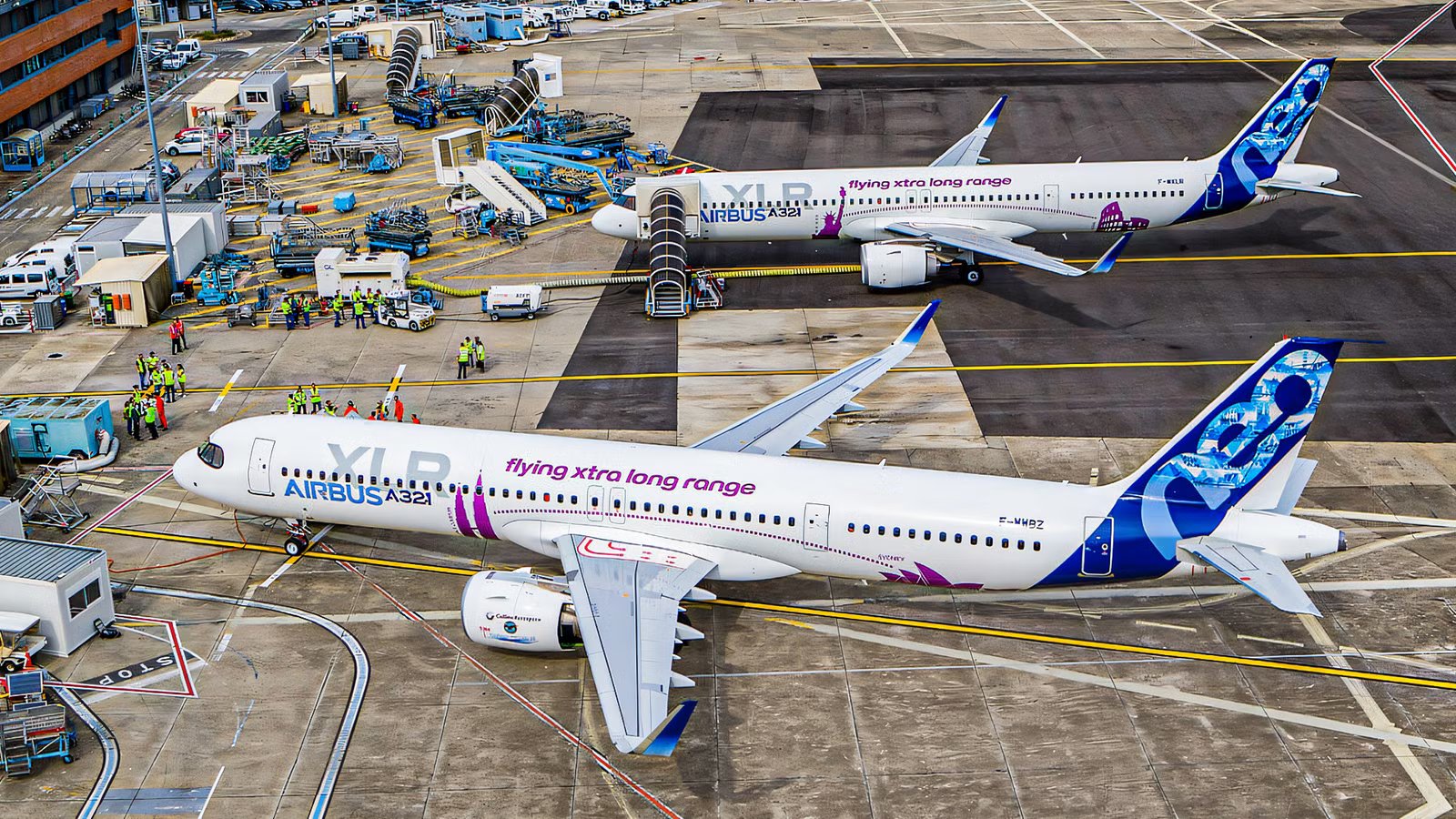
The Airbus A321XLR’s massive fuel tanks create one of the only visual differences between itself and other Airbus A321neo family variants. While the 13,100 liter Rear Centre Tank is not actually visible from the outside, its structure and placement create a noticeably larger belly fairing along the bottom of the aircraft. The XLR’s giant maximum range is enabled by this integrated fuel system, drawing fuel from wing, belly, and auxiliary tanks, all of which are built into the aircraft’s foundational structure.
With the A321XLR rapidly growing in popularity across the industry, currently accounting for around a tenth of all A321neo orders, these long-range aircraft are increasingly used on routes all over the world. Drawing on Airbus production data and various documentation surrounding the Rear Centre Tank, it becomes clear just how important the structural reconfiguration of the A321XLR is to enable long-haul narrowbody operations.
The A321XLR’s Long-Range Mission

Building upon the highly successful Airbus A320 family, the Airbus A321XLR was designed as an extra-long-range variant of the Airbus A321neo. With a maximum range of up to 4,700 nautical miles (8,700 km), the A321XLR promises airlines the capability to operate “long and thin” routes, long-haul routes where demand might not be enough to sustain operating a widebody aircraft. The aircraft’s impressive range opens up countless routes, like from Dallas to Lisbon, Paris to Vancouver, or New York to Buenos Aires.
Together with its range, the A321XLR touts many of the same advantages as the A321neo. These include 30% lower fuel burn and CO2 emissions per seat, along with half the noise footprint of earlier-generation aircraft. Additionally, the XLR has a maximum takeoff weight of 101.5 tonnes, an increase of 4.5 tonnes compared to the NEO variant. This higher weight allows the aircraft to carry additional fuel while still maintaining payload capacity, which is essential for long-haul narrowbody operations.
Inside, the A321XLR looks the same as an Airbus A321neo, with a maximum seating capacity of up to 244 passengers, although many of the XLR configurations operating today seat well below 200 passengers. For example,  American Airlines’ XLR seats 155 passengers, with 20 business class suites, 12 premium economy recliners, and 123 economy seats, while
  Iberia fits 182 passengers on the same aircraft, with 14 business class suites and 168 standard economy seats.
What Is The A321XLR’s Rear Centre Tank?

The Airbus A321XLR’s main additional fuel tank, the “Rear Centre Tank” (or RCT) as described by Airbus, is one of the most distinctive technical features of the aircraft which allows its range of up to 4,700 NM. Unlike previous generations of A321neo aircraft like the A321LR equipped with auxiliary fuel tanks placed in the cargo hold, the RCT is built directly into the A321XLR’s fuselage structure. Occupying the rear portion of the lower fuselage, behind the wing and main landing gear, the tank utilizes space that would otherwise go unused.
Essentially, the RCT stretches the main fuel tanks and the belly underneath the wings of the A321neo further back to make more room for the additional fuel. According to Airbus, the Rear Centre Tank has a capacity of up to 3,460 gallons (13,100 liters) of fuel. In addition, airlines can also install an optional “Additional Centre Tank” (or ACT) in the cargo hold, which provides another 820 gallons (3,100 liters) of fuel capacity for a total of 4,280 gallons (16,200 liters). In comparison, the A321LR, which is typically only equipped with three ACTs, has room for an additional 2,350 gallons (8,890 liters) of fuel. This gives the A321XLR an advantage of about 82% more fuel capacity on top of a standard A321neo than an A321LR, translating into a major difference in maximum range.
|
Aircraft |
Fuel Capacity |
Range |
|---|---|---|
|
A321neo |
6,350 gallons (24,050 liters) |
3,300 NM (6,110 km) |
|
A321LR |
8,700 gallons (32,940 liters) |
4,000 NM (7,400 km) |
|
A321XLR |
8,910 gallons (37,150 liters) |
4,700 NM (8,700 km) |
The integrated design of the RCT helps reduce the need for additional structural modifications post-production and allows the aircraft to distribute fuel weight more efficiently. Additionally, the RCT preserves cargo space onboard the A321XLR, opening up volume once occupied by the three ACTs for cargo. Airlines that operate the A321XLR can therefore maintain their revenue capacity from cargo operations even on long-haul routes, although it is important to note that the heavier the aircraft is, the less range it will have, even with the additional fuel tank. This is particularly important for the growing market of long, thin transatlantic routes where cargo can play an important role, especially as the A321XLR increasingly replaces larger widebodies with greater cargo capacities.

Inside The Airbus A321XLR’s Fuel Tank System
By adding the Rear Centre Tank, Airbus was able to increase the XLR’s range to 4,700 nautical miles allowing it to fill the Boeing 757’s shoes.
The addition of the Rear Centre Tank provides the A321XLR with the most noticeable difference between itself and the base or long-range A321neo. While the RCT is integrated into the fuselage itself, the tank occupies space within the lower fuselage, which requires adjustments to the A321’s belly fairing and surrounding structure. These changes resulted in a slightly modified appearance compared to other A321 variants but ensured proper aerodynamic performance and provided enough protection for the tank during normal operations.
The modified belly fairing is the most noticeable difference visually on the A321XLR. While the RCT itself is not visible as it is located inside the aircraft, the bottom of the A321XLR’s fuselage, particularly aft of the trailing edge of the wing up to the third set of doors (or door plugs) towards the back of the aircraft, is larger and more robust. This design is to accommodate the internal tank and additional structural reinforcements. The fairing itself allows for smooth airflow around the modified fuselage, minimizing aerodynamic penalties associated with the larger bump underneath.
In comparison, as can be more clearly seen in the side-by-side comparison posted by X user Tobias_Gudat, the A321XLR’s bottom belly extends to the aft edge of the mid-aircraft door, while on the A321neo, the belly fairing stops short of the forward edge of the door. In two aircraft that are otherwise essentially identical, this minor difference is one of the few visual clues that an A321 family aircraft is an XLR variant rather than a standard A321neo or A321LR.
Special Certification Conditions For The A321XLR’s Fuel Tank

The unique placement of the Rear Centre Tank, requiring structural modifications from the base A321neo, along with the inherently heavier maximum takeoff weight and altered center of gravity, required additional scrutiny from aviation regulators. Traditionally, airliner fuel tanks are located in the wings of an aircraft, rather than inside the fuselage, as is the case with the XLR. This integrated design puts the fuel tank much closer to passengers than if it were solely located on the wing.
Because fuel is highly combustible in order to produce the energy required to maintain flight, several regulating agencies, like the FAA, expressed initial concerns about the location of the RCT. These included worries about the possibility of more explosive post-crash ground fires. Because the RCT is located much lower on the ground than wing tanks, which are typically higher up and less likely to directly impact the ground in a collision, the RCT could pose a greater threat to passengers in the event of an emergency.
To address potential safety issues, Airbus modified the XLR to focus on mitigating any potential external fuel-fed ground fires. This requires making sure the external walls of the fuel tank, which also serve as the exterior of the aircraft skin, are strong enough to prevent penetration upon impact. This was achieved through the use of advanced fire-resistant materials and rigorous evacuation testing to ensure the A321XLR, with its Rear Centre Tank, is safe in the event of an emergency.

The Striking Differences Between The Airbus A321neo & A321XLR
A321neo set the standard for efficiency; the A321XLR extends single-aisle range to 8,700 km — reshaping long-haul travel with narrowbody economics.
The Difference In Range Between The A321XLR And A321neo

The significance of the Rear Centre Tank becomes clear when comparing the range of the A321XLR with the standard A321neo. The A321neo typically offers a range of just over 3,300 nautical miles (5,920 km), depending on the specific configuration and payload. This range is sufficient for the bulk of medium-haul routes, like between the East and West Coasts of the U.S., but limits its ability to operate routes that the XLR can fly, like transatlantic ones.
As previously mentioned, the A321XLR extends the range of the A321neo to approximately 4,700 NM (8,700 km). This increase of roughly 1,500 NM (2,780 km) allows airlines to connect cities that previously required widebody aircraft. For example, airlines like Iberia are now operating nonstop narrowbody flights from Madrid to Boston and Washington D.C. For U.S. carriers like American Airlines and  United Airlines, the two main U.S.-based customers for the type, the XLR offers connections from the United States to South America and Europe.
The range improvement also translates to much longer flight durations, sometimes stretching to nine or even ten hours. For a narrowbody, this is a significant amount of time spent onboard, given the smaller cabin size and less effective cabin comfort systems compared to widebodies. Additionally, the smaller size of the XLR also translates to slower en-route cruise speeds and longer flight times on the same routes as an Airbus A350 or Boeing 787. However, the lower operating economics of the XLR can often translate into slightly lower fares, providing benefits for both airlines and passengers alike.