dailynewsnblog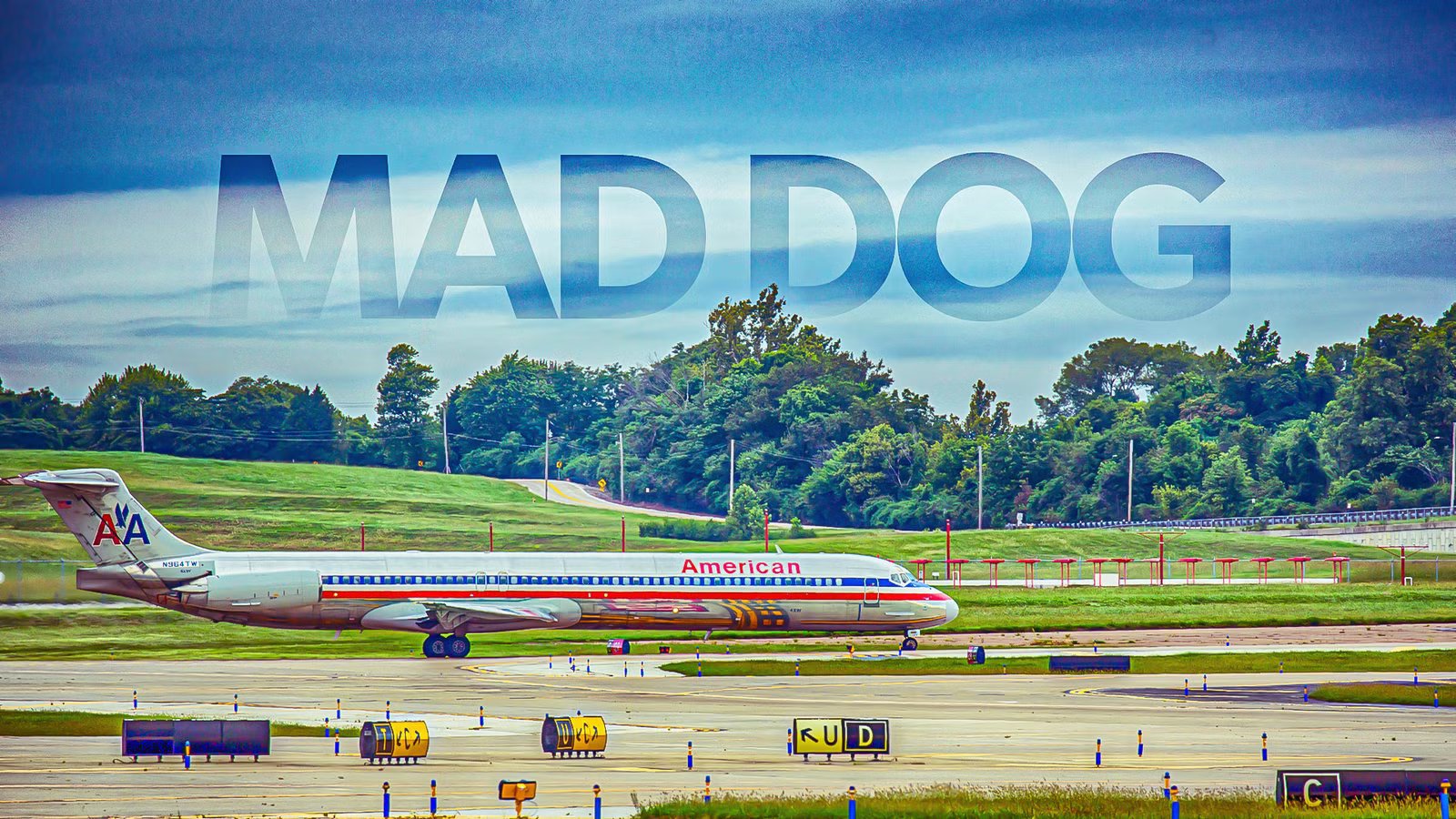
Spend even a small amount of time at any major US airport, and you are bound to see a Boeing 737 in the instantly recognizable livery of  American Airlines. After all, the Fort Worth, Texas-based carrier is one of the largest global operators of the type, with 303 Boeing 737-800s and 93 737 MAX 8s currently operating in its fleet.
But for many years, American Airlines had actually spurned the Boeing 737, choosing instead to build its entire hub-and-spoke operation around the McDonnell Douglas MD-80. For the better part of three decades, their glistening, polished metal bodies with the distinctive T-tails were the predominant aircraft at the airline’s hubs across the country. But why did American choose the MD-80 over the 737, and what caused it to eventually return to  Boeing? Let’s take a closer look.
The Development Of The “Mad Dog”

The McDonnell Douglas MD-80, often nicknamed the “Mad Dog,” was developed in the late 1970s as a second-generation, stretched evolution of the highly successful McDonnell Douglas DC-9. Initially marketed as the DC-9-80 or “Super 80”, it featured a fuselage that was lengthened by over 14 feet compared to the DC-9-50, a 28% larger wing, and more powerful, quieter Pratt & Whitney JT8D-200 series engines.
For all of its advances, the Mad Dog was initially not a very good seller. Swissair was the launch customer for the MD-80, placing the aircraft into service in 1980 after having ordered 15 of the type. Austrian Airlines followed with an order for eight aircraft. The only US carrier that showed any interest was Pacific Southwest Airlines (PSA), which placed an initial order for 12 aircraft.
By late 1982, only 62 aircraft had been delivered in the first two years, and with a backlog of just seven aircraft, the MD-80 program was on the brink of shutdown. To save it, McDonnell Douglas reduced the price of the aircraft to the break-even point just to move planes, but even that didn’t raise sales. The company realized that it needed to do something radical, and most of all, it needed a large US airline to show some commitment to the type, thereby boosting confidence with other airlines. To achieve this, it turned to American Airlines with a unique offer.
American Gets A “Sweetheart Deal”

Going into the 1980s, American was facing its own set of challenges. The 1978 Airline Deregulation Act had ended government control over routes and pricing, and in order to compete effectively, American needed to rapidly build its hub-and-spoke system, centered on  Dallas/Fort Worth International Airport as its fortress hub.
But high interest rates and a recession meant American was cash-poor, and could not afford the multi-billion dollar debt typically required for a massive fleet expansion to support the hub. What made things even more difficult was the airline was saddled with a fleet of 727s that were increasingly inefficient gas-guzzlers. It needed a more efficient, competitive aircraft, but had no easy way to acquire them. Enter McDonnell Douglas with the deal of the century.
|
The Full Details Of The “Sweetheart Deal” |
|
|
Low-Risk Trial: |
American leased 20 aircraft for five years with no money required up-front. |
|
Low Lease Payments: |
Extremely low lease payments were arranged, coming out to less than the interest payments on the financing of a new aircraft. |
|
Easy Exit: |
The airline could return the planes after five years with no penalty, or on 30 days notice with a minimal one-month lease payment penalty. |
|
Profit Sharing: |
McDonnell Douglas agreed to a deal where they would share in the profits if the aircraft proved exceptionally productive for American. |
McDonnell Douglas offered 20 MD-80s to American on a low-cost, low-risk trial basis. The cost to American was paltry — less than the interest payments on a new aircraft — and the airline could return the aircraft at any time if they weren’t happy with them. The only alternative available to American was the Boeing 737-300, which was still two years away from entering service, and Boeing, after picking up a large order from  Southwest Airlines, was in no mood to offer any discounts.
So, American took the offer that it couldn’t refuse, and the rest, as they say, is history. The first MD-82s entered service in May 1983 and proved to be more efficient than advertised, with a 37% reduction in fuel burn per seat mile compared to the 727s they replaced. American also discovered that it was a perfect fit for its new hub-and-spoke strategy, and by early 1984, had returned to McDonnell Douglas and placed an order for 67 MD-82’s, with options for an additional 100 aircraft.
For McDonnell Douglas, the deal was quite literally the saving grace for the MD-80. Other US carriers like  Delta Air Lines and TWA would go on to order the type, and it continued to pick up European customers like Alitalia and SAS. By the time that production of the MD-80 series ceased in 1999, a total of 1,191 had been delivered, with the type even outlasting its original designer, which had been swallowed up in the 1997 merger with Boeing.
The Right Aircraft For The Job

The MD-80 also provided American with a host of other benefits. It was the first jet in its fleet that could be operated by only two pilots, eliminating the need for a flight engineer and reducing cockpit crew costs by 42% per seat mile. The MD-80 also had excellent “hot and high” performance and a faster climb rate than the early 737-300s appearing on the scene, which was critical for airports like Denver or Salt Lake City. And it could operate into smaller fields with shorter runways than the 727 or 737 could handle, even able to push back from the gate under its own engine power.
|
Comparing The Options That American Airlines Considered |
|||
|
Feature |
MD-82/83 |
Boeing 727-200 |
Boeing 737-300 |
|
Engines |
2 (JT8D-217/219) |
3 (JT8D-15/17) |
2 (CFM56-3) |
|
Cockpit Crew |
2 |
3 |
2 |
|
Typical Seats |
140–150 |
145–155 |
128–140 |
|
Max Range |
2,050–2,500 nautical miles |
1,700–2,100 nautical miles |
2,200 nautical miles |
But what was most advantageous to American Airlines was that it was the right-sized aircraft. Specifically, then-CEO Robert Crandall used the MD-80 as a scalpel to surgically dismantle Braniff International’s dominance at DFW, something that was necessary to create the space for it to become American’s fortress hub.
While Braniff was struggling with a bloated fleet of 727s, Crandall leveraged the MD-80’s superior economics to execute a strategy of aggressive frequency. He realized that business travelers preferred more flight options rather than larger aircraft, so he used the MD-80 to offer hourly service on key routes. Braniff couldn’t match this frequency without losing a fortune in fuel on their three-engine 727s. He flooded DFW with connections, timing arrivals and departures in “banks,” making it nearly impossible for Braniff to attract passengers away from American’s massive network. And when Braniff finally collapsed, American was positioned with the perfect mid-sized jet to instantly seize and make use of Braniff’s abandoned gates.

The Last Plane In America With An Analog Cockpit
The McDonnell Douglas MD-80 features an analog cockpit.
Building The World’s Largest MD-80 Fleet

American would go on to operate 391 MD-80s over the course of nearly four decades. The most numerous variant was the MD-82, which American preferred over the original MD-81 as it offered more powerful engines, making it ideal for ‘hot and high’ operations. According to data from ch-aviation, American operated a total of 270 MD-82s, with the first joining the carrier in May 1983 as part of the original batch of 20 leased aircraft. Arrivals continued steadily throughout the 1980s and 1990s, with a final flourish in December 2001 when all ex-Trans World Airlines (TWA) aircraft were added to the fleet following its acquisition by American.
|
The American Airlines MD-80 Fleet |
||
|
Variant |
Number Operated |
First Delivery |
|
MD-81 |
8 |
December 2001 |
|
MD-82 |
270 |
May 1983 |
|
MD-83 |
108 |
June 1987 |
|
MD-87 |
5 |
August 1999 |
American also operated a three-figure contingent of MD-83s, totaling 108 examples. The MD-83 offered a greater range, with more powerful engines and a higher maximum takeoff weight (MTOW), which enabled a greater fuel capacity. The MD-83 started arriving at American with steady deliveries from 1987, with a boost in 1999 as ex-Reno Air examples were added, and again in 2001 when more than 60 ex-TWA examples entered the fleet.
While American operated hundreds of MD-82s and MD-83s, it is also worth noting its less numerous variants of the Mad Dog. It flew five examples of the short-fuselage MD-87, but these ex-Reno Air jets were only a short-term fixture and served American between 1999 and 2001. Similarly, following the TWA acquisition in 2001, it took on eight examples of the MD-80 family’s original MD-81 variant, but these had also left the fleet by 2003.
Boeing Fights Back With The 737-800

With the MD-80 proving to be such a reliable and right-sized aircraft for American Airlines’ hub-and-spoke strategy, the airline completely bypassed the Boeing 737 “Classic” series. However, despite never placing a direct order, American Airlines did briefly operate these variants through airline mergers:
- AirCal (1987): American inherited eight 737-300s when it acquired AirCal. However, these were seen as “oddballs” in AA’s all-MD-80 fleet and were quickly sold or leased to other airlines, such as Southwest and Morris Air.
- US Airways (2013): American technically inherited a fleet of 737-400s from US Airways, but these aircraft were retired by 2015 without ever being repainted into the American livery.
For Boeing, the fact that one of the largest US carriers was ignoring its narrowbody offerings was a source of great frustration. So, as the 1990s were drawing to a close, Boeing doubled down on its efforts to get American Airlines to consider the then-new Boeing 737-800. Through a combination of advantageous pricing and offering early delivery slots, it was able to secure an order in 1998 for 103 aircraft, with the first being delivered in February 1999, less than a year after the type had entered service.
|
Comparing The Options That American Airlines Considered |
||
|
Feature |
MD-80 |
Boeing 737-800 |
|
Engines |
2x P&W JT8D (Low-bypass) |
2x CFM56-7B (High-bypass) |
|
Max Thrust |
19,000–21,000 lbs per engine |
24,000–27,000 lbs per engine |
|
Fuel Burn |
1,050 gallons per hour |
850 gallons per hour |
|
Efficiency Gap |
Baseline |
35% more efficient per seat |
|
Typical Seats |
140 (16 First / 124 Econ) |
160 (16 First / 144 Econ) |
|
Max Range |
2,050–2,500 nautical miles |
3,000+ nautical miles |
For American, the decision to switch to the 737-800 was driven by necessity. By 1998, the MD-80 was facing the end of production, and with the carrier’s oldest examples approaching 20 years of age, the airline needed to settle on a replacement that had a long-term future well into the next century.
It also made sense to go with the 737-800 because it provided 35% better fuel efficiency per seat compared to the MD-80, while accommodating 160 passengers versus the MD-80’s 140. The 737-800 also featured a fully digital glass cockpit with Head-Up Displays (HUD) and hydraulically boosted flight controls, and its newer CFM56 engines have much longer “on-wing” times between major overhauls compared to the older JT8D series.
American would go on to place multiple new orders for the 737-800, and today it is still the most numerous type in the mainline fleet, with 303 examples flying. The airline would become such an important Boeing narrowbody customer that by 2011 it was able to influence the manufacturer’s strategy. At that time, Boeing wanted to build an entirely new aircraft to replace the 737, but American, needing new planes immediately, pressured Boeing to instead put new engines on the existing 737 frame, using a potential deal with Airbus to force Boeing into a corner. To prevent American from switching entirely to Airbus, Boeing’s board approved the launch of the 737 MAXprogram.

In Pictures: American Airlines’ Final McDonnell Douglas MD-80 Flight
The MD-80 was the last aircraft to fly American’s polished aluminium livery.
Final Flights & A Sterling Legacy

Unlike Delta, which only retired its MD-80s and MD-90s after they were grounded during the pandemic, American began to phase out its MD-80s throughout the 2010s as new 737-800s came online. By September 2019, the aircraft had operated its final flight from DFW to  Chicago O’Hare International Airport(ORD), and all that remained were lines of MD-80s in the New Mexico desert. Sadly, the MD-80s retirement also saw the end of the carrier’s iconic polished aluminum tri-color livery that was first introduced in the late 1960s.
American’s flight operations director, David Clark, commented on the MD-80 upon its retirement.
“It is very old school, there aren’t any modern computer screens affixed to the controls. The steering columns are connected to a cable that goes directly to the flight controls. You can feel it give and pull throughout each flight, and it is a totally thrilling experience that pilots trained on newer aircraft may never experience.”
Greg Kunasek, the airline’s MD-80 fleet captain, also praised the aircraft.
“I love the airplane, it’s my second home. I raised my family on this aircraft as we took many trips throughout the years,” he remarked. “My kids grew up seeing the brushed metal finish, which will forever be recognized as an iconic piece of our history. It will definitely be missed.”
Less than 100 MD-80s remain in operational service today, but the aircraft will live long in the memory of the millions that flew on it during its nearly four decades of service with American Airlines. It is no understatement to say that it was the aircraft that rescued the airline from the perils it faced in the aftermath of deregulation and recession, that it was the bedrock upon which it built its hub-and-spoke network, and that it was the foundation for what would become the largest aviation entity in the world.