dailynewsnblog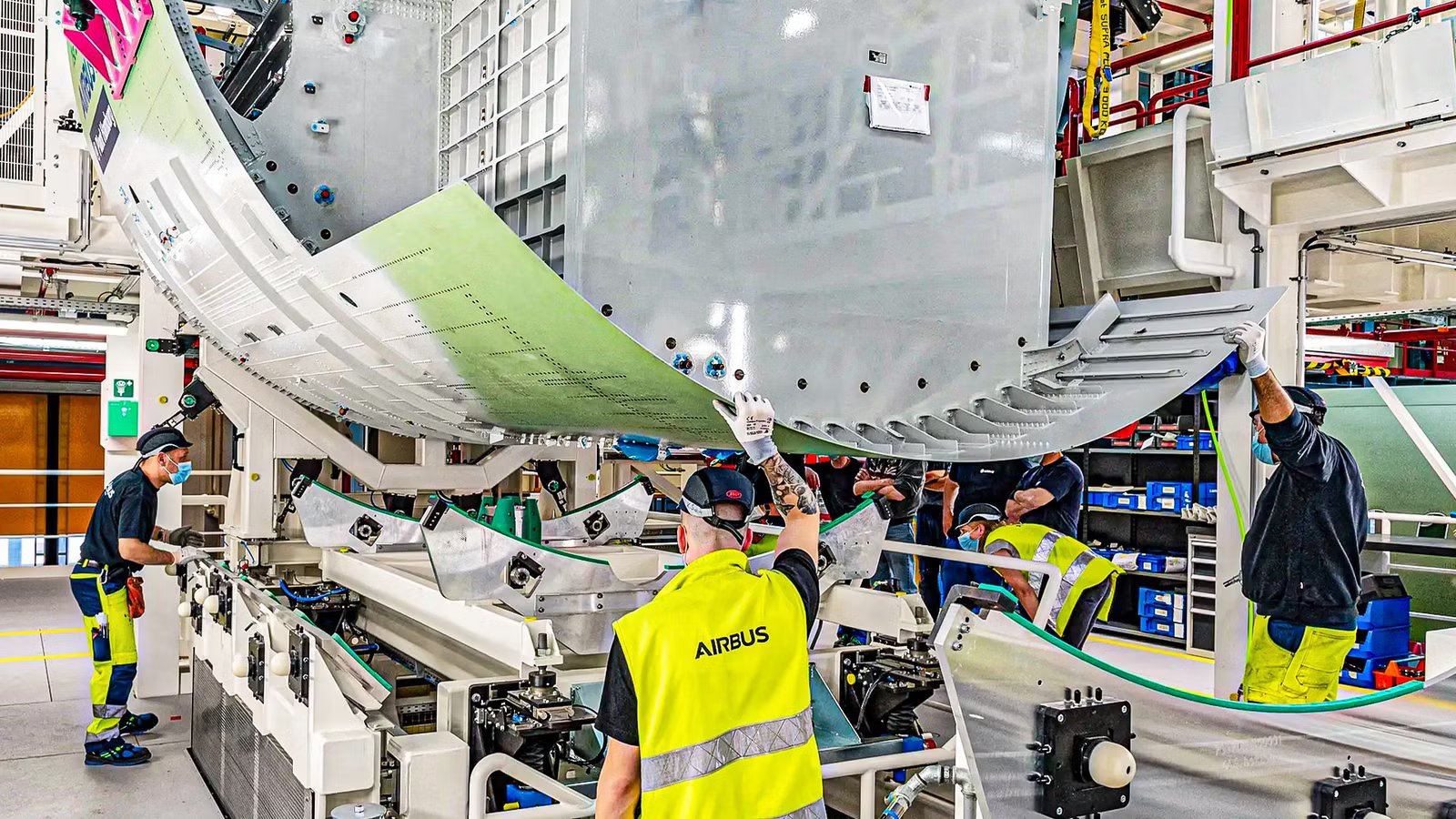
It is well known that commercial aircraft store their fuel in the wings, but while that is mostly true, it is not completely true. Some long-range variants have extra tanks installed, and at the heart of the Airbus A321XLR’s long range is the Rear Centre Tank. While the tank comes with some trade-offs and penalties, it allows the A321 to exploit the mid-sized aircraft market without having to design a cleansheet aircraft.
Around 10% of the A321neos on order are Airbus A321XLR variants. These should be considered specialized aircraft for specific routes. The vast majority of European, Asian, Middle Eastern, and North American routes can be served by the base models and the shorter-ranged Boeing 737 MAX family. Here is what to know about the XLR’s fuel tank system and why it has been successful.
The Airbus A321XLR’s Rear Centre Tank

In May 2021, Airbus announced it had reached a significant milestone in constructing the first A321XLR (Xtra Long Range). At the time, Airbus stated, “production has started in Germany with the structural assembly of the Centre and Rear fuselages.” It said that Premium AEROTEC (an Airbus manufacturing partner) had delivered the first “fully equipped Rear Centre Tank to Airbus’ major component assembly facility in Hamburg.”
Airbus explained that the Rear Centre Tank (RCT) is unique to the A321XLR and is permanently installed. By contrast, some other long-range variants, like the A321LR cousin, have removable tanks to give the aircraft extra range. The RCT is integrated in the A321XLR’s fuselage Sections 15 and 17, located behind the main landing gear bay. According to Airbus, the RCT has a capacity of 12,900 liters (3,400 US gallons). This is more than several Additional Centre Tanks (ACTs) combined that A321s can carry.
Airbus commissioned Premium AEROTEC in September 2019 to manufacture the RCT sub-assembly. Separately, the FAA has previously expressed concerns about the placement of the tank. Wing tanks are typically higher off the ground and so are less likely to be affected by post-crash ground fire. The placement of the center tank meant there were no standard regulations for the type, forcing the FAA to issue a set of special regulations for the tank.
How A321neo, A321LR, A321XLR Differ

The baseline A321neo comes with a tank layout with two wing tanks plus the Center Wing Tank (CWT). It does not carry any other extra tanks in its cargo hold, although it can be fitted with ACTs. This gives the baseline model a fuel capacity of 24,050 liters of usable fuel or around 41,800 lbs. Depending on its mission, payload, headwinds, and other real-life factors, Airbus advertises the A321neo as having a range of up to 3,500 nautical miles.
The Airbus A321LR (Long Range) has the same tank layout as the A321neo but can also carry up to three ACTs in its cargo hold. These tanks are removable and located in the underfloor cargo space. The A321LR with three ACTs has around 32,943 liters of usable fuel or around 57,010 lbs. Increases the usable fuel within the aircraft’s MTOW, adding flexibility for long missions. This extends its advertised range to 4,000 nautical miles.
The A321XLR differs by permanently adding the RCT, while retaining the option for a small forward ACT. This boosts the A321XLR’s fuel capacity to around 36,000 to 39,000 liters or 63,000 to 69,000 lbs, depending on whether the optional ACT is added (it has around 3,100 liters). The RCT allows the XLR to get a narrowbody industry-leading 4,700 nautical miles, and allows it to fill the mid-sized aircraft gap left by the termination and phase out of the Boeing 757.

The Striking Differences Between The Airbus A321LR & A321XLR
The A321LR is designed with the flexibility to have more tanks while the XLR is designed to permanently serve longer-haul routes.
Drawbacks Of The RCT

While the RCT allows the A321 to effectively replace the Boeing 757 (including with Icelandair) and bridge the gap between narrowbody aircraft and widebody aircraft, it comes with drawbacks. There are reasons why the overwhelming majority of A321neo orders are for the base model. The most obvious factor is that the XLR costs more, but that is far from the only factor.
To accommodate the increased fuel volume, the XLR has an increased MTOW of 101 tonnes, up from 97 tonnes. This also increases the aircraft’s structural weight, and extra weight incurs a fuel penalty. This is a fuel penalty airlines have to pay regardless of the distance they fly. Having the RCT as part of the fuselage increases the aircraft’s complexity, and it is harder to inspect, repair, and maintain. There are even added safety complexities with stricter fire protection and crashworthiness requirements.
|
A321 variants (per Airbus) |
A321neo |
A321LR |
A321XLR |
|---|---|---|---|
|
Range (nautical miles) |
3,500-4,000 |
4,000+ |
Up to 4,700 |
|
Tanks |
2 wing tanks + center wing tank (CWT) |
Plus up to 3 ACTs |
Plus 1 RCT + 1 optional ACT |
|
Type |
Baseline |
Reconfigurable |
Permanent tank |
|
Outstanding orders |
Approx. 5,000 |
Unclear, often included in A321neo numbers |
Approx. 500 |
Put another way, the A321XLR is excellent when it’s assigned to long-range missions that shorter-range A321s cannot service. But it is deadweight and worse when operating on shorter routes that the baseline model can service. This is why Wizz Air has slashed its XLR order. After it lost Abu Dhabi as a major operating base to expand into South Asia, it lost the long routes that would require it. Subsequently, it cut its orders for the XLR down from 47 to ten to 15, converting them to the standard A321neo.
Example Routes The XLR Is To Serve

The A321XLR is able to serve or open up various transatlantic thin routes, like from New York City to Prague or from Philadelphia to Naples. It is able to open up various North American and European city pairings outside of the typical thick routes, like from New York to London. It also has the range to connect European cities like London with cities in India, like Mumbai. On the other side of the planet, it can operate routes like Singapore to Tokyo (even though that’s a thick route) or from Kuala Lumpur to Tashkent in Uzbekistan.
Its range means that Australia can host more narrowbody international flights (like Perth to Singapore). It is able to fly from the Brazilian cities of Fortaleza and Recife to Miami and Orlando, respectively. It can also open up new thin routes connecting Africa to Europe, like from Madrid to Dakar. The XLR is impressive in its ability to fly for up to 10 hours.
Overall, the perfect XLR routes are ones with a range of around 3,500 to 4,700 nautical miles or whatever its real-life maximum feasible range is. It is also suited to thinner routes that offer around 150 to 220 passengers a day. Routes shorter than that can be served by baseline A321neos or MAXs. Routes longer than that require widebody airliners (like 787s or A330neos). Additionally, routes thicker than that (e.g., with 300 daily passengers) may be better served by widebody aircraft.

How Much Does An Airbus A321XLR Cost?
The range and efficiency of the XLR commands a premium over other narrowbody aircraft currently on the market.
A Popular Aircraft With High Orders

So far, the A321XLR has attracted around 550 firm orders, including the 30 or so orders Wizz Air is expected to convert. Overall, the A321neo is the world’s most popular aircraft variant, having attracted a total of 7,382 orders for the A321neo family overall. Adding in the A320neo family and the minimal A319neo family, the narrowbody family has a total of 11,605 orders (both on order and delivered).
Around 2,027 A321neo family aircraft have been delivered, leaving an order backlog of 5,355 jets. This makes it the most popular commercial passenger jet on the market with the highest backlog. The A320neo has another 1,822 back orders, giving the NEO family a total order backlog of 7,193 jets, counting a few A319neos on the books. The next most popular passenger jet is the Boeing 737 MAX, which has attracted 7,045 orders, of which 2,200 have been delivered.
Boeing records it has a total of 4,861 unfilled orders for its Boeing 737 family. It also has 96 orders for the Boeing 767, 676 orders for the Boeing 777, and 1,108 orders for the Boeing 787. Airbus has a couple of thousand more orders for around 300 A330neos, 827 A350s, and 456 A220s. In all, the 7,163 A320/A321 family backlog is greater than the total Boeing order book of 6,741 aircraft, making it an exceptionally successful aircraft.
A Narrowbody Range Leader

Compared with the removable ACTs, the XLR’s RCT is fixed, and part of the aircraft’s structure, which allows it to reduce weight with part of the aircraft’s structure doubling up as the tank. That said, it is permanent, meaning that airlines lack the flexibility to change back. It enables the aircraft to exceed the aging Boeing 757-200’s range of 3,900 to 4,100 nautical miles and unlock more routes. The 757-300 was shorter ranged than the 757-200.
By comparison to the A321neo lineup, the Boeing MAX family is shorter ranged. This is made worse by the fact that only the MAX 8 and MAX 9 have their type certificates as of March 2026. The longest range MAX variant, the MAX 7, is to have a range of 3,800 nautical miles (up from the 737-700’s 5,570 nautical mile range), but it is not yet on the market. This leaves the longest ranged MAX as the MAX 8 at 3,500 nautical miles (up from the 737-800’s 2,935 nautical mile range).
The MAX 9 gets 3,300 nautical miles, while the MAX 10 manages 3,100 nautical miles. One notable design difference between the 737 and A320 families is that their ranges move in opposite directions. The stretched A321 has the longest range, while the extra-stretched MAX-10 has the shortest range. The longest ranged MAX aircraft is also the shortest model. This is partly related to how their wings are optimized.