dailynewsnblog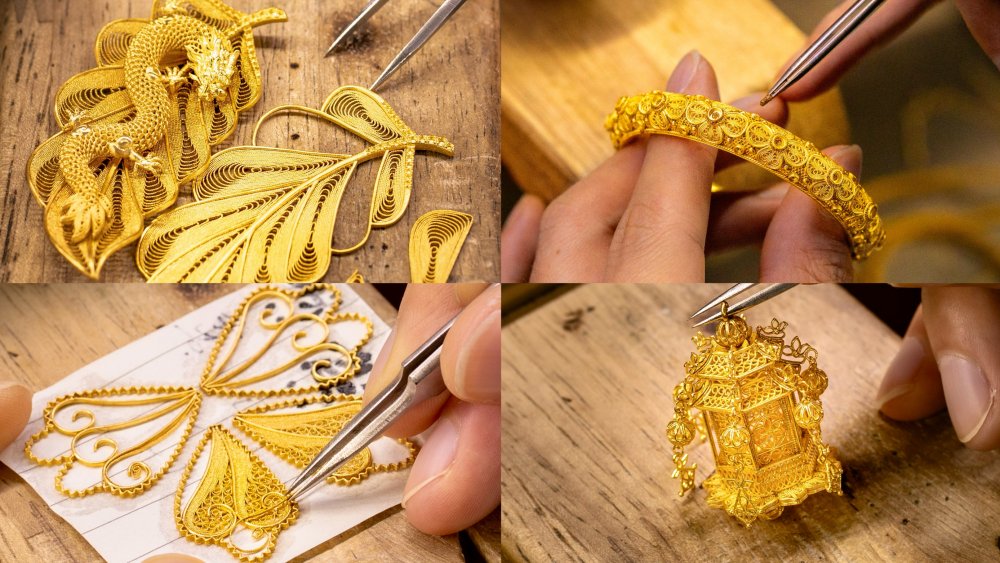
Like Pop Mart, Borland belongs to China’s new wave of founder-led companies taking the world by storm, defined by an unrelenting obsession with a single niche category.
Riding China’s gold jewelry boom, the 10-year-old brand made headlines last December with a 100 million renminbi, or $14.3 million, Series A round led by star investors including Kering Ventures, Challengers Venture Capital and Shunwei Capital.
For Borland founder Xu Zewei, an industrial engineer by training, the draw of the family business — then a storied Beijing jewelry workshop producing made-to-order pieces since the 1980s — was its potential to revive traditional gold jewelry craftsmanship.
“My father has been honing the craft for decades, so I was easily immersed in it from a young age. At the same time, we wanted to create our own brand, our own design language, and innovate beyond what already existed,” explains Xu.
After graduating from McGill University, where he studied supply chain management and finance, Xu officially joined the company and, in about a year’s time, opened the brand’s first retail outlet at the prestigious Hangzhou Tower department store. The breakthrough prompted the company’s move to Hangzhou, where it launched a creative hub surrounded by serene ponds and majestic pagodas.

The filigree inlay technique.
Courtesy
Unlike its peers in the market, Xu has focused on one single craft called the filigree inlay technique, which uses gold filament as thin as a hair to create striking mesh patterns that resemble “metal embroidery.” The second component, inlay work, involves mounting the precious stone to the item or the carving. Additional inlay of a precious stone, which is sometimes omitted, then adds texture to the finished work.
The art of filigree inlay, recognized as an intangible cultural heritage in 2008, is arguably one of the most labor-intensive yet infinitely playful techniques in the Eight Great Traditional Chinese Metalworking Crafts repertoire, allowing for the full exploration of gold’s malleable nature.
“We are not the only brand working with this technique, but our ambition is to master it. In the same way Van Cleef & Arpels has come to be synonymous with the Mystery Set, our goal is to set the industry gold standard for filigree inlay,” enthuses Xu.

The soaring dragon atop a sacred leaf piece.
Courtesy
With 200 pairs of hands strong in its Hangzhou workshop, which is led by filigree masters from Beijing, Borland is able to execute nearly everything by hand, with a typical two-month wait time that remains on the faster end of the current market.
The brand’s bestsellers are pieces featuring auspicious symbols, including a soaring dragon atop a sacred leaf, imperial lanterns, and the gourd, a potent symbol of good fortune.
Beyond its core collections, the workshop has extended its craft into couture-level pieces, which range from dragon and phoenix bridal robes to filigree Miao-style hats, and more.

The gourd pendant.
“Gold has intrinsic value, but that should not be the main selling point,” explains Xu. “I want to change the conversation — We’re more interested in its symbolic weight [of gold] — its relationship with time, memory, and culture,” he added.
Xu likens Borland’s collectibles to single-cask whisky; just like pure gold jewelry, or 99.9 percent gold jewelry, it has become a pursuit of both purist connoisseurs and investors. “We want each piece to resemble single-cask whisky, with its own craft story, its own design, and its own cultural narrative — it’s the ultimate luxury,” says Xu, a whisky lover himself. “This strategy has helped us attract high-net-worth clients who truly value uniqueness, quality and cultural depth.”
Facing a growing roster of competitors — including legacy label Chow Tai Fook, the Beijing-based Laopu Gold, and more trend-driven players such as Jemper Gold and Lamchiu — Xu remains undeterred, as the brand has fostered a deep relationship with seasoned gold jewelry collectors.

A lucky carriage designed by Borland.
Courtesy
“Our clients are not impulse buyers. They are thoughtful, patient and often well-educated about culture and craftsmanship. Many of them are collectors in other fields — art, watches, ceramics,” explains Xu. “They’re already trained to look slowly and they like to ask questions like, ‘Will this still matter in 10 years’ time?’”
In essence, China’s recent turn toward homegrown luxury has reached a new pinnacle with the rise of “pure gold” jewelry labels, a trend Chinese netizens have dubbed as Chinese consumer’s “bloodline awakening.”
For Xu, one more challenge remains — how to explain the aesthetic to a global audience. For now, the company has set its eyes on the Dubai market, where it will be confronted with a more mature gold jewelry consumer.
“It’s a real challenge for every brand out there to develop pieces that strike a balance between tradition and modern styles, but let’s just say we’ve also got plenty of Eastern takes on minimalism to explore — the idea of negative space, for example,” says Xu.
For the tech-savvy Xu, it’s just as important to take note of how technology, including supply chain technology, can continue to fuel the rise of the local craft.
“Take one of the first steps, which is called drawing the gold thread, this process is now neater with the help of machines. It’s about achieving a certain amount of exactitude while preserving the human touch,” says Xu.
For Xu, Borland’s creations preserve the human touch and, more importantly, the human eye.
“Even when designs are similar, the execution of craft is always slightly different. That’s something we value deeply,” says Xu.