dailynewsnblog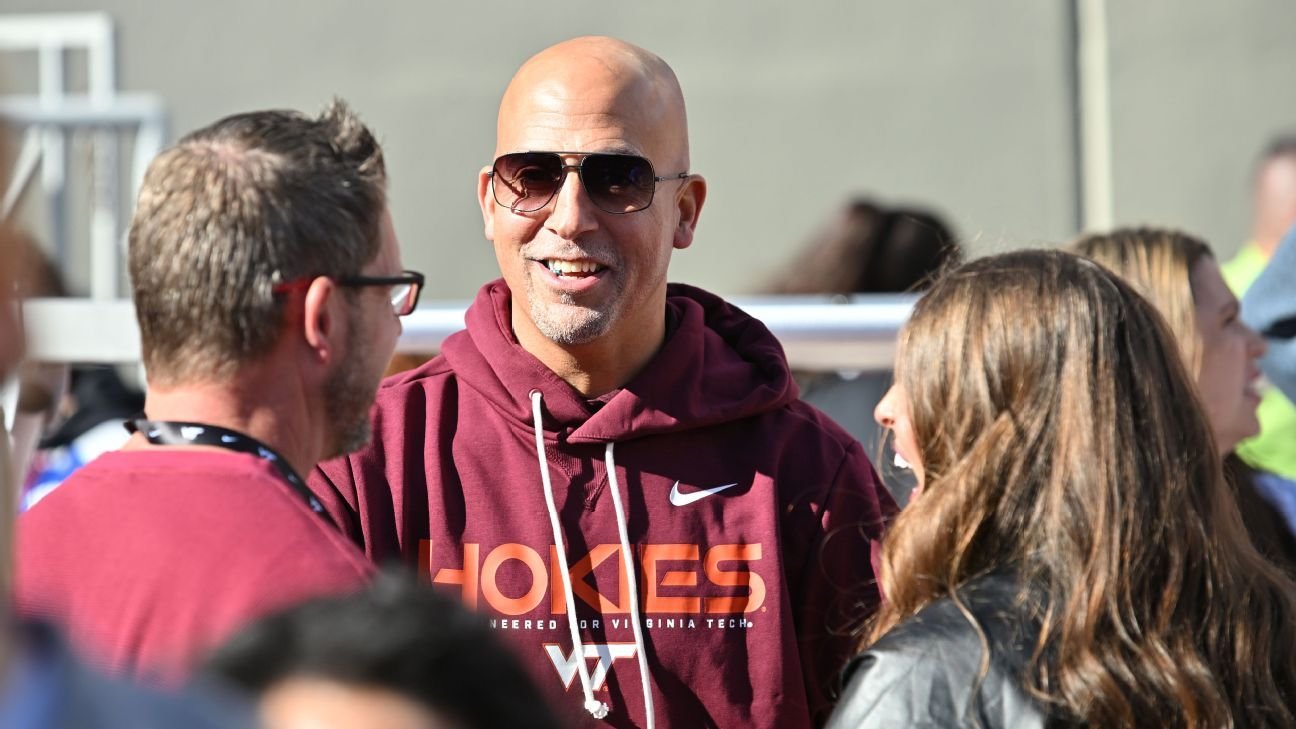
-

Eli Lederman
Multiple Authors
JAMES FRANKLIN DIDN’T have any answers. Instead, minutes before Virginia Tech’s Nov. 22 home game against Miami, he was asking for a considerable leap of faith. Roughly a dozen of them, actually.
It had been just 38 days since Penn State made the decision to fire Franklin six games into his 12th season with the program. Now, sporting a maroon hoodie inside the Hokies’ team room, he was pitching a collection of high school prospects on why they should join him in Blacksburg. Among the group: quarterback Troy Huhn, running back Messiah Mickens and six other recruits who a month earlier had made up the core of a promising Nittany Lions recruiting class.
The clock, less than two weeks from the 2026 early signing period, was ticking. But Franklin, only 72 hours after his formal introduction as Virginia Tech’s new head football coach, was still assembling his coaching staff and learning to navigate his new campus. He also couldn’t say precisely how the program would attack the impending transfer portal window.
“They’re asking me who the coordinators are going to be? And I just said, you have to trust me,” he told ESPN. “‘Who is my position coach going to be?’ And I just said, you have to trust me.”
Franklin and the Hokies picked up 17 pledges over the next 12 days, including commitments from 11 ex-Penn State recruits led by Huhn, Mickens and fellow ESPN 300 prospects Davion Brown and Pierce Petersohn. Unranked upon Franklin’s Nov. 17 hiring, Virginia Tech’s incoming class enters Wednesday’s national signing day 21st in ESPN’s national class rankings, catapulted by the hottest finish to the 2026 cycle of any program across college football.
Virginia Tech’s gain came at significant expense to Penn State, which saw its initial 2026 class crater in the lead-up to the early signing period. With nearly 50% of Franklin’s former Nittany Lions class in tow, the Hokies secured the potential foundation to an ambitious rebuild on a campus just 367 miles south of Happy Valley.
To pull it off, Franklin leaned on long-standing relationships, a trusted recruiting staff from Penn State, a significant financial push on the recruiting trail and a pair of frantic late-November recruiting weekends, in turn offering an immediate window into the promising impact Franklin’s presence could bring to a football program that has posted just one winning season since 2020.
“It was unusual and stressful,” Franklin said. “I don’t want to go through it again. But it ended up working out really well, hopefully for these kids and their families, but also for Virginia Tech.”
ESPN spoke with 12 members of the program’s 2026 class, including eight ex-Penn State pledges, along with program and industry sources to go inside the unprecedented 2½-week recruiting run that supercharged the start of the James Franklin era at Virginia Tech.
“Coach Franklin told us this place was going to be home,” Huhn, ESPN’s No. 12 pocket passer, said. “He told me when I committed to Penn State to always trust him. I just relied on that.”
“We took a detour there for a second,” said linebacker Tyson Harley, another former Penn State commit. “But we got where we were supposed to be because we put our faith into Franklin.”
VIRGINIA TECH’S TORRID finish to the recruiting cycle might have unfolded across 16 days in the final days of a three-win season. For Franklin, however, it was years in the making.
Mickens, for instance, had known Franklin since middle school. He later became the very first to commit to Penn State’s 2026 class. Like him, most of the Nittany Lions’ pledges had spent their high school years around the program, attending camps and visit weekends on campus, with Franklin at the heart of it all. Current and former recruits describe an energetic and engaging coach who forges close bonds with his players long before they step onto the field.
“He’s family,” said Hokies offensive tackle signee Marlen Bright, who was offered by Penn State during his freshman year. “Coach Franklin has been with me on my journey for almost five years now. If you ever see Franklin next to my dad, they’re like brothers. I call him Uncle Franklin.”
Virginia Tech marks the latest restoration project Franklin has undertaken since he landed his first head coach position at Vanderbilt in 2011. His relational approach to recruiting has been central in each stop.
With the Commodores, it helped lay the groundwork for consecutive nine-win seasons in 2012 and 2013. Upon arriving at Penn State in January 2014, Franklin needed only weeks to cobble together an impressive signing class that included future All-Big Ten quarterback Trace McSorley and future NFL pros Chris Godwin Jr., Mike Gesicki and Marcus Allen, a rapid, late-cycle recruiting turnaround that carried many of the same notes as Franklin’s successful start with Virginia Tech.
“He’s one of the best head coach recruiters that I’ve been around,” a holdover from Virginia Tech’s previous recruiting staff told ESPN. “He has a vision and a plan, and he’s extremely personable when recruits are on campus. You understand why he gets good players.”
Franklin had assembled another tight-knit and talent-rich Nittany Lions class in 2026. Then, after an overtime loss to Oregon and two embarrassing defeats to UCLA and Northwestern, he was out as Penn State’s coach on Oct. 12. “I was just in shock,” linebacker recruit Mathieu Lamah said. Several commits, including Brown, the ranked receiver prospect, reopened their recruitments immediately.
Suddenly, the figure behind the program’s incoming class was gone. But Franklin didn’t disappear. Multiple prospects told ESPN that the 54-year-old coach stayed active in class group chats in the weeks after his firing and continued making regular phone calls, reassuring families of former recruits who never really became former recruits.
“He was checking up on me probably once or twice a week,” said Mickens, ESPN’s No. 13 running back in 2026. “He kept it real with me. That just showed my family what kind of coach he was. The whole time, he was telling us he was going to get a job somewhere soon.”
When Penn State fired Franklin, the program’s 2026 class sat at No. 18 in ESPN’s national rankings. Around the same time, Virginia Tech’s class was hanging on by a thread a month after the school fired former coach (and current defensive coordinator) Brent Pry.
Over the next eight weeks, while Franklin plotted his next steps and Penn State embarked on a 58-day search for his replacement, the Nittany Lions’ incoming class fell apart. Multiple former Penn State recruits told ESPN that communication from the program became sporadic. With no head coach in place, the vision for the future was unclear. And the front office infrastructure Franklin had left behind only left the program more vulnerable.
Sources familiar with the program described a Franklin-centric front office operation at Penn State that relied heavily on its head coach and an old-school approach to financials in college football’s NIL/revenue share era. Contracts and negotiations moved slowly, according to families of former recruits. At the time of Franklin’s firing, the vast majority of the Nittany Lions’ 2026 class were not fully locked into revenue share agreements.
“We were trying to get the serious stuff set up and we just couldn’t,” said Lamah, who later signed with Virginia Tech. While programs such as Florida and LSU retained most of their recruiting classes amid coaching upheaval in the fall, Penn State’s collapsed. The Nittany Lions signed just two 2026 prospects during the early signing period. “You can tell who spent this cycle and who didn’t,” an SEC general manager told ESPN.
Meanwhile, by early November, Franklin had made his intention to secure another job clear.
“My name was being mentioned with a number of different jobs and they were getting pulled and pressured in a lot of different directions,” said Franklin, who was linked to Arkansas and Florida State as well as Virginia Tech. “I said [to the recruits], ‘Look, this decision should be made here pretty soon and try to hold out as long as you can.'”
The night Franklin’s hiring was announced, he invited members of Penn State’s recruiting staff to his home and offered them roles in the Hokies’ front office. Eight longtime Nittany Lions personnel figures, including general manager Andy Frank, followed him the next day.
Within hours, Franklin and his staff were back on the phone with recruits. Days later, some of the biggest names from Penn State’s 2026 class visited Blacksburg with the early signing period on the horizon.
“You know the feeling when you go to a family gathering and you see a cousin you haven’t seen in a while?” Bright said. “That was the feeling we had that weekend because that’s family to me.”
WHEN HUHN AND the other former Penn State recruits walked into the hotel lobby of The Inn at Virginia Tech on Nov. 21, one peculiarity in particular caught their attention.
“It just felt weird that Coach Franklin wasn’t wearing blue,” Huhn explained. “That shocked me a little bit. I mean, we’re still getting used to it.”
Short on time, Franklin gravitated to familiarity in his earliest days at Virginia Tech, opting against flying across the country and trying to flip prospects he hadn’t recruited before. Instead, he turned his attention to getting his former Penn State class and the remaining Hokies commits to campus for the final two weekends before the early signing period.
“I wanted to build it with people that I knew, trusted and respected,” Franklin said. “No better starting point for me than the people that I had relationships with. I wanted them to be a foundation.”
Franklin’s first recruiting weekend at Virginia Tech was a concoction of competing emotions: the joyous spirit of a pseudo-Penn State reunion mixed with uneasiness around the early signing period and uncertainty hovering over the Hokies’ interim coaching staff.
“They still had the current coaches on staff there,” said Huhn’s father, Jay. “Coach Franklin invited them to all the events we had. And so it was kind of awkward for everybody. Do I have a job? Is Troy going to be here? It was almost like an interview process for everyone involved.”
However, the unique circumstances also provided an advantage. Seldom, if ever, is a sitting head coach as available on a game weekend as Franklin was in Week 13. While interim coach Phillip Montgomery led the Hokies on the field, Franklin spent the weekend recruiting.
There wasn’t time to hatch any fresh ideas. So Franklin & Co. stuck to the traditional Virginia Tech official playbook. Staff, recruits and their families spent Friday night at McLain’s, a combination bowling alley/arcade/sports bar just off campus. On game day, not even the two-touchdown defeat to Miami could dampen the excitement surrounding Franklin’s arrival. That night, the recruits dug into steak over dinner in the club level overlooking Lane Stadium.
One of the most significant moments of the weekend, according to multiple recruits, came Saturday morning. As the current Hokies warmed up on the field, Franklin pulled the group of official visitors into the program’s team room. He wanted to understand their concerns and share his vision for the future at Virginia Tech. And he wanted to impart how badly he wanted them to be there with him in Blacksburg.
“He sat down with all of us together and just spoke from the heart,” Mickens said. “It was the same coach I committed to at Penn State.”
The next morning, Franklin found Mickens in the hotel lobby. He wanted to get a gauge on where the four-star running back stood on Virginia Tech after the visit weekend. “He told me once I committed, then we’re going to get the whole class,” Mickens recalled.
Mickens left without making a firm decision. He still had a visit scheduled to Oklahoma the following weekend. He thought he needed to take 24 hours to think it over. But somewhere along the five-hour drive home to Harrisburg, Pennsylvania, Mickens’ choice crystalized.
The next morning, Mickens called Franklin and the first domino in the Hokies’ late-cycle recruiting run fell.
“I told Coach Franklin I was going to commit,” Mickens said. “He was like, ‘Cool. Now let’s go get the other guys with us.'”
MICKENS OFFICIALLY ANNOUNCED his commitment to Virginia Tech on Nov. 25. The rest of the ex-Penn State contingent followed over the next week, including Huhn on Dec. 1. Among the former Nittany Lions pledges who visited for the Miami game, four-star safety Matt Sieg, who signed with West Virginia in December, marked the Hokies’ only miss.
Coveted in-state offensive tackle Thomas Wilder, a previous Virginia Tech commit, rejoined the program’s class Dec. 1. Late-cycle decommits Maddox Cochrane (Wisconsin) and Garrett Witherington (Kentucky) — prospects Franklin’s staff has previously pursued at Penn State — jumped at the opportunity to be part of Franklin’s rebuild as well, tacking on to the late surge of incoming talent that will represent the Hokies’ highest-ranked signing class since 2018.
“We needed a foundational class to build around,” Franklin said. “At the end of the day, it came down to the relationships we had with these kids and their families.”
By the close of the early signing period, Franklin and Virginia Tech had 22 pledges and a top-25 class. Two months later, Franklin insists the pilfering of the Nittany Lions’ class “was not an attack or a shot at any program.” Nonetheless, as former Iowa State coach Matt Campbell inherited a tattered class at Penn State in December, the contrasts were impossible to ignore.
Franklin’s instant retool and the decisions Virginia Tech made that led to it have drawn praise from across the sport. “It’s the blueprint for why you hire and fire someone early,” one ACC general manager said. Industry sources were particularly impressed with the Hokies’ financial aggression in the final weeks of the cycle; multiple sources confirmed to ESPN that one former Penn State recruit more than tripled his previous $250,000 deal upon signing with the Hokies.
The Franklin era at Virginia Tech is still very much in its infancy. After pulling together a 25-man portal class featuring 12 Penn State transfers in early January, Franklin hit the road to begin his work in the 2027 class last month. “I literally haven’t even been around our guys,” he told ESPN.
Early signs, though, are encouraging. Beyond his initial success on the recruiting trail, Franklin has successfully blended Pry-era personnel holdovers into his Penn State-heavy front office. He still believes his model of program-building, once adapted to the unique features of Virginia Tech, can work in 2026. And the university has displayed a motivation to continue to invest in the program. Since pledging $229 million in athletic department spending over the next four years late last year, the school has announced record donations — including a $20 million gift from an anonymous donor in December — and plans for major facilities upgrades.
No different from Vanderbilt or Penn State, Franklin believes he can build at Virginia Tech.
“The challenge is to do it again and do it at a different place and a place that’s very hungry to win,” Franklin said, “But the reality is I need to surround myself with people that I trust and that I can build this thing around.”
On that front, Franklin is already on his way. He landed at Virginia Tech in November flanked by key players from his Penn State recruiting staff. Sixteen days later, they were joined by 11 more familiar faces from the 2026 class who signed on to follow them into the Hokies’ program.
But a disastrous Nittany Lions season that spiraled despite consistent recruiting and significant financial investment is still fresh. Months into his tenure, Franklin is quick to caution: On the field, inside the program and at the administrative level, the Hokies still have a long way to go.
“It’s early on,” he said. “The good thing is there’s a ton of excitement to get Virginia Tech back to where it was. But there’s still a lot of work and tough decisions that need to be made.”