dailynewsnblog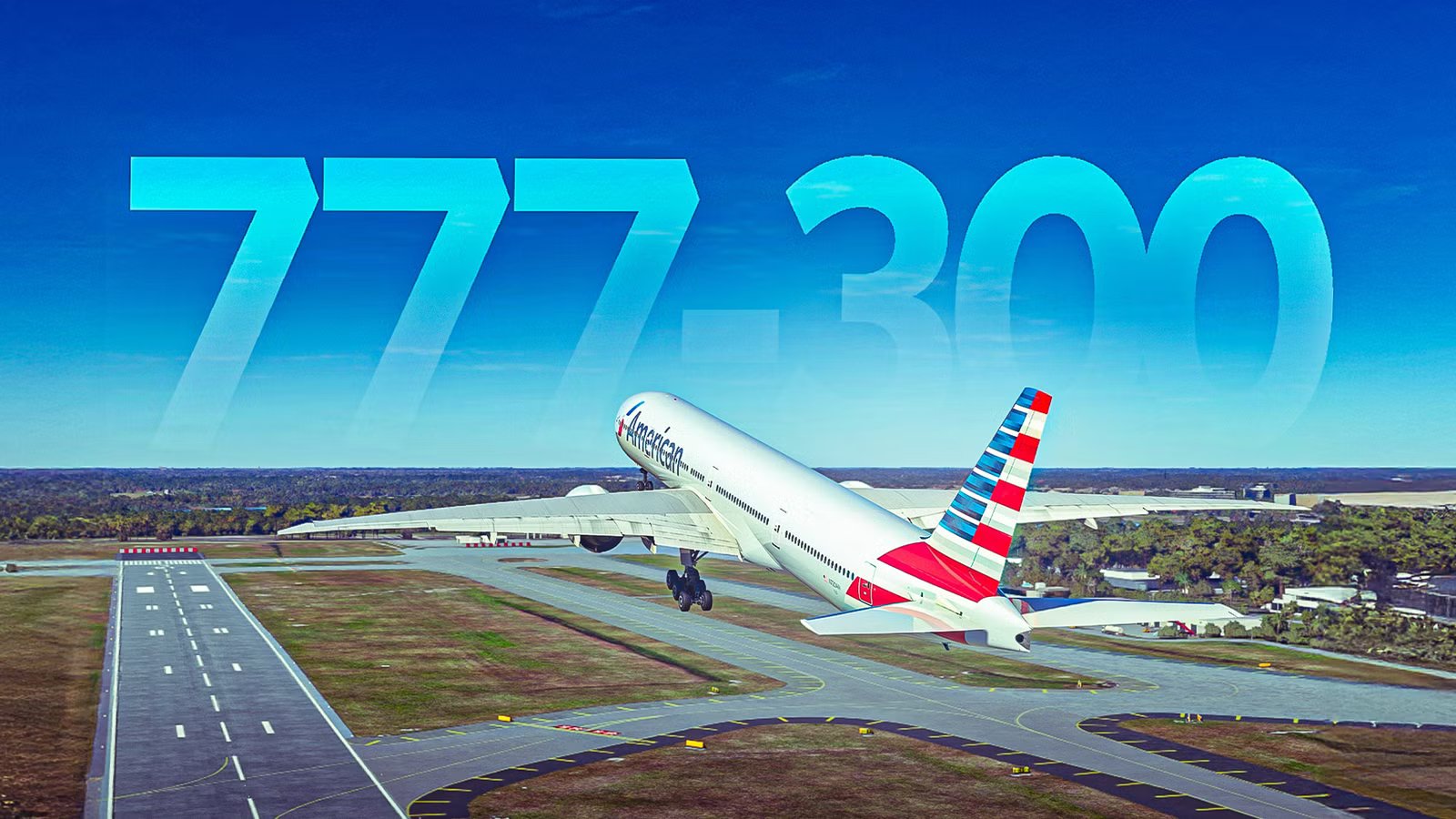
The title of ‘flagship’ is a prestigious designation typically given to the largest, most impressive aircraft in a given airline’s fleet. These will also usually feature an airline’s top-of-the-line onboard seating products, as well as a more premium configuration than other aircraft in an airline’s fleet. As such, a flagship aircraft is often deployed to a given carrier’s largest markets, which typically have the heaviest business demand, such as New York, London, Tokyo, Paris, Los Angeles, Sydney, and other globally influential cities.
At American Airlines, the title of flagship has been bestowed on the Boeing 777 since 1999. Initially, the American 777 fleet was solely made up of 47 777-200ERs, but in 2012, American began taking delivery of 20 Boeing 777-300ERs. These debuted with a new livery, along with new seats in all classes, ushering in a new era for American Airlines. This article will explore the flagship of the American Airlines fleet: the Boeing 777-300ER.
The Role Of The 777-300ER Fleet In American’s Fleet

American Airlines operates 20 777-300ERs along with 47 777-200ERs, making for a combined fleet of 67 Boeing 777s. It bases the 777s in New York, Charlotte, Miami, Dallas/Fort Worth, and Los Angeles. American uses the 777-300ER at all of these hubs, although it operates only one daily flight out of Charlotte (to London) with the type. The 777-200ER is used as the carrier’s general workhorse, whereas the 777-300ER serves a select number of destinations.
From Dallas, the 777-300ER operates all the carrier’s flights to London Heathrow. From Miami, American operates the 777-300ER to London Heathrow and to São Paulo, while the 777-300ER is used for most of American’s flights from New York to London. The 777-300ER also flies to London from Los Angeles, and American also operates the 777-300ER from Los Angeles to Sydney.
The 777-300ER in American’s current configuration seats 304 passengers in a four-class layout. This is divided between eight first class seats, 52 business class seats, 28 premium economy seats, and 216 economy seats. In contrast, the 777-200ER seats 273. With the huge number of premium seats on the 777-300ER, American only deploys these aircraft to the world’s most influential cities, many of which are major  oneworld hubs.
First Class On The 777-300ER

American Airlines is the only US airline to offer international first class, and the 777-300ER is the only aircraft in its fleet to feature it. This is the pinnacle of premium travel in the US, as it is the most elaborate and exclusive cabin in the country. However, when compared to other first class products offered by foreign airlines, American has been criticized for its onboard offering, as its ‘Flagship First’ cabin is light on bells and whistles, while also having an open design with minimal privacy.
The seat is a Zodiac (now acquired by Safran) design with a four-abreast layout, and it is significantly more spacious than a business class seat, but it does not feature privacy doors like most international first class products. Rather uniquely, the seat rotates up to 90° away from the aisle, allowing passengers to work on the side table while facing the window. The seat also needs to be rotated slightly to align with the ottoman when in use as a bed.
The cabin only features two rows, making for a total of eight seats. With two lavatories and a few passengers, this makes the experience of flying Flagship First far more personalized than in business class. The onboard soft product is also upgraded from business, with improved catering and drink selections. While the difference between the two isn’t as striking as on some carriers, American’s Flagship First still offers the best onboard experience on the 777-300ER.
Flagship Business On The Boeing 777-300ER

Throughout its widebody fleet, American Airlines offers four types of business class seats. However, all four are remarkably similar as American has focused on reverse herringbone seats. The primary benefit of a reverse herringbone seat over other types of business class seat models is that every seat is virtually identical. As such, customers receive the same experience regardless of where they’re seated, whereas other types of seats, like staggered products, have more variation in quality.
The 777-300ER was the first in American’s fleet to offer a reverse herringbone product, using the Safran (formerly Zodiac) Cirrus II. This was one of the most successful reverse herringbone models in the 2010s, and it was also used by carriers such as Cathay Pacific and Finnair. The distinguishing feature between the Cirrus and the Collins Aerospace Super Diamond, its primary competitor, is that the Cirrus II has a screen that folds out rather than being fixed.
|
Seat Model |
Aircraft |
|---|---|
|
Safran Cirrus II |
Boeing 777-300ER |
|
Safran Concept D |
Boeing 777-200ER, Boeing 787-8 |
|
Collins Aerospace Super Diamond |
Boeing 777-200ER, Boeing 787-8, Boeing 787-9 |
|
Adient Ascent |
Boeing 787-9 |
The 777 features 52 Flagship Business seats arranged four-abreast across 13 rows. Rows three and four are located in a small mini-cabin ahead of the second seat of emergency exit doors, making for a far more private and intimate experience, given that there are only eight seats in total. The remaining 44 seats are all located in the main business class cabin, which occupies the full space between the second and third set of exits.
Premium Economy On The 777-300ER

American Airlines was the first airline in the United States to introduce premium economy when it began taking deliveries of Boeing 787-9s with the new cabins in 2016. The 777-300ERs were originally delivered with just first class, business class, and economy, but were later retrofitted to feature the new premium economy seats. Other than a reupholstery project for the economy cabin, this is the only major refurbishment performed on the 777-300ER so far.
Whereas the seats in the front half of the aircraft were supplied by Zodiac, American chose the Collins Aerospace MiQ for its premium economy seats. This is one of the most popular seat models for premium economy and short-haul first/business class around the world, with this being the seat that American uses on nearly all of its twin-aisle aircraft. American also uses the MiQ as its domestic first class seat, and this model is used by Delta and United for long-haul premium economy as well.
|
Airline |
Widebody Aircraft With Premium Economy |
|---|---|
|
American Airlines |
Boeing 777-200ER, Boeing 777-300ER, Boeing 787-8, Boeing 787-9 |
|
Delta Air Lines |
Airbus A330-200, Airbus A330-300, Airbus A330-900, Airbus A350-900, Boeing 767-300ER, Boeing 767-400ER |
|
United Airlines |
Boeing 767-300ER, Boeing 767-400ER, Boeing 777-200ER, Boeing 777-300ER, Boeing 787-8, Boeing 787-9, Boeing 787-10 |
American configures the 777-300ER with 28 premium economy seats. The cabin is configured with eight seats across three rows by the windows and four rows in the center. American’s offering is largely the same as what the premium economy seats on its rivals feature, although American’s premium economy seats do have slightly smaller screens and do not include a legrest, a feature offered by both  Delta Air Lines and
  United Airlines.
Economy Class On The 777-300ER

Despite being significantly larger than the 777-200ER, American’s 777-300ER only seats four more economy passengers than its smaller sibling, reflecting just how premium these airliners really are. Like its US rivals, American offers extra legroom seating, called ‘Main Cabin Extra,’ with at least 34″ of legroom, compared to the standard 31″. However, American only sells 28 seats in Main Cabin Extra on the 777-300ER, which is significantly fewer than what its rivals typically offer.
The economy cabin features the Safran Weber 5751, a common economy seat from the 2010s. As is standard on Boeing 777s today, American configures its economy seats ten abreast, making for a comparatively tight onboard experience. The Safran Weber 5751s are also found on American’s 777-200ERs and older Boeing 787s. These seats also feature a 9″ display and 3″ recline, which is comparable to rivals.
|
Airline |
Economy Seat Models On Widebody Aircraft |
|---|---|
|
American Airlines |
Safran Weber 5751 (Boeing 777, Boeing 787), Collins Aspire (Boeing 787) |
|
Delta Air Lines |
Safran Weber 5751 (Boeing 767-300ER), Collins Pinnacle (Airbus A330, Boeing 767-400ER), Recaro CL3710 (Airbus A350) |
|
United Airlines |
Collins Pinnacle (Boeing 767, Boeing 777-300ER, Boeing 787-8, Boeing 787-9), Collins Aspire (Boeing 777-200ER, Boeing 787-9, Boeing 787-10) |
Innovations in economy class are more subtle than in premium classes, as they largely relate to incremental improvements in space and weight reduction. These seats, while innovative in 2012, are outdated by today’s standards, but not to the extent that passengers will notice much difference. They’re slightly heavier than newer seat models like the Collins Aspire and have a less space-efficient design, but the differences are subtle.
What The 777-300ER Will Soon Look Like Inside

American began receiving its first 777-300ERs around the same time as when the iPhone 5 came out, but the interiors of these planes have largely been kept the same since their introduction, and they’re no longer state-of-the-art. As such, American Airlines will soon begin retrofitting its entire fleet of 777-300ERs under ‘Project Olympus,’ aiming to overhaul the entire aircraft from nose to tail to bring its flagship aircraft in line with its future brand direction.
Flagship First will be going away, instead being replaced by the Flagship Suites business class already present on the 787-9P subfleet. The seat model is the Adient Ascent, and it offers technological improvements, including a larger screen, along with a privacy door. Premium economy will feature the Recaro R5 with privacy wings, while economy will use the Collins Aspire. Throughout the aircraft, American is updating technology and increasing screen sizes.
The Olympus 777-300ERs will feature 70 business class suites, more than any other US airline, along with 44 premium economy seats and 216 economy seats, for a total of 330 seats. Despite larger premium cabins, American was able to retain the same number of economy seats by removing galleys and lavatories.