dailynewsnblog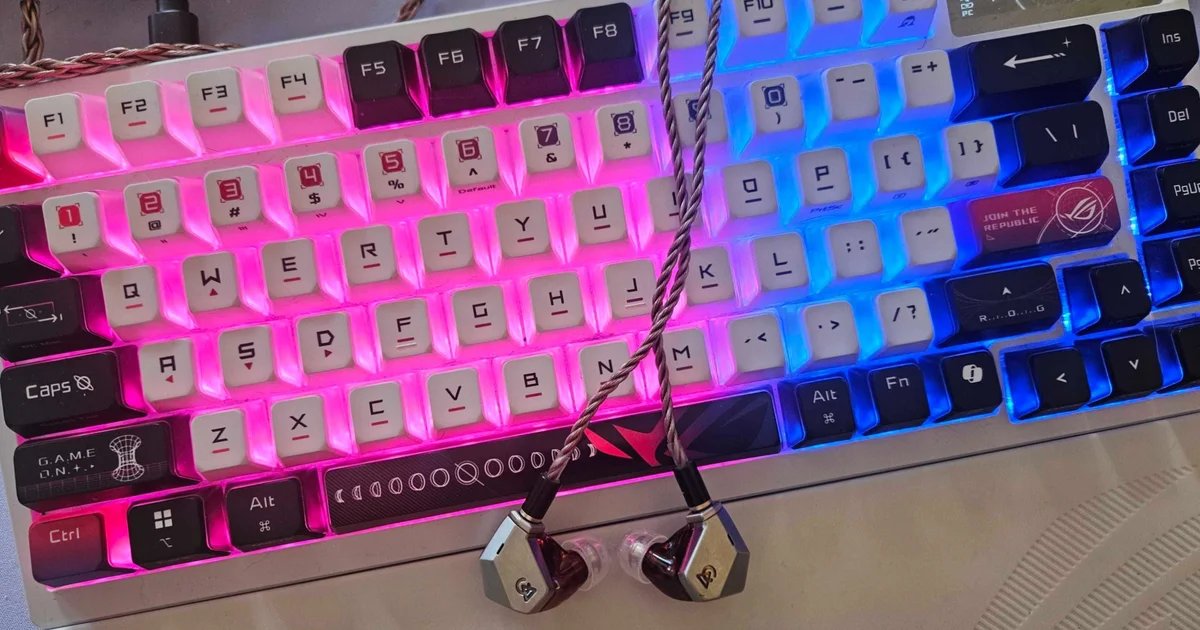
Over the past few years, I’ve been searching for the best audio option for my PC gaming setup. It’s been a battle. I have big, satellite-dish ears and the kind of Neurospicy that makes ear cushions and heavy headsets unbearable to wear. I’ve tried and tested nearly a dozen headsets in my mission to find the best fit, and I recently found it in the most unexpected place: IEMs.
IEMs, or in-ear monitors, wear like wired earbuds but provide sound quality on the same level as a top-tier pair of headphones. Nonetheless, I was sceptical. How on earth could these tiny little buds challenge the SteelSeries Arctis Nova Pro Wireless sitting on my desk, or throw hands with the £280 ROG Kithara? Yet it turns out – as long you don’t need an integrated mic, at least – that IEMs are small but mighty, and offered everything I was looking for in pure audio performance.

Much of IEMs’ appeal comes down to the absolute fundamentals of sound tech. One reason I’ve come to love them is that they are invariably wired, which might sound weird to anyone who’s embraced the convenience of wireless headphones, but then jacked IEMs offer both more input options and less compression than wireless headsets. Which is important, as compression can flatten sounds and make them harder to distinguish in a mix. For example, when I play breezy farming life sim Story of Seasons: Grand Baazar with my Arctis Nova Pro Wireless, the full orchestra soundtrack would mush together, and I occasionally lost the sounds of my pickaxe hitting a rock or my footsteps on the ground as the soundtrack and atmospheric sounds ran together. I play cozy games for that tactile feel and for the relaxation of the soundtracks, so this was a big bummer.
However, when I played with a pair of Campfire Audio Iris IEMs for the first time, the improvement in clarity was genuinely shocking. Every footstep was cleanly layered under the soundtrack, and I could hear every instrument clearly as songs shifted between seasons. It was a night and day difference, way beyond the degree I expected. The Arctis headset offers so many presents that are fine-tuned for different games, but I couldn’t ignore the wireless compression once the Iris had made it apparent.
The vast majority of gaming headsets also aren’t tuned for true hi-fi (high fidelity) audio, the audiophilliac standard for reproducing sound with as much accuracy and and as little distortion as possible. This is changing somewhat, the aforementioned ROG Kithara being the result of a collaboration between Asus and premium headphone makers Hifiman, but headsets with full hi-fi compatibility remain extremely rare.
IEMs, on the other hand, are hi-fi by nature, their origins being in professional musicianship and sound engineering. And they sound even better with a dedicated amplifier, which can sit between the IEMs and a PC or even come as as inline cable attachment. I eventually settled on the Fosi Audio K7, a desktop amp that’s since been imbuing my tiny IEMs with huge amounts of audio power.

Their design sets them apart as well. In a headset, soundwaves are projected into the earcup via a large driver and diaphragm. Even though it’s only a few centimetres of travel distance before these waves reach the ear, that still opens up the chance for the sound to become distorted on its journey. Closed-back headsets with active noise-cancelling can even create sound reflections in the trapped space, which dulls and wraps sound. Most of the gaming headsets I’ve used over the years have been closed-back, and I usually find I need to turn the volume up to hear clearly.
IEMs don’t have this problem. When I pop in my Iris monitors or my Fosi Audio IM4s, the shell sits directly in my ear. The sound is then projected directly into my ear from the nozzle, and is shaped by the type of eartip I’ve selected from the bundled pairs. I prefer the more balanced sound of silicone tips, though I will swap for foam if I’m listening to soundtracks with heavy bass. Because the IEM leaves so little empty ear-space, it can project clear, high-fidelity sound with minimal opportunities for en-route distortion – a quality that’s as conducive for better game audio as much as it is for music.
I was also pleasantly surprised to find that each pair of IEMs I tried offered something a bit different in terms of sound. My Campfire Audio Grand Luna are best at warm, rich tones, so I love them for the epic soundtracks of RPGs like Final Fantasy VII Rebirth. It’s the Iris monitors, though, that make for ideal everyday use. Back on the Arctis Nova Pro Wireless, the dead-silent world of The Long Dark never felt as quiet or as tense as the first time I played with the Irises in. Suddenly, every crack of the ice, shift in the breeze, and crunch of my footsteps felt overwhelming. When surprised by a pack of wolves, the aural shock nearly ejected me from my chair; the fierce sounds of their teeth crunching my character with a sickening sharpness. It was delightfully terrifying, and exactly what I want in a pair of headphones.

IEMs’ weakness against regular music earbuds has typically been price: a ‘cheap’ IEM set is always more expensive than a pair of bargain bin ‘buds. Next to the costlier competition of gaming headsets, however, they look a a lot more like good deals. The new Fosi Audio IM4 open-back IEMs, for instance, are £100 / $100, about the same as the SteelSeries Arctis Nova 3X Wireless and its PlayStation version, the Nova 3P Wireless. I’ve used both the latter and the IM4s, and where the Nova 3P Wireless can sound hollow and flat, the IM4s deliver crystal-clear, pin-sharp audio without a bulky headset or ear claustrophobia.
For those of a more luxurious persuasion, the next bracket up still matches high-end gaming headsets, but with the power and accuracy of IEM drivers. Take something like the Razer Blackshark V3 Pro: at £250 / $250, it is less than the $350 Campfire Audio Iris IEMs. But while its Hyperspeed wireless tech claims to cut latency, it can’t prevent compression, and the bulky earcup design is an effective trapper of hot, sticky air. The Irises not only sound more detailed, but come with heaps of extras too, from the carry case and all the cables you’d need to multiple ear tip sets and a cleaning kit.
The Irises also produce a natural soundstage that more effectively enables a sense of being in the same place as the sound that’s being projected – a clear advantage for games. This spatial audio isn’t the same as the THX 3D audio that the BlackShark V3 Pro is equipped with, but it still feels more accurate and detailed. The Iris is also free of battery limitations, and can be worn for long periods of time with excellent comfort. Additionally, while gaming headsets are often defined by their built-in noise isolation, IEMs naturally seal sound out when a proper fit is achieved with an ear tip. If a headset’s ANC isn’t strong enough, outside noise interference can be a real annoyance. I’ve never had such an issue while wearing my IEMs.

IEMs are versatile, too. I use my IEMs to play games, listen to music, and take video calls on my PC all day long, but can also instantly swap the 3.5mm jack into my Steam Deck – no USB-C receivers or wireless pairing required – to get the same excellent audio quality in handheld form. No bulky headset to interfere with my sofa-laying, either. With equal ease, IEMs can also plug into the headphone port on gamepad controllers, though you’ll get better sound quality by sticking the cable directly into a PC, handheld, or amp.
The one big downside to IEMs as gaming devices is that they typically don’t include microphones. This doesn’t bother me personally, as I rarely stray beyond singleplayer, and I keep an Audio Technica podcast microphone for occasions where I need to speak up. You might feel the loss of a headset mic more keenly, but then if it isn’t an outright dealbreaker, I would say that the boost in audio quality is definitely worth it. Desktop microphones tend to sound better than built-in headset mics too.
Even now, the transformative effect of playing games on IEMs is still surprising me in the best possible way. Compared to any conventional headset I’ve ever used, SFX details are clearer, atmospheric sounds are more impactful, and the comfort level is much more agreeable to my long-sufffering ears. If you don’t like wearing big over-ear headsets or are just looking to make your games sound better, give IEMs a shot. I know I won’t be going back.