dailynewsnblog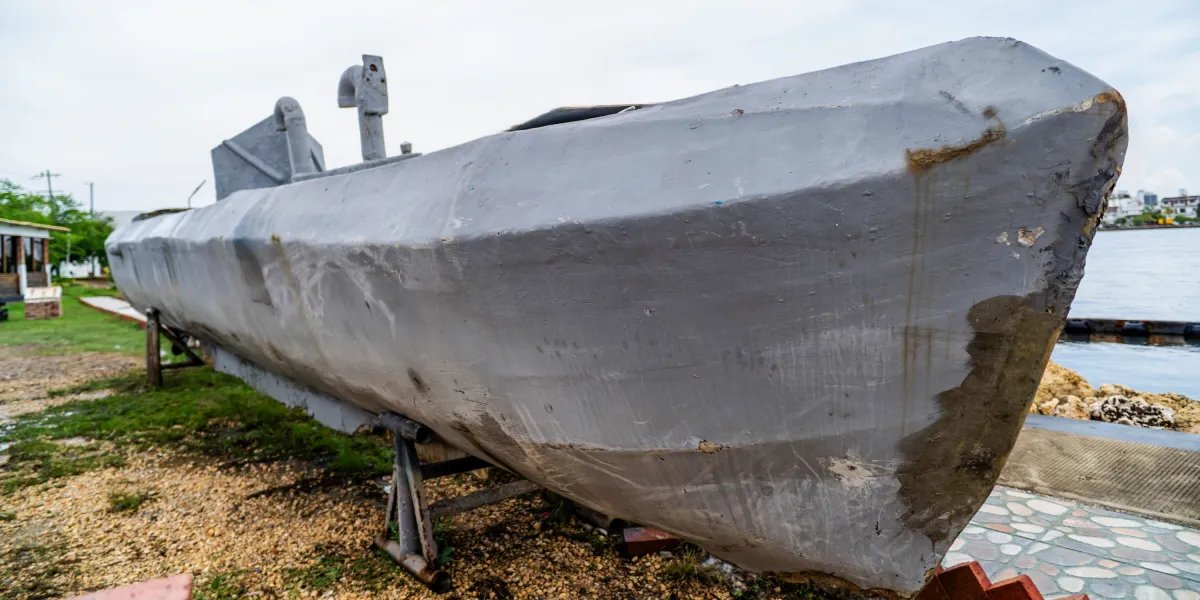
Today, the Tayrona semisubmersible sits on a strip of grass at the ARC Bolívar naval base in Cartagena. It’s exposed to the elements; rain has streaked its paint. To one side lies an older, bulkier narco sub seized a decade ago, a blue cylinder with a clumsy profile. The Tayrona’s hull looks lower, leaner, and more refined.
Up close, it is also unmistakably handmade. The hull is a dull gray-blue, the fiberglass rough in places, with scrapes and dents from the tow that brought it into port. It has no identifying marks on the exterior—nothing that would tie it to a country, a company, or a port. On the upper surface sit the two Starlink antennas, painted over in the same gray-blue to keep them from standing out against the sea.
I climb up a ladder and drop through the small hatch near the stern. Inside, the air is damp and close, the walls beaded with condensation. Small puddles of fuel have collected in the bilge. The vessel has no seating, no helm or steering wheel, and not enough space to stand up straight or lie down. It’s clear it was never meant to carry people. A technical report by CMCON found that the sub would have enough fuel for a journey of some 800 nautical miles, and the central cargo bay would hold between 1 and 1.5 tons of cocaine.
At the aft end, the machinery compartment is a tangle of hardware: diesel engine, batteries, pumps, and a chaotic bundle of cables feeding an electronics rack. All the core components are still there. Inside that rack, investigators identified a NAC-3 autopilot processor, a commercial unit designed to steer midsize boats by tying into standard hydraulic pumps, heading sensors, and rudder-feedback systems. They cost about $2,200 on Amazon.
“These are plug-and-play technologies,” says Wilmar Martínez, a mechatronics professor at the University of America in Bogotá, when I show him pictures of the inside of the sub. “Midcareer mechatronics students could install them.”
For all its advantages, an autonomous drug-smuggling submarine wouldn’t be invincible. Even without a crew on board, there are still people in the chain. Every satellite internet terminal—Starlink or not—comes with a billing address, a payment method, and a log of where and when it pings the constellation. Colombian officers have begun to talk about negotiating formal agreements with providers, asking them to alert authorities when a transceiver’s movements match known smuggling patterns. Brazil’s government has already cut a deal with Starlink to curb criminal use of its service in the Amazon.
The basic playbook for finding a drone sub will look much like the one for crewed semisubmersibles. Aircraft and ships will use radar to pick out small anomalies and infrared cameras to look for the heat of a diesel engine or the turbulence of a wake. That said, it might not work. “If they wind up being smaller, they’re going to be darn near impossible to detect,” says Michael Knickerbocker, a former US Navy officer who advises defense tech firms.
Autonomous drug subs are “a great example of how resilient cocaine traffickers are, and how they’re continuously one step ahead of authorities,” says one researcher.
Even worse, navies already act on only a fraction of their intelligence leads because they don’t have enough ships and aircraft. The answer, Knickerbocker argues, is “robot on robot.” Navies and coast guards will need swarms of their own small, relatively cheap uncrewed systems—surface vessels, underwater gliders, and long-endurance aerial vehicles that can loiter, sense, and relay data back to human operators. Those experiments have already begun. The US 4th Fleet, which covers Latin America and the Caribbean, is experimenting with uncrewed platforms in counternarcotics patrols. Across the Atlantic, the European Union’s European Maritime Safety Agency operates drones for maritime surveillance.