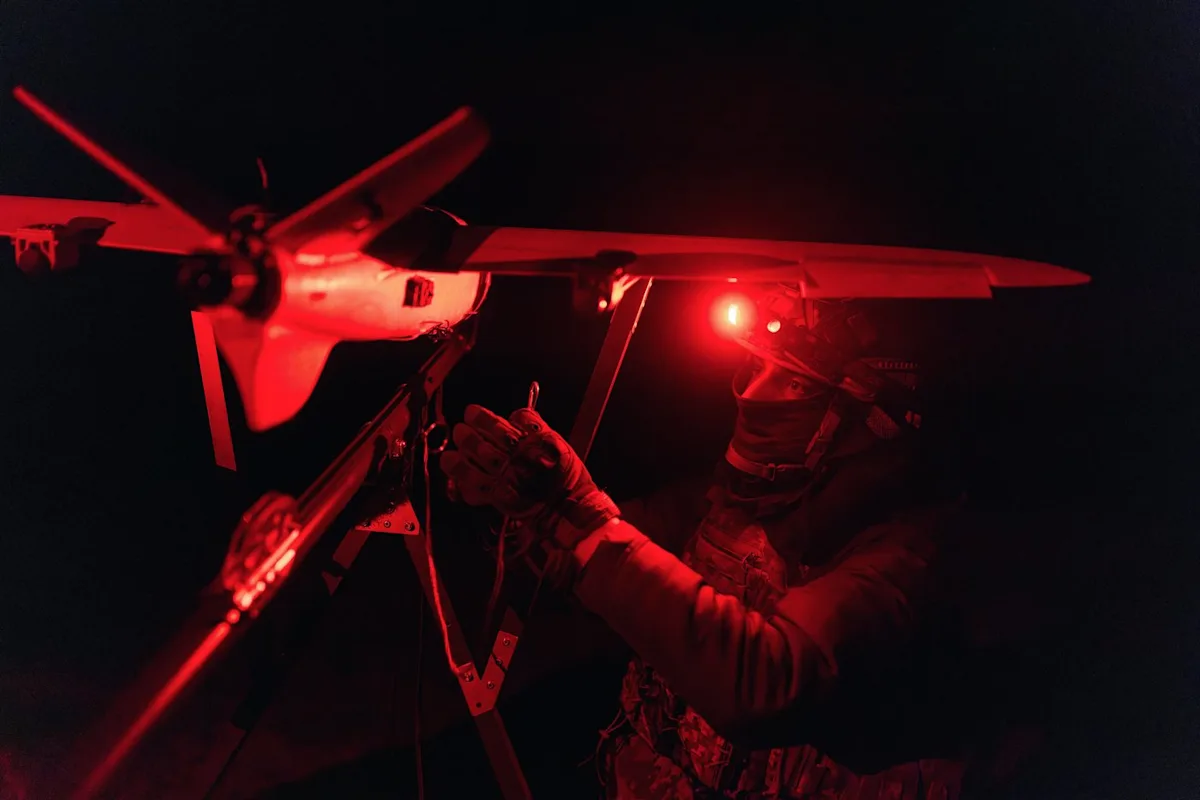
KHARKIV, Ukraine (AP) — The night air in eastern Ukraine is crisp, and a myriad of stars scatter above a small crew of soldiers watching for Iranian-designed Shahed drones that Russia launches in waves.
Such teams are deployed across the country as part of a constantly evolving effort to counter the low-cost loitering munitions that have become a deadly weapon of modern warfare, from Ukraine to the Middle East.
While waiting, the crew from the 127th Brigade tests and fine-tunes their self-made interceptor drones, searching for flaws that could undermine performance once the buzzing threat appears. When Shahed drones first appeared in autumn 2022, Ukraine had few ways to stop them. Today, drone crews intercept them in flight with continually adapting technology.
In recent years, Ukraine’s domestic drone interceptor market has burgeoned, producing some key players who tout their products at international arms shows. But it’s on the front line where small teams have become laboratories of rapid military innovation — grassroots technology born of battlefield necessity that now draw international interest.
President Volodymyr Zelenskyy says U.S. allies in the Middle East have approached Ukraine for help in defending against Iranian drones, the same type that Russia has fired by the tens of thousands in the 4-year-old war.
Iran has also used the same drones in retaliation for joint U.S.-Israeli strikes, at times overwhelming far more sophisticated Western-made air defenses and highlighting the need for cheaper and more flexible countermeasures.
“It’s not like we sat down one day and decided to fight with drones,” said a pilot with Ukraine’s 127th Brigade, sitting at his monitor after completing a preflight check. “We did it because we had nothing else.”
How the drone war began
Moments earlier, the pilot carefully landed his interceptor drone to avoid damaging it. He spoke on condition of anonymity because military rules did not allow him to be quoted by name.
Though designed to be disposable, limited resources mean Ukrainian crews try to preserve every tool they have, often reusing even single-use drones to study their weaknesses and improve them.
“Just imagine — a Patriot missile costs about $2 million, and here you have a small aircraft worth about $2,200,” the pilot said. “And if it doesn’t hit the target, I can land it, fix it a bit and send it back into the air. The difference is huge. And the effect? Not any worse.”
Ukraine’s 127th Brigade is building an air defense unit centered on interceptor drone crews — a model increasingly adopted across the military.
Leading the brigade’s effort is a 27-year-old captain, who previously served in another formation where he had already helped organize a similar system. He also spoke on condition of anonymity because military rules did not allow him to be quoted by name.
He clearly remembers the moment about two years ago when everything changed. He said he was assigned to lead a group of soldiers ordered to intercept Russian reconnaissance drones using shoulder-fired air-defense missiles.
The approach quickly proved ineffective. Agile drones equipped with cameras could easily maneuver away from the slower, less-flexible weapons, he said.
Determined to find a better solution, the young officer began searching for alternatives, asking fellow soldiers and volunteers supporting the front.
The answer turned out to be simple: another drone.
The captain still remembers the day a Russian Orlan reconnaissance drone hung above a Ukrainian position, transmitting coordinates to guide Russian artillery. A pilot from his unit downed it by using another drone, he added.
“That’s when I realized — this is a drone war. It had begun,” he said. “We had been moving toward it for some time, but that was the moment I saw it with my own eyes.”
They never found the wreckage of the Orlan, which burned as it fell to the ground.
Downing Shaheds
Another challenge soon emerged: how to intercept the hundreds of fast, durable Shahed drones flying far beyond the front line.
The young captain’s search for a solution led him to the 127th Brigade in Kharkiv and to cooperation with a local defense company. Their joint efforts resulted in aircraft-style interceptor drones capable of matching the speed of the Shaheds.
Kharkiv is not only where they work — it’s where their families live, a city that regularly comes under Shahed attacks.
Working with the company allows soldiers to test interceptor drones in real conditions and quickly refine the technology through direct feedback.
The company’s Skystriker drone differs from more widely known interceptor systems such as Sting or P1-Sun, which are based on modified first-person view, or FPV, drones. Instead, it resembles a small aircraft with wings, allowing it to stay aloft longer.
“Yes, this is a joint effort,” said the director of the company, who spoke on condition he not disclose the name of the firm or his own identity for security reasons.
“It’s not enough just to build it. It has to work — and work properly — and perform real combat tasks,” he said. “That’s why communication with the military is so important. They give us feedback and help us improve it every time.”
Nonprofits and volunteers
In Ukraine, cooperation often goes beyond the military and manufacturers. Volunteers frequently act as intermediaries between the two, sometimes even helping them find one another.
The Come Back Alive Foundation, a nonprofit think tank and charity that raises money to equip Ukraine’s forces, launched a project called “Dronopad,” loosely translated as “Dronefall,” in summer 2024.
The idea grew from battlefield reports that FPV drone pilots were occasionally able to track and intercept aerial targets — early cases that helped shape efforts to counter the Shaheds.
“At that moment it wasn’t clear whether this was even a scalable solution or just isolated incidents,” said Taras Tymochko, who leads the project. “Our goal was to turn it into a system — to help units that already had their first successful cases build the capability and scale what they had achieved.”
The foundation worked with drone manufacturers to better understand what systems soldiers needed. As the project developed, the capabilities of interceptor drones evolved.
“At some point they were able to reach speeds of more than 200 kilometers per hour (124 mph), which made it possible to intercept targets like Shaheds in the air,” Tymochko said.
The team closely monitored the rapidly growing drone market. A key factor, he said, was ensuring close cooperation between manufacturers and the military so that engineers could receive feedback quickly from battlefield tests.
“It’s always action and counteraction,” Tymochko said, noting both sides develop ways to counter enemy drones and improve their technology to neutralize each other’s responses. “That cycle is what drives the evolution of drone warfare.”
The technology itself, he said, is not especially difficult to copy. The real value lies in how it is used — and in the experience of the pilots who have learned to operate it effectively.
“People were very skeptical about the technology,” Tymochko said of the early days of interceptor drones. “Some thought it wouldn’t work, that within a month the Russians would come up with countermeasures and the drones would become useless.”
Nearly two years later, the results suggest otherwise.
“Many people called it air defense for the poor,” he said. “But it turns out that air defense for the poor can sometimes be more effective than air defense for the rich.”
___
Associated Press journalist Vasilisa Stepanenko contributed to this report.
___
Follow AP’s coverage of the Ukraine war at https://apnews.com/hub/russia-ukraine
Hanna Arhirova, The Associated Press


 dailynewsnblog