dailynewsnblog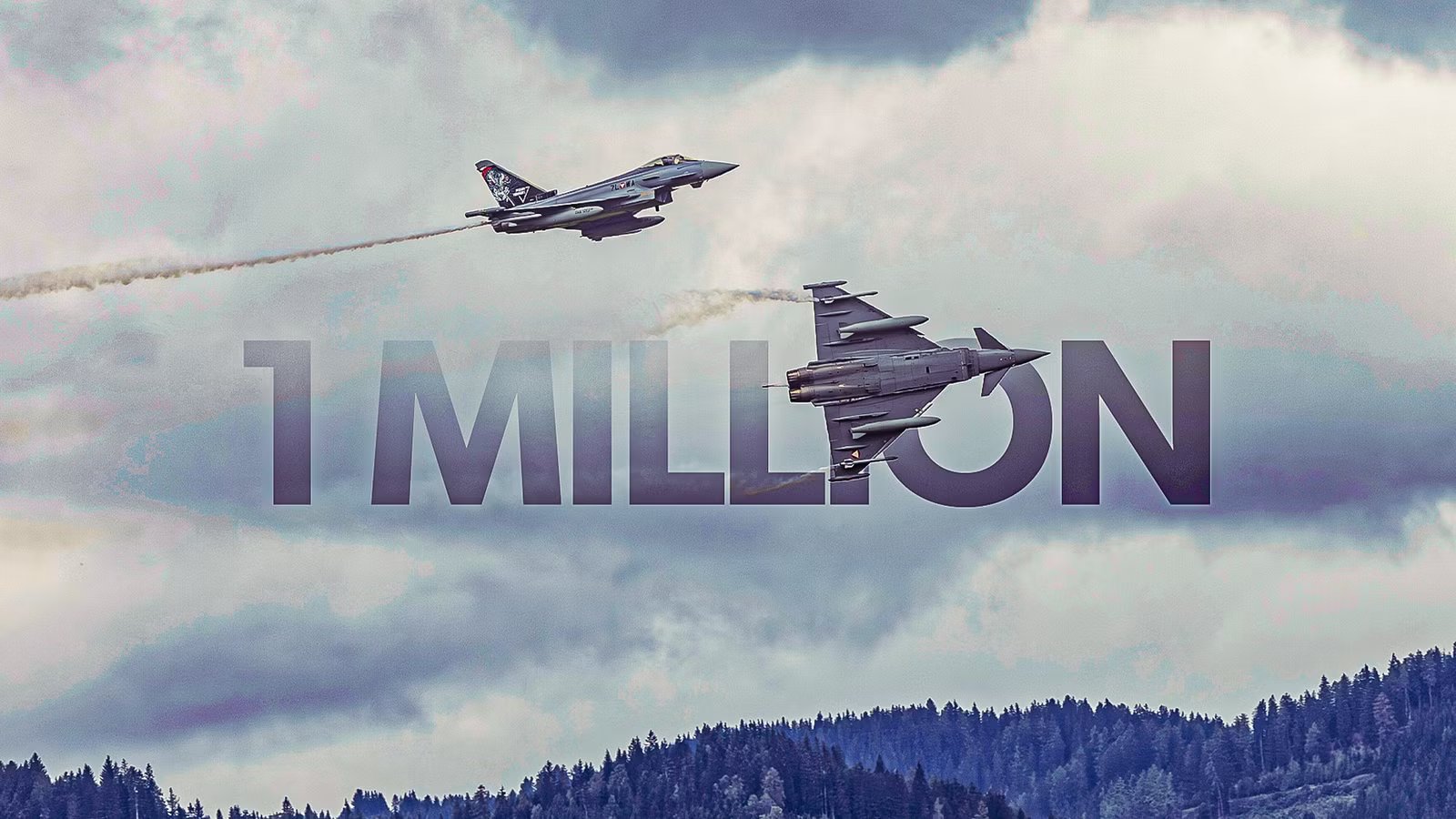
Among many modern combat aircraft programs, one European program can point to longevity, adaptability, and sustained operational relevance in equal measure. Entering 2026, the Eurofighter Typhoon crossed one of those rare milestones: more than one million flying hours worldwide. Although not a fifth-generation fighter as it was conceived at the end of the Cold War, this achievement says as much about design foresight as it does about how modern air combat has evolved over the last three decades. Flight-hour milestones encompass thousands of sorties, countless training missions, live operations, NATO air-policing deployments, and real-world combat tasks executed by pilots and maintainers over decades. Reaching one million flying hours places the Eurofighter Typhoon in rare company, alongside aircraft like the F-16 and F/A-18, highlighting its continued relevance in an era increasingly dominated by fifth-generation platforms.
Crucially, this milestone comes at a pivotal moment in the Typhoon’s career. With upgrades such as the ECRS Mk2 radar, long-range weapons integration, and deeper networking, the aircraft is evolving rapidly. This guide takes a deep look at how the Eurofighter Typhoon reached this landmark, why it matters, and what it reveals about the aircraft’s role today. From its multinational origins and constantly evolving variants to the missions it flies daily across Europe and beyond, we’ll explore why the Typhoon remains one of the world’s most capable and heavily used swing-role combat aircraft, and it is likely to remain at the cutting edge of European airpower well into the 2030s and beyond.
One Million Hours: Why This Milestone Matters

The announcement that the Eurofighter Typhoon fleet had surpassed one million flying hours was confirmed by Eurofighter GmbH on January 29, 2026, marking a defining moment for the program. This particular figure carries weight due to the Typhoon’s demanding operational profile and multinational structure. Unlike single-nation fighters, the Typhoon program is sustained through the collaborative industrial effort of Airbus, Bae Systems, and Leonardo, with operations spread across multiple air forces that maintain differing training standards, mission priorities, and maintenance philosophies.
Accumulating one million hours under these conditions underscores not just aircraft reliability, but also interoperability and logistical maturity across Europe and allied nations. Operationally, those hours represent a wide spectrum of missions. Typhoons routinely conduct quick reaction alert (QRA) duties, intercepting unidentified aircraft near NATO airspace. They also fly long-duration air-policing missions in the Baltics, deploy to the Middle East, and increasingly perform precision strike and electronic warfare roles once considered secondary to their air superiority mission.
That trust that was placed by partner nations and export customers has been earned through sustained availability rates, strong safety records, and an upgrade path that has kept pace with rapidly changing threats. In the words of Jorge Tamarit-Degenhardt, Chief Executive Officer of Eurofighter:
“One million flying hours is a truly historic milestone that reflects three decades of teamwork, innovation, and commitment from thousands of people across Europe.”
A Multinational Fighter With Global Reach

The Eurofighter Typhoon is, at its core, one of the most ambitious collaborative defense programs ever undertaken in Europe. Developed jointly by the United Kingdom, Germany, Italy, and Spain, the aircraft embodies a distinctly European approach to air combat capability. According to Airbus, a total of 617 Typhoons have been delivered, with approximately 610 remaining in active service.
Today, the aircraft is operated by nine air forces across 38 squadrons. In addition to the four core partner nations, Typhoons serve with Austria, Saudi Arabia, Oman, Kuwait, and Qatar, each contributing to the growing global flight-hour total. Türkiye is negotiating the potential acquisition of up to 44 Typhoons, which would further expand the fleet’s operational footprint.
From RAF Coningsby in the United Kingdom to Al Udeid Air Base in Qatar, Typhoons operate in vastly different climates and mission sets. Each operator tailors the aircraft’s configuration, weapons, and tactics to national requirements. This diversity has accelerated platform maturity, as software updates and hardware improvements must function reliably across fleets exposed to everything from cold-weather air policing to sustained desert operations. The result has been continuous refinement in avionics reliability, cooling systems, and maintainability across the entire Typhoon fleet.
Eurofighter Typhoon Operators Worldwide:
|
Country |
Air Force |
Variants in Service |
Primary Roles |
|
United Kingdom |
Royal Air Force |
Tranche 1, 2, 3 |
Air defense, strike, QRA |
|
Germany |
Luftwaffe |
Tranche 1, 2, 3 |
Air superiority, NATO policing |
|
Italy |
Aeronautica Militare |
Tranche 1, 2, 3 |
Multirole, expeditionary ops |
|
Spain |
Ejército del Aire |
Tranche 1, 2, 3 |
Air defense, homeland security |
|
Austria |
Austrian Air Force |
Tranche 1 |
Air policing |
|
Saudi Arabia |
Royal Saudi Air Force |
Tranche 2, 3 |
Strike, air superiority |
|
Oman |
Royal Air Force of Oman |
Tranche 2 |
Multirole |
|
Kuwait |
Kuwait Air Force |
Tranche 3 |
Multirole, strike |
|
Qatar |
Qatar Emiri Air Force |
Tranche 3 |
Advanced strike, air dominance |
What stands out is how evenly flight hours are distributed across operators. While the RAF and Luftwaffe contribute significantly due to fleet size and NATO commitments, export customers flying in hotter, harsher environments have also logged substantial hours. This has fed back into design refinements, improving cooling systems, avionics reliability, and maintainability across the entire fleet.

Is The Eurofighter Typhoon Faster Than The F-35?
A riveting race between two titans of the sky: does the Eurofighter Typhoon outrun the F-35?
From Air Superiority To True Swing-Role Combat

When the Eurofighter Typhoon was conceived in the late 1980s, its purpose was narrowly defined: achieve and maintain air superiority against advanced Soviet fighters. That design priority remains visible today in the aircraft’s high thrust-to-weight ratio, carefree handling, and sustained supersonic performance without afterburner.
Early Typhoon operations, and a significant portion of the fleet’s initial flight hours, were therefore dominated by air-defense sorties, quick reaction alert duties, and air-combat training rather than strike missions.
The aircraft’s contribution to the one-million-hour milestone, however, increasingly reflects a fundamental shift in how it is armed and employed. Over the past two decades, successive weapons integrations transformed the Typhoon from a specialist interceptor into a genuine swing-role platform.
The introduction of precision-guided munitions such as Paveway II and IV, followed by deep-strike weapons like Storm Shadow and close-air-support solutions such as Brimstone, allowed the aircraft to execute missions that would previously have required dedicated strike fleets. Crucially, these integrations expanded mission planning complexity, sortie duration, and operational demand, directly increasing utilization rates across Typhoon units.
Typhoon squadrons began launching multi-mission sorties capable of transitioning between air-to-air and air-to-ground tasking in flight. This flexibility reshaped force planning across several air forces, reducing the need to maintain separate fleets for air defense and strike roles.
From a flight-hour perspective, this was decisive: aircraft that can credibly perform multiple mission types are flown more often, deployed more frequently, and retained longer in frontline service. The Typhoon’s expanding weapons portfolio ensured that the aircraft remained continuously tasked, heavily exercised, and operationally indispensable, accelerating its path to the one-million-hour milestone.
Variants, Tranches, And Continuous Evolution

The Eurofighter Typhoon’s achievement of more than one million flight hours is inseparable from the way the aircraft has evolved through successive tranches, which determined not just what the aircraft could do, but how often and how intensively it was flown. Rather than progressing through clean block upgrades, the Typhoon developed through an incremental and politically complex tranche system that created uneven capability across the fleet, allowing newer variants to assume an increasing share of high-tempo operational flying as mission demands expanded.
Tranche 1 aircraft formed the backbone of early Typhoon operations, contributing heavily to the initial accumulation of flight hours through air-defense and training sorties, but they were optimized almost exclusively for air-to-air combat and offered limited growth margin for sustained multirole use.
Tranche 2 and Tranche 3 aircraft marked a structural shift. Improvements in power generation, cooling capacity, wiring, and mission computing enabled true swing-role operations, significantly increasing utilization during NATO air policing, multinational exercises, and expeditionary deployments. While some earlier aircraft could be upgraded, these enhancements were never uniformly achievable, resulting in a tiered fleet in which later tranches increasingly absorbed operational demand.
This trend has intensified with the emergence of aircraft commonly referred to as Tranche 4, encompassing late-production Typhoons procured under national programs such as Germany’s Quadriga and Spain’s Halcon orders. Built on the Tranche 3 standard but designed from the outset for advanced sensors and electronic warfare, these aircraft are positioned to exploit capabilities such as the ECRS Mk2 AESA radar. The result is a Typhoon variant capable of electronic attack, battlespace management, and deep integration into networked operations, concentrating the most demanding modern missions and future flight hours, among the most capable airframes.

Why Might The World’s Most Advanced Swing-Role Combat Aircraft Have Lockheed Martin Worried?
A European jet poses a surprising challenge to American defense dominance, forcing Lockheed Martin to watch closely.
How Operations And Training Drove The Hour Count

A common misconception is that flight hours are primarily driven by combat operations. In reality, the vast majority of the Eurofighter Typhoon’s one million hours were accumulated through training and readiness activities, a reflection of NATO’s emphasis on preparedness.
Typhoon squadrons regularly participate in large-scale exercises such as the Red Flag, Arctic Challenge, and the NATO Tiger Meet. These events involve intensive flying schedules, often pushing aircraft and crews to their limits in complex, multi-domain scenarios.
Export customers follow a different but equally intensive model. Operating smaller fleets with broader mission responsibility, air forces in the Middle East rely on the Typhoon as a primary combat platform rather than part of a layered force mix. Longer sortie profiles, environmental demands, and persistent regional deterrence roles result in high aircraft utilization rates.
Together, these parallel usage models—one alliance-driven, the other fleet-concentration-driven—explain how flight hours accumulate at scale, independent of headline-grabbing combat deployments.
What One Million Hours Means For The Typhoon’s Future

Reaching one million flight hours is a checkpoint: most Typhoon operators plan to keep the aircraft in frontline service well into the 2030s, with some extending usage even further through structural upgrades and avionics modernization.
The Typhoon will increasingly operate alongside fifth-generation fighters and future platforms like the UK’s Global Combat Air Programme (GCAP). In this context, its role may evolve again, acting as a missile truck, sensor node, or electronic warfare platform within a networked battlespace.
The aircraft’s continued high utilization suggests that the next million hours may arrive faster than the first. With geopolitical tensions driving increased air patrols and training activity across Europe and the Middle East, the Typhoon remains not just relevant, but indispensable.
In many ways, the Eurofighter Typhoon’s million-hour milestone tells a broader story: that well-designed, continuously upgraded fourth-generation aircraft still have a critical role to play. As air forces balance cutting-edge technology with operational reality, the Typhoon stands as proof that evolution, not replacement, is often the smarter path.