dailynewsnblog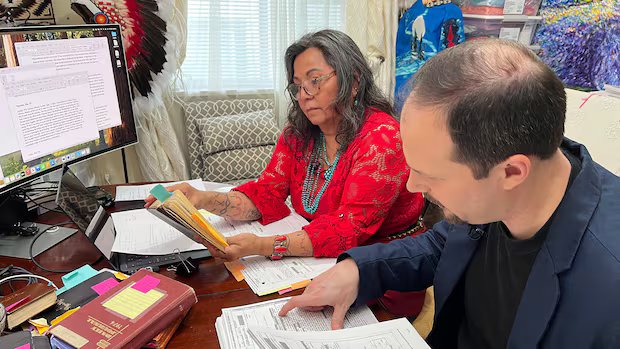
We use this editor’s blog to explain our journalism and what’s happening at CBC News. You can find more blogs here.
Today, we begin publishing a series of exclusive stories that expose a sweeping RCMP program of surveillance, disruption and infiltration of Indigenous organizations between 1968 and 1982.
Though long suspected by Indigenous leaders across Canada, the scope and scale of the spy program has remained hidden behind walls of government secrecy, until now.
The dossier of these now-declassified documents is substantial, comprising 6,000 pages of surveillance reports conducted by what was then called the “Racial Intelligence Section” of the RCMP’s Security Service.
The scale of the operation is staggering: 150 police officers, with hundreds of Indigenous people and 30 Indigenous organizations under police watch, mostly during the 1970s. The RCMP used a range of methods, from paying informants, physical surveillance, covert filming and photography to tracking travel, monitoring media and assembling intelligence files.
The documents corroborate for the first time that the RCMP used covert electronic surveillance and wiretaps to monitor the telephones of the offices of the National Indian Brotherhood (NIB) — now the Assembly of First Nations (AFN) — in Ottawa during the mid-’70s.
The investigation
This was a years-long investigation by reporter Brett Forester and the team at CBC Indigenous.
He first began inquiring about RCMP files on the NIB in 2022. Libraries and Archives Canada, the holders of these classified documents, resisted on grounds it needed to consult with CSIS to prevent release of material potentially injurious to national security. He was told he’d have to wait 1,398 days for an answer — an “eye-watering” delay, as he described it.
The CBC appealed to the Office of the Information Commissioner, which sided with the CBC, but the minister of Canadian Heritage intervened, referring the matter for judicial review by the federal court.
In the lead-up to that hearing, Forester cross-examined a CSIS official, challenging the government’s claim that releasing the 50-year-old RCMP records would pose a risk to national security today. Ultimately the government relented, resulting in a slow drip of redacted documents to CBC, four years after our initial request for information.
(I’ve written before about the obstacles journalists face trying to obtain documents through access to information laws and there is some excellent journalism on the problem, including The Globe and Mail’s Secret Canada project.)
Still, Forester’s access to information journey may be one for the record books.

Why did we persist? As the national public broadcaster, this kind of in-depth investigative journalism is core to our public service mandate.
The CBC is committed to ensuring that the stories of Indigenous peoples in this country are widely known, including the history of injustices faced by First Nations, Inuit and Métis. As promised in the CBC’s National Indigenous Strategy, we are committed to journalism that “complies with the cultural and linguistic frameworks specific to Indigenous Peoples, while respecting our journalistic standards and practices (JSP).”
The stories you will watch, read and hear in the coming days are the work of CBC Indigenous in collaboration with our national investigative team. For months, our journalists pored over, deciphered and analyzed the coded language in these documents.
Some important notes
A note about the times in which these events occurred: Following the 1970 October Crisis, the RCMP was under pressure from the government of Pierre Trudeau to track and expose subversive movements in Canada.
It is not an exaggeration to say the RCMP was gripped by a fear that growing Indigenous self-determination and activism in Canada (and the U.S.) marked a potential threat to national security. That fear set in motion a dragnet that scooped up leaders and members of legitimate democratic movements across the country.
The documents are imbued with racist and paternalistic language of the era. The dusty and faded files are stamped with words like “Racial Intelligence” and “Native Extremism.”
It’s also important to note that this is not ancient history but rather living memory — and of consequence today. In our stories, you will hear the reactions of influential leaders like Georges Erasmus, former national chief of the Assembly of First Nations; Gloria George, the former president of the Native Council of Canada; and Stephen Kakfwi, former premier of Northwest Territories.
We also put our findings to experts and academics who have studied the era. They consider these documents to be of tremendous historic significance and an essential contribution to scholarship.
Some may ask if the surveillance of these groups really ended when the RCMP Security Service was disbanded and CSIS became Canada’s new civilian intelligence agency. We put that question to a current deputy director of CSIS as part of our reporting.
Also of note: the names of informants — or “human sources,” as they are called — were redacted in the documents CBC obtained. However, several interviewees told us they believe they know who some of the informants are.
One of the most compelling voices in our series is that of Doreen Manuel, who was saddened to learn that informants had betrayed her father, George Manuel, a longtime and respected president of the NIB. She issued a challenge to the informants to come forward today in the spirit of truth and healing.
Perhaps her words will help influence the public discussion we expect will follow our reporting on these important historical records.