dailynewsnblog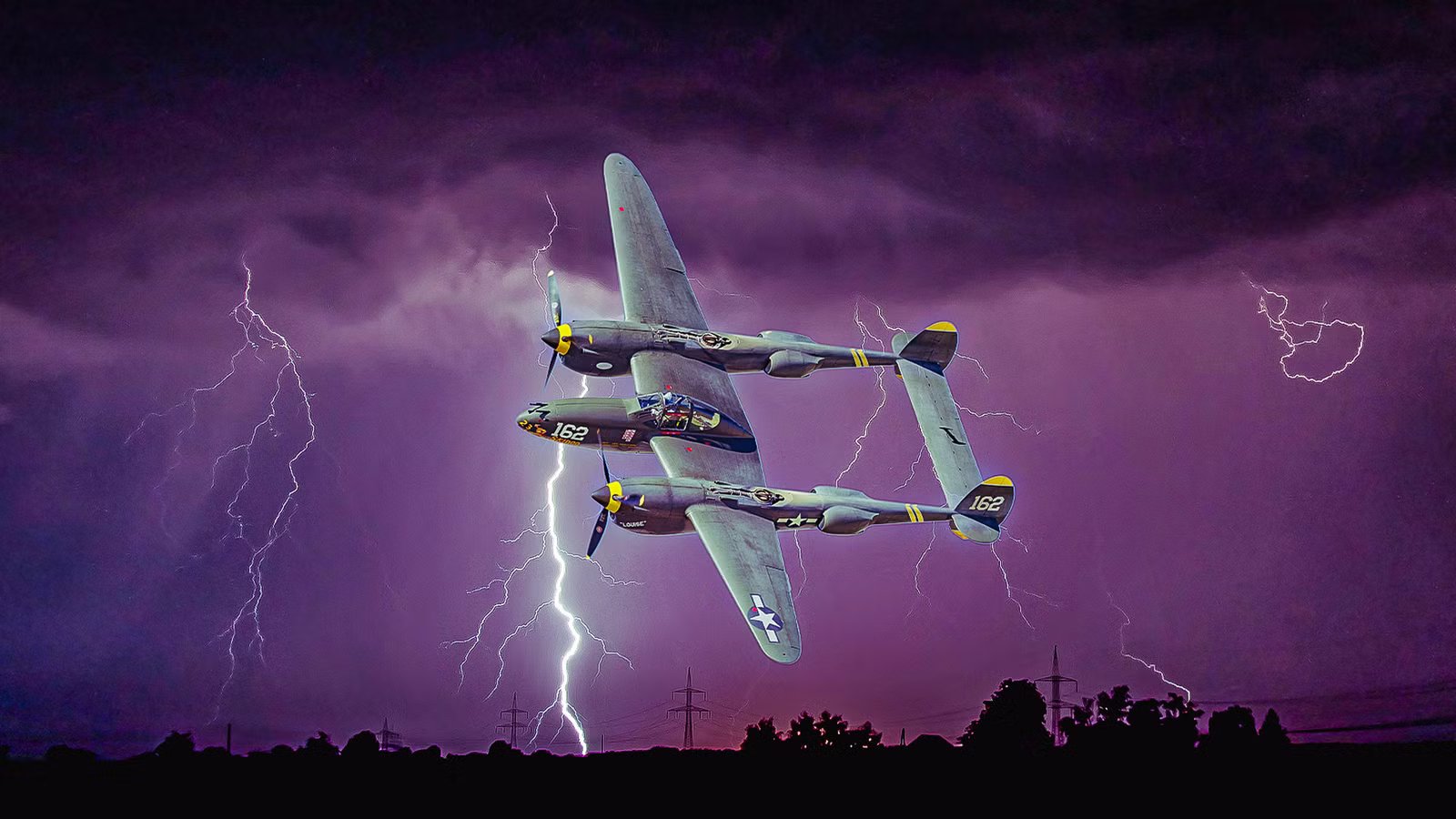
When lightning strikes, it rarely does so quietly, and few combat aircraft live up to that metaphor quite like the Lockheed P-38 Lightning . Thanks to its twin-boom silhouette, concentrated nose armament, and long-range performance, the P-38 became one of the most versatile American fighters of the second world war. This guide explores how the Lightning evolved from an ambitious pre-war interceptor into a multirole workhorse that proved itself across vastly different theaters of war.
January 27, 2026, marked the 87th anniversary of the XP-38’s maiden flight, a reminder of just how far ahead of its time the aircraft truly was. Conceived in an era when most fighters were still single-engine, lightly armed machines, the Lightning pushed boundaries in speed, altitude, range, and firepower. Its story reveals a platform continually modified to meet new threats, climates, and missions. Drawing on documented variations and historical accounts, this guide shows how the Lightning earned its reputation as one of the most flexible combat aircraft of World War II.
Born From Ambition: The P-38’s Radical Design Origins

The Lockheed P-38 emerged from a 1937 US Army Air Corps requirement for a high-altitude interceptor capable of uncommon speed and climb performance. Lockheed engineers Clarence “Kelly” Johnson and Hall Hibbard experimented with different designs, ultimately choosing one that broke almost every contemporary fighter convention.
Instead of a single fuselage, the aircraft featured twin booms housing the engines and turbo-superchargers, connected by a central nacelle for the pilot and armament. This configuration laid the foundation for the Lightning’s future versatility.
The aircraft was powered by a couple of Allison V-1710 liquid-cooled, turbo-supercharged engines, each driving a counter-rotating propeller to eliminate torque effects. This choice provided redundancy over long distances and allowed the P-38 to carry heavy fuel loads without sacrificing performance.
Equally revolutionary was the armament, concentrated in the nose: four .50-caliber machine guns and a 20 mm cannon. Unlike wing-mounted guns that required convergence, the P-38’s weapons delivered maximum firepower at any range, a decisive advantage in air-to-air combat. Beyond its armament, the P-38 also pioneered several other design and operational innovations that set it apart from contemporary fighters:
- Twin-boom layout with turbo-supercharged engines: improved redundancy and high-altitude performance
- Heavy payload for a fighter: could carry up to 4,000 lb, equal to early B-17s or Mosquito bombers
- Versatile adaptations: reconnaissance (F-4/F-5), bomber leader (Droop Snoot), night fighter (P-38M), and radar pathfinder
Test pilot Ben Kelsey conducted the XP-38’s first flight on January 27, 1939, and despite the failed transcontinental dash ending with a crash landing in Mitchel Field, the aircraft received instant attention, although early development was not without challenges. Compressibility effects at high speeds, cockpit heating issues, and engine reliability all required solutions before the P-38 could reach its potential. Yet these growing pains underscored the Lightning’s ambition: it was designed to anticipate requirements. This forward-looking philosophy would later allow the P-38 to adapt to roles far beyond its original interceptor mission.
From Prototype To Production: A Family Of Variants

The first demonstration of the P-38’s versatility lies in the number of variants produced during the war. From early YP-38 test aircraft to late-model P-38L fighters, the Lightning underwent continuous refinement, driven by precious combat experience feedback. Early production models such as the P-38D and E were produced with basic combat readiness in mind, adding self-sealing fuel tanks and armor protection.
As the war progressed, variants like the P-38G and H improved engine performance and high-altitude capability, making them better suited for bomber escort missions. Later versions, notably the P-38J and L, introduced airbrakes and redesigned intercoolers, boosted ailerons, and increased internal fuel capacity—changes that dramatically improved handling, range, and pilot confidence.
Beyond fighter variants, the Lightning also spawned specialized subtypes. The F-4 and F-5 reconnaissance versions replaced armament with cameras, leveraging the P-38’s speed and altitude to gather intelligence deep behind enemy lines. Among the pilots of the unarmed reconnaissance P‑38s was Antoine de Saint-Exupéry, the French writer of Le Petit Prince. He flew an F‑5B Lightning with Groupe de Reconnaissance II/33 (Free French Air Force) in the Mediterranean and Southern Europe. On 31 July 1944, he departed Borgo, Corsica, on a solo high-altitude photographic mission over southern France and never returned. Decades later, wreckage confirmed the loss of his aircraft, cementing the P‑38’s role in both military and literary history.
Lockheed P-38 Lightning: Key Variant Performance Overview
|
Variant |
Max Speed |
Service Ceiling |
Internal Fuel |
Notes |
|
P-38D |
~390 mph (628 km/h) |
~39,000 ft |
~306 US gal (1,160 L) |
First combat-ready Lightning; armor and self-sealing tanks added, early cooling and turbo limits |
|
P-38E |
~390 mph (628 km/h) |
~39,000 ft |
~306 US gal (1,160 L) |
Electrical and systems refinements; standardized armament |
|
P-38G |
~400 mph (644 km/h) |
~40,000 ft |
~306 US gal (1,160 L) |
Improved turbo-supercharger control and oxygen systems |
|
P-38H |
~402 mph (647 km/h) |
~44,000 ft |
~306 US gal (1,160 L) |
Higher-power Allison V-1710-89/91 engines; improved climb and ceiling |
|
P-38J |
~414 mph (666 km/h) at 25,000 ft |
~44,000 ft |
~416 US gal (1,575 L) |
Wing leading-edge intercoolers; major cooling, range, and handling improvements |
|
P-38L |
~414 mph (666 km/h) at 25,000 ft |
~44,000 ft |
~416 US gal (1,575 L) |
Reinforced structure; dive-recovery flaps standard |
|
F-4 / F-5 |
Comparable to parent |
Comparable |
Same as parent |
Unarmed reconnaissance variants; cameras replaced armament |
Sources: Warbird Resource Group
As the P-38 evolved from pure fighter to fighter-bomber, its heavy bomb load rivaled that of early medium bombers, but the solid nose limited bombing accuracy. To solve this, the Droop Snoot variant replaced the guns with a glazed bombardier’s station and Norden bombsight, allowing a single lead aircraft to guide and release bombs for an entire formation of P-38s, even through cloud cover.
Other adaptations included pathfinder aircraft, equipped with a dedicated an AN/APS-15 ground-mapping radar and operator, which guided aircraft formations through cloud-covered targets during bombing missions, and even experimental night fighter concepts.
In the final year of the war, a number of P‑38Ls were converted to the P‑38M “Night Lightning,” a radar‑equipped night fighter variant with a second crew station for a radar operator and a distinctive flat‑black paint scheme. Less than 100 P‑38Ls were modified with an AN/APS‑6 airborne interception radar pod mounted under the nose and flash hiders on the guns, but they arrived too late to have a significant impact in combat.

WW2 US Military Planes: The Roles Of The Most Iconic Aircraft
The United States of America was blessed with multiple iconic aircraft during WWII. What were their specific individual roles?
Lightning In The Pacific: Range, Firepower, And Adaptability

One theater truly showcased the P-38’s strengths and weaknesses; It was the vast expanse of the Pacific. Long distances between islands, limited airfields, and the need for extended escort missions placed unique demands on combat aircraft. The Lightning’s twin-engine reliability and long range made it exceptionally well-suited to these conditions. As a result, it became one of the most effective US Army Air Forces fighters in the Pacific theater.
The P-38’s concentrated nose armament proved devastating against Japanese aircraft, which were often lightly armored. Pilots could engage from longer distances with greater accuracy, reducing exposure to defensive fire. The aircraft’s ability to carry external drop tanks further extended its reach, enabling missions that single-engine fighters simply could not attempt. One of the most famous examples was Operation Vengeance on April 18, 1943, when 16 P-38s with pilots of the 339th Fighter Squadron, 347th Fighter Group, 13th Air Force USAAF, flew hundreds of miles to intercept and shoot down the Mitsubishi G4M “Betty” carrying Imperial Japanese Navy Admiral Isoroku Yamamoto, who conceived the Pearl Harbor attack.
Despite its advantages, the Lightning was not without critics in the Pacific. Its size and weight made it less competitive in low-altitude turning fights against agile Japanese fighters. However, elite pilots such as Major Richard Ira Bong and Major Thomas Buchanan McGuire Jr. mastered the P-38’s strengths: high-speed slashing attacks, altitude control, and devastating concentrated firepower. Avoiding prolonged turning engagements, they employed disciplined energy-fighting and boom-and-zoom tactics, achieving the majority of their victories in Lightnings. By war’s end, the P-38 had become synonymous with American air superiority in the Pacific when flown to its strength.
High Altitude Over Europe: Escort Fighter And Interceptor

If the main challenges for the P-38 in the Pacific were range and endurance, the European theater tested the aircraft in an entirely different way. Here, the Lightning faced dense air defenses, advanced German fighters, and harsh weather conditions.
In the European Theater, P-38 Lightnings served with several US Army Air Forces groups under both the Eighth and Ninth Air Forces. From late 1943 through mid-1944, before the arrival of later escort fighters, units such as the 20th, 55th, 364th, and 479th Fighter Groups flew P-38s from England on long-range bomber escort and fighter sweep missions deep into occupied Europe and Germany.
At high altitudes, early P-38 variants struggled with cockpit heating and engine management, leading to mixed pilot impressions. Compressibility issues during high-speed dives further complicated combat against German aircraft such as the Messerschmitt Bf 109 and Focke-Wulf Fw 190. However, incremental improvements, especially in later J and L models, addressed many of these shortcomings. Enhanced intercooling systems and boosted controls improved both the reliability and handling of the aircraft, while the air brakes improved the high-speed dive behavior, allowing the P-38 to remain competitive. The experience can be resumed by one of the last P 38 aces in the European Theater (and, of course, future ace in the Vietnam War), Colonel Robin Olds:
“The fact is, the P-38 Lightning was too much airplane for a new kid and a full-time job for even a mature and experienced fighter pilot. Our enemies had difficulty defeating the P-38 but, as much as we gloried in it, we were defeating ourselves with this airplane.”
After the Normandy invasion, Ninth Air Force tactical groups, including the 474th, 367th, and 370th Fighter Groups, employed Lightnings for fighter-bomber and ground-attack missions as Allied forces advanced across France and into Germany. The P-38’s ability to carry bombs and rockets made it effective against rail yards, airfields, and troop concentrations.
Reconnaissance Lightnings provided invaluable intelligence in preparation for major operations, including the Normandy invasion. Although eventually overshadowed by the North American P-51 Mustang in the European escort role, the P-38’s service revealed both its limits and its resilience.

USAAC P-38 Lightning Vs RAF De Havilland Mosquito: Which Was The Better WWII Fighter?
Two fantastic twin-engine Allied WWII fighters: Amerca’s Lightning and Britain’s Mosquito. Was one truly better than the other?
More Than A Fighter: Reconnaissance, Ground Attack, And Special Roles

As production matured, the P-38 evolved into a series of distinct blocks whose engineering changes directly enabled new operational roles. Early models such as the P-38E and P-38F introduced strengthened wing structures and standardized external hardpoints, allowing the aircraft to carry bombs or drop tanks in addition to its concentrated nose armament. Subsequent blocks, including the P-38G with improved oxygen systems and uprated Allison V-1710-55 engines, expanded high-altitude capability while retaining multirole flexibility. These incremental changes meant that the Lightning could be reassigned between escort, interception, and attack roles without altering its basic airframe.
The transition toward specialized missions accelerated with later variants. The P-38H introduced higher-power V-1710-89/91 engines and reinforced pylons capable of supporting heavier bomb loads, while the P-38J series incorporated redesigned intercooler ducting, relocated radiators, and increased internal fuel capacity within the wings. Blocks such as the J-15 and J-25 also introduced power-assisted ailerons and dive-recovery flaps, addressing control forces and compressibility issues while improving handling during high-speed attack profiles. These engineering refinements directly supported sustained fighter-bomber operations and long-range escort missions across multiple theaters.
The P-38L represented the culmination of this evolution, combining higher-rated V-1710-111/113 engines with standardized zero-length rocket launchers and strengthened external stores capability. In this configuration, the Lightning routinely carried bombs, HVAR rockets, auxiliary fuel tanks, or napalm while retaining its full gun armament, reflecting a deliberate shift toward tactical strike and close-support missions.
Parallel reconnaissance variants, including the F-4 and later F-5 series derived from J and L blocks, removed armament in favor of multiple camera installations, exploiting the same speed, altitude, and range characteristics for unescorted photographic missions. Taken together, these variants illustrate how the P-38 functioned not as a single fighter type, but as a technically coherent family of aircraft tailored to divergent combat roles.
Legacy Of The Lightning: Lessons From A Versatile Warbird

Today, the Lockheed P-38 occupies a unique place in aviation history, celebrated not only for its striking appearance but for the breadth of its accomplishments. Surviving airworthy examples and museum displays continue to draw attention, especially around anniversaries of key milestones like its maiden flight. These moments invite renewed appreciation for an aircraft that consistently defied expectations. The Lightning was never the simplest or easiest fighter, but it was often the most capable.
For modern readers and aviation enthusiasts, the P-38 offers enduring lessons about design philosophy and operational flexibility. Its story highlights the value of anticipating future needs, embracing iterative improvement, and matching technology to mission requirements. In both the Pacific and Europe, success depended less on raw specifications and more on how effectively the aircraft’s strengths were employed. That balance remains relevant in contemporary airpower discussions.
As research continues and restoration projects uncover new details, the Lightning’s legacy continues to evolve. Organizations like the P-38 Association play a crucial role in preserving technical knowledge and firsthand accounts, and few aircraft are still in flying condition. Good news for all our American readers, in 2026 the P-38 Lightning of the Flying Bulls will cross the Atlantic to be at Oshkosh from July 20 to 26!