dailynewsnblog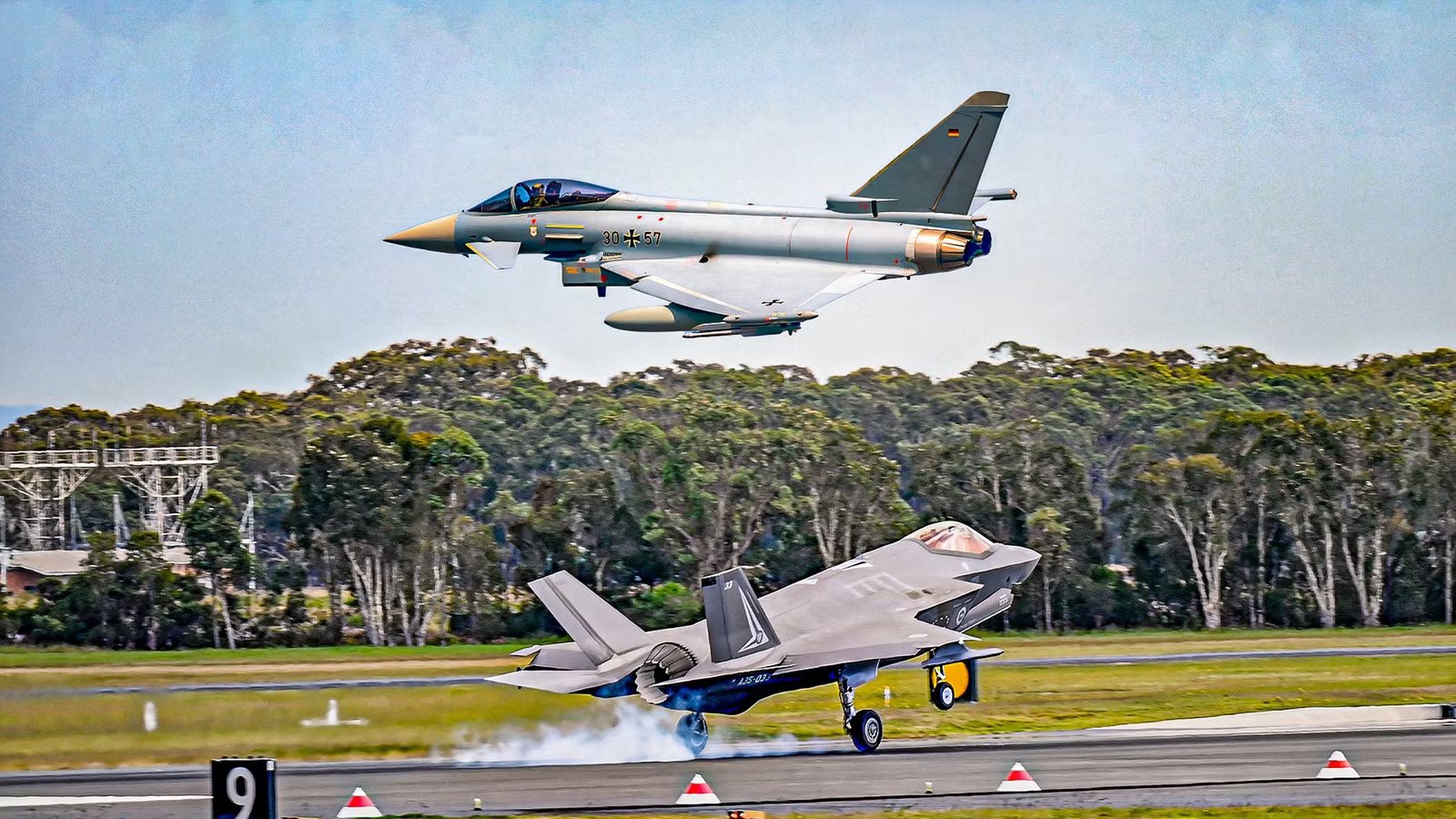
In 2026, many countries have adopted the Lockheed Martin F-35 Lightning II and the Eurofighter Typhoon, but only two countries have so far operated both types side by side – the UK and Italy. The F-35 was built to survive and dominate in contested airspace through stealth, sensor fusion, and networked warfare. The Typhoon, born from Europe’s Cold War air superiority needs, has evolved into a fast, agile, and highly capable multirole platform.
The British and Italian experience provides a rare, live test of how fifth-generation stealth and advanced fourth-generation performance complement each other. Meanwhile, Germany is moving toward a similar dual-fleet setup, Saudi Arabia is exploring F-35 acquisitions to reshape regional airpower, and Turkey’s exclusion from the program has redirected it toward an expanded Eurofighter fleet. These two aircraft are a story about doctrine, industrial strategy, and the future of European and Middle Eastern airpower.
F-35 vs Eurofighter – Two Philosophies Of Airpower In 2026

By 2026, the debate between the Lockheed Martin F-35 Lightning II and the Eurofighter Typhoon has shifted from airshow performances to real-world operations: NATO air policing, carrier deployments, and multinational exercises put these aircraft head-to-head. Both are multirole fighters, but they reflect contrasting philosophies. The F-35 is built around stealth, sensor fusion, and battlefield awareness, while the Typhoon prioritizes raw speed, agility, and kinetic dominance. Each shapes how air forces project power in complementary but very different ways.
The F-35, designed in the 1990s, emphasizes surviving contested airspace over outright speed. Its AN/APG-81 AESA radar, AN/ASQ-239 electronic warfare suite, and Distributed Aperture System feed a single, fused tactical picture directly to the pilot. This integration gives it a decisive first-look, first-shot advantage, making situational awareness its core weapon. As reported by The Aviationist, early Red Flag exercises reportedly saw F-35As achieve simulated kill ratios of 20:1, demonstrating the practical impact of fifth-generation sensor fusion.
Meanwhile, the Eurofighter Typhoon was born to counter Cold War-era Soviet fighters and remains one of the most aerodynamically capable jets ever built. Its twin engines push it to Mach 2 (making it much faster than the F-35), and it thrives in energy, maneuverability, and sustained high-speed operations. Over time, it has evolved into a multirole platform: upgrades like the Captor-E AESA radar and the upcoming ECRS Mk 2 extend its electronic warfare and strike capabilities. With Meteor missiles and a heavier external payload, it retains formidable lethality at beyond-visual-range distances.
Cost and operational factors also shape their use. The F-35A flyaway cost sits around $80–85 million, with the STOVL F-35B higher, while the Typhoon ranges from $90–120 million depending on variant. Flight-hour costs remain higher for the F-35 ($33–38k) versus the Typhoon ($20–25k), influencing mission planning: stealth and sensor fusion missions favor the F-35, while endurance, speed, and lower operating costs favor the Typhoon.
F-35 Vs Eurofighter Typhoon specs
|
Category |
F-35A |
F-35B |
Eurofighter Typhoon |
|
Generation |
5th |
5th |
4.5 |
|
Max Speed |
Mach 1.6 |
Mach 1.6 |
Mach 2.0 |
|
Radar |
AN/APG-81 AESA |
AN/APG-81 AESA |
Captor-E / ECRS Mk 2 |
|
Combat Radius |
~670 NM (1,241 kilometers) |
~505 NM (935 kilometers) |
~750 NM (1,389 kilometers) |
|
Unit Cost |
~$80–85m |
~$100–110m |
~$90–120m |
|
Cost per Flight Hour |
~$33k |
~$38k |
~$20–25k |
Basically, the F-35 does not replace the Typhoon but redefines how it is deployed. The F-35 penetrates and shapes battlespace through stealth and information dominance, while the Typhoon dominates it kinetically with speed, payload, and advanced missiles. Together, they showcase two complementary yet distinct philosophies of modern airpower, proving that air superiority in the 21st century is about choosing to operate them in tandem.
Global Operators – And Why The UK And Italy Stand Alone

By 2026, the global map of fast-jet operators tells a broader story about the shifting center of gravity in Western airpower. The Lockheed Martin F-35 Lightning II has evolved from a controversial procurement program into the backbone of NATO’s fifth-generation capability, with operators and customers including the United States, the United Kingdom, Italy, Norway, the Netherlands, Denmark, Belgium, Poland, Finland, Japan, Australia, Israel, and South Korea. With more than a dozen air forces flying it, the F-35 has effectively become the alliance’s common digital combat language.
The Eurofighter Typhoon, meanwhile, represents Europe’s flagship fourth-generation-plus fighter, serving the United Kingdom, Germany, Italy, Spain, Austria, Saudi Arabia, Oman, Kuwait, and Qatar. Unlike the F-35, conceived as a multinational but US-led program, the Typhoon is a pure European consortium aircraft — the product of British, German, Italian, and Spanish industrial collaboration.
What makes the United Kingdom and Italy unique is not simply that they operate both jets, but how they employ them. No other air force has yet integrated the two aircraft into a coherent, layered doctrine, though Germany is moving in that direction. For Italy, the dual-fleet structure is closely tied to industrial strategy. The country hosts the Cameri Final Assembly and Check Out (FACO) facility, assembling F-35s for itself and other European customers. According to the Italian Air Force’s official F-35 program diary, Rome has steadily expanded operational use in NATO air policing missions and multinational exercises, marking its transition to full frontline integration. At the same time, Italy remains a core member of the Eurofighter consortium. In 2025, Rome confirmed additional F-35 purchases while continuing Typhoon modernization, as reported by Janes, signaling that the F-35 would complement rather than replace the Typhoon.
Britain’s path has been similarly pragmatic but shaped by different imperatives. The return to carrier strike required a short takeoff and vertical landing (STOVL) aircraft, which led to the selection of the F-35B. Air Force Technology highlighted that this decision would carry long-term consequences for Britain’s industrial and operational posture. Nevertheless, it restored a sovereign carrier-based strike capability absent since the Harrier’s retirement. Meanwhile, the Typhoon remains the RAF’s primary air defense platform, performing Quick Reaction Alert duties near UK airspace and deploying for NATO Baltic Air Policing. The result is a clear division of labor: the Typhoon protects the homeland and sustains multirole capability, while the F-35 extends Britain’s reach into contested environments.
In 2024, the RAF and Italian Air Force formalized deeper cooperation through an implementation agreement covering F-35 integration and training. This reflects a shared understanding that operating both aircraft requires doctrinal refinement, not just procurement alignment, and this distinction places the UK and Italy at the forefront of NATO’s evolving air doctrine.

F-35 Lightning II Vs Eurofighter Typhoon: How Do Their Radar Systems Compare?
Stealth design meets superpower sensors, a radar showdown between F-35 Lightning II and Eurofighter Typhoon. Who dominates the skies?
The RAF’s Layered Doctrine – How Britain Actually Uses Both Jets

The most mature integration of the Lockheed Martin F-35 Lightning II and the Eurofighter Typhoon is operational doctrine within the Royal Air Force, where the two aircraft are treated not as competitors, but as layers in a single combat system. This layered approach has emerged from necessity: Britain must defend its airspace, contribute to NATO’s eastern flank, sustain carrier strike operations, and maintain expeditionary forces — all under a finite defense budget. The Typhoon remains the backbone of UK air defense, performing Quick Reaction Alert missions, Baltic Air Policing rotations, and deploying the Meteor beyond-visual-range missile. In pure kinetic air superiority, particularly at high speed and altitude, the Typhoon remains formidable, but it is not expected to penetrate advanced integrated air defenses on its own.
That role falls to the F-35B, Britain’s short-takeoff and vertical-landing variant optimized for operations from Queen Elizabeth-class carriers, effectively replacing the older Harrier VTOL jets. The F-35B also excels in information dominance: its AN/ASQ-239 electronic warfare suite, sensor fusion, and secure datalinks allow it to detect, geolocate, and share enemy radar emissions, building a live electronic order of battle. Typhoons operating further back can then engage targets using F-35-provided data, effectively allowing the F-35 to “see first” while the Typhoon “shoots safely.” Exercises consistently highlight this synergy, with the Typhoon contributing payload flexibility and the F-35 shaping the engagement environment, a model reinforced by operational and financial considerations — the F-35’s higher flight-hour cost means routine air policing is handled by the Typhoon, reserving the stealth platform for high-threat missions.
At sea, the contrast becomes clearer: the Royal Navy‘s F-35B provides Britain’s main carrier strike capability by performing deep strikes, ISR, and electronic attack in contested airspace, while the Typhoon remains land-based. Ongoing upgrades to both aircraft, from Typhoon radar and electronic warfare improvements to F-35 Block 4 enhancements, continue to improve their interoperability. Strategically, operating both aircraft supports the UK’s role in European industry and the US-led F-35 program. The RAF’s layered approach shows that the F-35 does not replace the Typhoon but redefines how they operate by combining stealth and information dominance with kinetic power. Italy is now adopting this strategy for its own needs.
Italy’s Mediterranean Strategy And Industrial Calculus

Italy’s integration of both aircraft reflects its geography, industrial policy, and Mediterranean power projection. Unlike the UK, whose dual-fleet model is shaped by carrier strike and homeland defense, Italy faces immediate strategic pressures across the Balkans, Libya, the Eastern Mediterranean, and key NATO maritime routes. Its air doctrine requires rapid-response air superiority and precision strike capabilities, often from forward-deployed bases or naval platforms. To meet these needs, Italy operates both the F-35A (land-based) and F-35B (carrier-capable) variants, giving it greater flexibility than the UK. The F-35B links naval and air force operations, enabling Italy to project fifth-generation capabilities from the aircraft carrier Cavour and amphibious ships, while maintaining interoperability with US Marine Corps F-35Bs during joint exercises. Additionally, the Italian Navy is replacing its aging Harriers with F-35s, as is the UK.
Italy’s dual-fleet approach is as much industrial as operational. The Cameri Final Assembly and Check Out (FACO) facility assembles F-35s for Italy and other European customers. Simultaneously, Italy remains a founding partner in the Eurofighter consortium, sustaining high-value aerospace jobs and preserving technological sovereignty. By maintaining both fleets, Rome balances transatlantic integration with European industrial autonomy. Operationally, the Typhoon performs NATO air policing, homeland defense, and long-range overwater patrols with advanced air-to-air weapons such as the Meteor missile, while the F-35 serves as Italy’s stealth penetrator, capable of entering contested airspace and providing high-end strike and ISR support where advanced air defenses may be present.
Doctrine and cost considerations further refine the balance. The F-35’s higher operating cost reserves it for high-threat missions, strategic signaling, and maritime strike roles, while the Typhoon absorbs routine patrols and sustained missions. Networked operations allow F-35s to detect, classify, and relay targeting data to Typhoons, reducing exposure and preserving ordnance. This layered, hybrid model also preserves industrial and engineering expertise critical for the future Global Combat Air Programme (GCAP), ensuring continuity toward sixth-generation platforms.

Why Will The Eurofighter Typhoon Never Be A Stealth Fighter?
Why the Typhoon can’t be “stealthified.”
Germany’s Strategic Dilemma — And The Next Dual-Operator Nations

If the United Kingdom and Italy represent the present of hybrid airpower, Germany may represent its future tension point. Berlin’s evolving force structure is increasingly shaped by the same question that London and Rome have already answered: how do you balance the stealth-driven dominance of the Lockheed Martin F-35 Lightning II with the industrial, operational, and political weight of the Eurofighter Typhoon?
Germany’s decision to procure the F-35A to replace its aging Tornado fleet was driven primarily by NATO nuclear-sharing obligations. As noted by the Air and Space Forces magazine, the F-35 can carry the B61 nuclear gravity bomb. The Typhoon, despite discussions about upgrades, was not selected for that role. That choice alone signals the degree to which fifth-generation capability has become embedded in alliance deterrence planning.
But Berlin is not abandoning the Typhoon. On the contrary, Germany continues to invest heavily in new Tranche upgrades and electronic warfare variants. The Luftwaffe sees the Typhoon as a long-term pillar of European airpower. Germany’s participation in the Future Combat Air System (FCAS) — Europe’s separate sixth-generation project with France and Spain — further complicates the picture. Industrial sovereignty remains politically sensitive in Berlin.
The result is an emerging dual-structure model, even if Germany does not publicly frame it that way. The F-35 will likely serve as Germany’s stealth penetration and nuclear-certified strike platform. The Typhoon will continue to provide air superiority, quick reaction alert duties, and large-scale conventional deterrence. This division mirrors, albeit for different reasons, the UK and Italian approach.
Beyond Germany, Saudi Arabia may soon become another potential dual operator, as reported by The Key Aero. Riyadh already deploys Typhoons and has expressed interest in acquiring the F-35. If approved, such a purchase would significantly shift the regional airpower balance in the Middle East. However, US export policy and considerations of Israel’s qualitative military edge complicate that scenario.
Turkey represents the inverse case. Ankara was originally a partner in the F-35 program but was removed after purchasing the Russian S-400 air defense system. Had that partnership continued, Turkey would almost certainly have become a dual operator. Instead, it remains a Typhoon customer waiting for delivery while pursuing indigenous fighter development.
What these examples reveal is that dual operation is not accidental. It emerges from three overlapping pressures: NATO integration, industrial strategy, and high-threat operational requirements. Countries facing advanced air defense environments cannot ignore stealth. Countries invested in the domestic aerospace industry cannot easily abandon legacy programs. The solution, increasingly, is coexistence.
Competition Or Complementarity?

The debate between the F-35 and the Eurofighter Typhoon is often framed as stealth versus speed, fifth-generation versus 4.5-generation, or future versus past. In reality, the most effective model for 2026, demonstrated by the United Kingdom and Italy, is not replacement, but integration.
The F-35 reshapes air combat through stealth, sensor fusion, and electronic warfare, enabling it to penetrate high-threat environments and clear the fog of war. The Typhoon, by contrast, remains one of the most capable non-stealth fighters, excelling in speed, altitude, payload, and beyond-visual-range lethality, all at lower operational cost. This dual approach allows air forces to combine stealth and aerodynamic performance rather than choosing between the two.
In that sense, the F-35 and Eurofighter are not rivals — they are complementary answers to the same question: how to fight and survive in the most contested airspace on Earth.