dailynewsnblog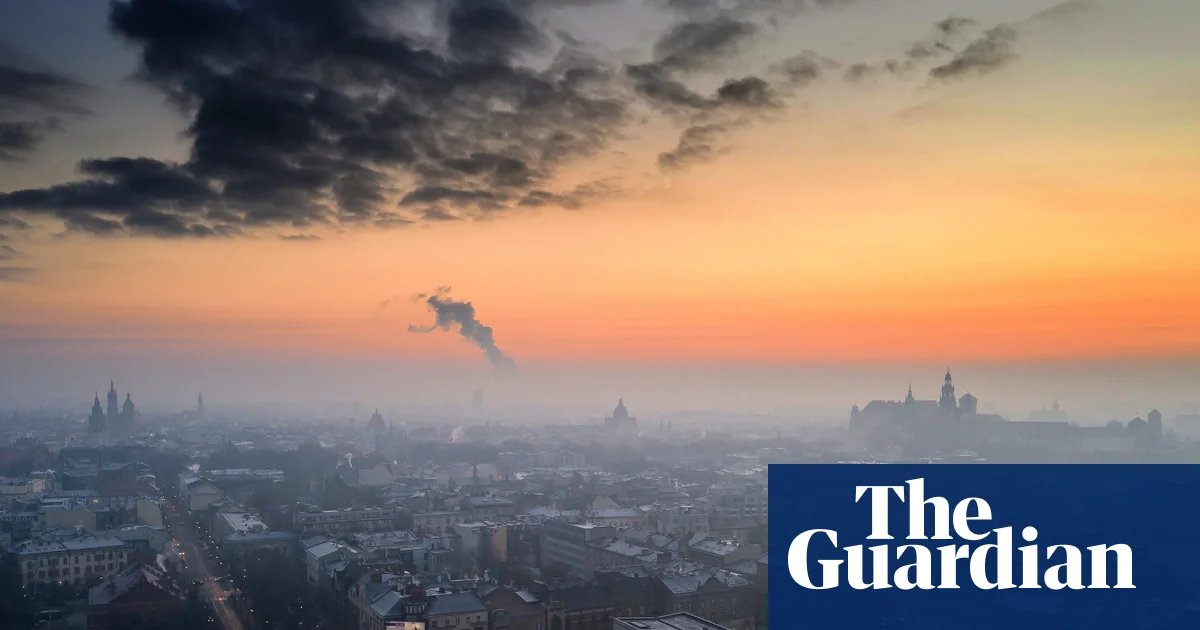
As a child, Marcel Mazur had to hold his breath in parts of Kraków thick with “so much smoke you could see and smell it”. Now, as an allergy specialist at Jagiellonian University Medical College who treats patients struggling to breathe, he knows all too well the damage those toxic gases do inside the human body.
“It’s not that we have this feeling that nothing can be done. But it’s difficult,” Mazur said.
Kraków, long known as the smog capital of Poland, is proof that politicians wield the power to save lives by cleaning the air. A drop in soot levels since 2013, when the city announced it would ban coal and wood in home heating, has averted nearly 6,000 early deaths over a decade, according to an expert assessment shared exclusively with the Guardian.
Mazur’s research has separately shown that there were 17% fewer cases of asthma and 28% fewer cases of allergic rhinitis in children in 2018 than in 2008.
Anna Dworakowska, a co-founder and director of Polish Smog Alert, said: “It’s a huge improvement.”. Polish Smog Alert is a network of campaign groups that began in Kraków and led a nationwide push to improve the quality of Poland’s air. “Little more than 10 years ago, we had about 150 days a year with too-high concentrations of particulates in Kraków. Now it’s down to 30,” Dworakowska added.
Kraków’s ban on burning solid fuels came into effect in 2019, by which point most of the tens of thousands of dirty stoves and boilers had been replaced. The local government subsidised the switch to cleaner forms of heating, sometimes paying the full cost, and restricted which fuels could be burned in the years leading up to the ban.
The reduction in soot – known as black carbon – saved 5,897 lives over a decade, according to the European Clean Air Centre. The researchers used established methods to calculate the death toll and relied on a special station in Wrocław to estimate the fraction of black carbon in the tiny particulate matter (PM2.5) they measured in Kraków.
Łukasz Adamkiewicz, the president of the European Clean Air Centre, said the progress was a result of rare consensus from parties of all political stripes. “Green, red, black, right, left, up, down – everyone said ‘OK, this is a problem we need to tackle’.”
Black carbon is a superpollutant more powerful than carbon dioxide that is released during the incomplete burning of fossil fuels and biomass. At the UN climate summit in November, nine countries announced first-of-their-kind plans to cut black carbon emissions as part of efforts to stave off global heating and save local lives from bad air.
Rachel Huxley, the head of mitigation at the health charity Wellcome, said: “It’s a big deal. If we take action to tackle superpollutants, we can have this huge impact on global warming and also on all of these premature health impacts.”
Early deaths from fine particulates in Poland fell by 18% between 2005 and 2022, the latest data shows, and across the EU they plunged by 45%.
Kraków, the capital of the coal-rich Małopolska region, has witnessed perhaps the most dramatic turnaround in air quality in Poland. In 2024 it recorded no breaches of daily limits for benzo(a)pyrene, another cancer-causing pollutant from burning wood and coal, for the first year since measurements began, according to Polish Smog Alert.
Pollution is expected to fall further due to the introduction of a low emissions zone – restricting the types of vehicle that can drive in about 60% of the city – at the start of the year.
Experts say more needs to be done. In late January, Kraków briefly became the most-polluted major city in the world, ahead of Lahore in Pakistan and Kolkata in India, according to a ranking of 120 global cities by IQAir. Smog floats into Kraków from surrounding towns and villages, where coal and wood dominate home heating and the city has little say over policy.
Things are not going as well elsewhere in Poland, said Mazur, who has a house in Szczawnica, a small town in the south of the country. Before he replaced the coal boiler, he had to fill it with fuel three times a day in winter and clear it of ash just as often. The switch to a heat pump and a gas boiler has been “incomparably more convenient, and much more eco-friendly”, he said.
“What happens in the towns and villages surrounding Kraków has a direct impact on the air quality in our city,” Mazur said.
The reverse may also be true. The ban in Kraków has spurred similar policies across Poland, with pressure from citizens and campaign groups driving political enthusiasm to adopt anti-smog measures and restrict the burning of the most polluting fuels.
Experts say its success could guide polluted cities across eastern Europe and further afield, where death tolls from air pollution are high but public discontent rarely rises to the level of protests or organised campaigns.
Huxley said: “My experience of working with cities is you can’t do it without public support. That will either drive it, or without it you’ll be hamstrung.”