dailynewsnblog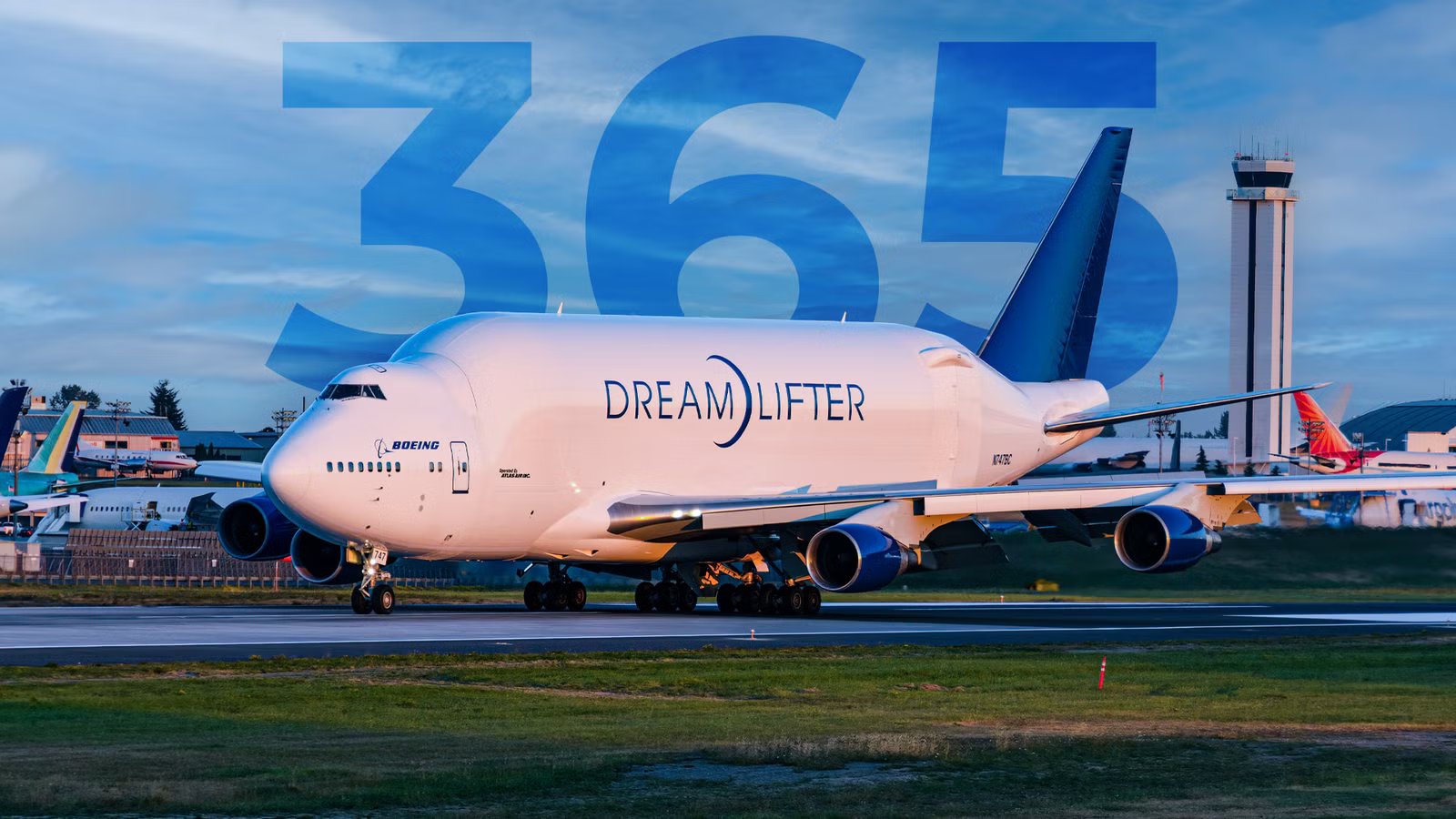
The  Boeing Dreamlifter is one of the most unusual aircraft in the skies, instantly recognizable by its oversized fuselage and bulbous profile. Unlike traditional cargo or passenger jets, the Dreamlifter was not designed to turn profits by flying daily routes or hauling commercial freight. Instead, it was made to serve a highly specialized role within Boeing’s own manufacturing ecosystem, moving massive aircraft components that do not fit inside conventional cargo planes.
Because of its unique mission, measuring the Dreamlifter’s activity is not as simple as counting scheduled departures. The question of how many flights it typically flies in a year opens a discussion about how Boeing builds airplanes, how global supply chains function, and why a small fleet of highly specialized aircraft can be more valuable than dozens of standard freighters. Understanding the Dreamlifter’s flight frequency helps reveal just how critical this odd-looking giant really is.
Meet The Dreamlifter

The Boeing Dreamlifter, officially designated the Boeing 747-400 Large Cargo Freighter (LCF), was created to solve a very specific problem: how to move enormous Boeing 787 Dreamliner components quickly across the globe. As Boeing’s 787 production network expanded to include suppliers in Japan, Italy, and other international locations, traditional sea transport proved too slow to support an efficient assembly operation. The solution was the aptly named Dreamlifter aircraft, which connected major supplier hubs and streamlined manufacturing efforts.
Boeing developed the Dreamlifter in the mid-2000s by heavily modifying used 747-400 airframes. This is an important distinction; the Dreamlifter is not an entirely new build, but rather a modification of an existing airframe. Designers dramatically expanded the fuselage to more than double the volume of standard 747 freighters. The first Dreamlifter flew in 2006 during testing and entered service after receiving FAA type certification on June 2, 2007. Its swing-tail design allows the entire rear fuselage to open, enabling the loading of complete fuselage sections, wings, and other outsized components.
Initially, the Dreamlifter’s mission was primarily to keep Boeing’s widebody production moving. While this is still the case, in more recent years, the Dreamlifter has been deployed on special missions, such as delivering medical supplies during the pandemic. Rather than flying on fixed schedules, it operates on demand. Each flight carries cargo that is irreplaceable and time-sensitive, making the Dreamlifter less about flight volume and more about mission importance within Boeing’s global manufacturing system.
Specs At A Glance

As mentioned, the Boeing Dreamlifter is derived from the 747-400, which means its principal dimensions are similar to the 747-400. However, the dramatic alterations to the fuselage prioritize volume over everything else, which garners different performance values. Its enlarged fuselage gives it an internal cargo volume of roughly 65,000 cubic feet, making it one of the most voluminous cargo aircraft ever built. While its maximum payload is lower than that of a standard Boeing 747-400F, the Dreamlifter is designed to carry extremely large components, such as complete fuselage sections and wings.
Powering the aircraft are four Pratt & Whitney PW4000 series turbofan engines, each producing over 60,000 pounds of thrust. These engines provide the performance needed to move the Dreamlifter’s massive, high-drag airframe while maintaining cruise speeds similar to other 747 variants. Despite its size, the aircraft retains a meaningful range of approximately 4,200 nautical miles when fully loaded.
|
Dreamlifter Principal Dimensions |
|
|---|---|
|
Dimension |
Value |
|
Length |
235 feet 2 inches |
|
Wingspan |
211 feet 5 inches |
|
Height |
70 feet 8 inches |
|
Fuselage width |
27 feet 6 inches |
|
Fuselage volume |
65,000 cubic feet |
|
Dreamlifter Principal Performance Numbers |
|
|---|---|
|
Metric |
Value |
|
Operating empty weight (pounds) |
398,000 |
|
Max. takeoff weight (pounds) |
803,001 |
|
Max. payload weight (pounds) |
250,000 |
|
Range (nautical miles) |
4,200 |
|
Fuel capacity (US gal) |
52,609 |
Source: SKYbrary
One of the Dreamlifter’s most distinctive features is its swing-tail loading system, which allows the entire rear fuselage to pivot open for cargo loading. This system, combined with specialized loaders and ground equipment, enables the aircraft to transport components that simply cannot fit into conventional freighters. Specifically, the DBL-100 cargo loader is used to load 787 components onto the Dreamlifter, and is the world’s longest cargo loader. Together, these specifications reflect the Dreamlifter’s highly specialized role. It is not hauling the heaviest freight; rather is moving oversized aircraft parts quickly and efficiently across the globe.

Why In The World Does The Boeing Dreamlifter Fly To Miami?
Why does the largest Boeing jet ever made fly to Miami so much?
Typical Operations

Unlike commercial cargo aircraft that fly daily schedules, the Dreamlifter operates at a deliberately measured pace tied directly to Boeing’s production needs. For example, let’s look at N747BC, one of the Dreamlifter aircraft. N747BC flew 180 flights in 2025, averaging 15 flights per month. Across the fleet, total annual flight counts remain relatively modest, with utilization rising or falling based on 787 production rates and supply-chain demands. In 2025, the summer months were busiest for this aircraft.
What is especially notable about Dreamlifter operations is how concentrated they are. In 2025, N747BC flew between the same seven airports: Anchorage (ANC), Charleston (CHS), Everett Paine Field (PAE), Wichita (IAB), Miami (MIA), Nagoya, Japan (NGO), and Taranto, Italy (TAR). Underscoring the Dreamlifter’s highly repetitive and purpose-driven mission, these routes are not about flexibility or market demand. Instead, they exist solely to connect key supplier sites to final assembly and logistics hubs, following the same long-haul routes repeatedly.
|
N747BC 2025 Flight Log |
|
|---|---|
|
Month |
Total Flights |
|
January |
9 |
|
February |
8 |
|
March |
12 |
|
April |
7 |
|
May |
10 |
|
June |
23 |
|
July |
26 |
|
August |
15 |
|
September |
15 |
|
October |
16 |
|
November |
17 |
|
December |
22 |
|
Total |
180 |
Source: FlightRadar24
Charleston, South Carolina, and Everett Paine Field in Washington are both closely tied to the 787 widebody program, with Charleston being the primary assembly site today. Nagoya, Japan, and Taranto, Italy, both produce major 787 components, which are then transported to Boeing assembly facilities. Anchorage International Airport serves as an international strategic fuel and transit stop on transpacific routes, while Wichita and Miami support supplier and logistics needs. It is a tight network, and even though a few aircraft fly a small number of routes, each flight has an immense impact on Boeing’s production system.
A Small But Important Fleet

The Boeing Dreamlifter fleet is small, consisting of only four aircraft. Unlike airlines with dozens or hundreds of freighters, the Dreamlifter fleet isn’t meant to fly constantly; it’s meant to fly purposefully. One interesting aspect of the fleet is that, while Boeing owns the aircraft, operation is handled under contract by Atlas Air, a major U.S. cargo airline and one of the world’s largest operators of Boeing 747 aircraft. Atlas provides pilots, crew, maintenance, and support for the Dreamlifters, freeing Boeing to focus on the logistics of where and when the flights are needed. This is the main reason why Miami is a frequent stop for Dreamlifters—it is one of Atlas Air’s hubs.
|
747 LCF Fleet |
|
|---|---|
|
Registration |
Year Built |
|
N249BA |
1990 |
|
N718BA |
1992 |
|
N747BC |
1992 |
|
N780BA |
1990 |
Source: FlightRadar24
In the context of global supply chains, the Dreamlifter gives Boeing a logistical advantage. By quickly moving massive aircraft sections from suppliers in places such as Japan and Italy to assembly facilities in the United States, these few aircraft help shrink transport times from weeks to hours. Maritime transport could take up to 30 days; the Dreamlifter can cross the ocean in hours, carrying the same cargo. Despite the fleet being small, it is incredibly important to Boeing’s ability to build and deliver Dreamliners at a competitive pace.

Atlas Air: 5 Fast Facts About The US Cargo & Charter Giant
The airline was selected to train the most exclusive group of pilots in the world.
How Does The Dreamlifter Match Up With Other Cargo Aircraft?

Shutterstock
On paper, the Dreamlifter looks like it should compete with other large commercial freighters like the 747-400F or Boeing 777F, but in practice it occupies a completely different niche. Traditional cargo aircraft are optimized for payload weight, efficiency, and route flexibility, allowing them to serve a wide range of customers and destinations. The Dreamlifter, by contrast, is optimized almost entirely for cargo volume, sacrificing payload efficiency and airport flexibility in exchange for the ability to carry specific aircraft components.
Perhaps the most similar comparison is with the Airbus Beluga (and Beluga XL), Airbus’s specialized, bulbous cargo aircraft. Both the Beluga and Dreamlifter exist to support aircraft manufacturing supply chains rather than general cargo markets. However, the Dreamlifter operates over much longer intercontinental distances, while the Beluga is more commonly used on shorter regional routes within Europe.
|
Dreamlifter Principal Performance Numbers |
||||
|---|---|---|---|---|
|
Metric |
747 LCF |
747-400F |
777F |
Airbus Beluga XL |
|
Max.takeoff weight (pounds) |
803,001 |
875,000 |
766,000 |
500,449 |
|
Cargo volume (cubic feet) |
65,000 |
~26,000 |
23,051 |
78,000 |
|
Range (nautical miles) |
4,200 |
4,455 |
4,970 |
2,600 |
|
Fuel capacity (US gal) |
52,609 |
53,985 |
47,890 |
24,030 |
|
Cruise Mach |
0.82 |
0.845 |
0.84 |
0.69 |
Source: SKYbrary, Boeing (74F), Boeing (777F), Airbus
Ultimately, the Dreamlifter isn’t trying to be the most efficient, flexible, or powerful cargo aircraft; it’s trying to be the right one for a single mission. While aircraft like the 747-400F, 777F, and An-124 excel in broader or heavier-lift roles, the Dreamlifter stands apart as a purpose-built logistics tool. Its value lies not in how much it can lift or how often it flies, but in its unmatched ability to keep a global supply chain afloat.
Future Outlook For Boeing’s Dreamlifter

The future of the Dreamlifter is closely tied to the long-term outlook of the 787 program itself. As long as Boeing continues to rely on a globally distributed supply chain for major Dreamliner components, the Dreamlifter will remain a critical part of that logistics network. However, its highly specialized role also means there is little flexibility for reuse or replacement. With only four aircraft in existence and no direct successor announced, the Dreamlifter is best viewed as a mission-specific tool rather than a platform with broad growth potential.
More broadly, the outlook for super-heavy, purpose-built transport aircraft is increasingly uncertain. Airbus has recently retired the original A300-600ST Beluga, replacing it with the larger but still niche BelugaXL, underscoring how narrow this market really is. As manufacturers explore more localized production, modular assembly, or alternative logistics strategies, the need for aircraft designed solely to carry outsized components may continue to shrink. For now, the Dreamlifter remains indispensable, but its future outlook highlights how rare and fragile the business case is for an aircraft this large, this specialized, and this singular in purpose.